

Acoustic guitar tonewoods are specific types of wood with unique acoustic properties that influence the overall sound, construction quality, and durability of the guitar.
When differentiating tonewoods the most important factors to consider are the appearance, availability, sound properties, use in acoustic guitar making, hardness of the wood, and density of the wood.
The appearance of the wood, ranging from light to dark hues and varying grain patterns, contributes to the visual appeal of the guitar. For example, the rich, dark hues of Indian rosewood with its varied grain patterns are highly sought after for their visual impact.
Sustainability and harvesting restrictions placed on wood types like Brazilian rosewood, mahogany, and ebony affect the availability of the woods. The scarce availability then increases the price of the tonewoods for guitar makers, which increases the overall price of the acoustic guitar that uses the scarce wood.
Sound properties are the most crucial characteristic of a tonewood. Each species has a unique sound profile, characterized by factors like brightness, warmth, sustain, and emphasis on specific frequency responses like lows, mids, and highs.
The usage of a specific tonewood or material in guitar-making is important because the sound of an acoustic guitar varies depending on where on the guitar is the wood type used. According to the study “Effect of back wood choice on the perceived quality of steel-string acoustic guitars,” published by the Acoustical Society of America, the species of wood used for the back and sides of a steel-string acoustic guitar has only a marginal impact on the sound of the guitar when compared to the wood species used for the top of the acoustic guitar body. While the back and sides have minimal effect compared to the top, the back and sides still contribute to the overall sound, primarily by affecting the guitar’s resonance and sustain.

5 Step Checklist To Avoid Buying The Wrong Guitar
What to check before you buy
What features actually matter for beginners
What makes a guitar easy to play
When choosing tonewoods for different parts of the acoustic guitar, it is also important to consider the properties of the specific piece of wood and not just rely on the type of tonewood. According to the study “Wood for Guitars” published by the Acoustical Society of America, a guitar’s sound depends on the specific properties of the wood, which can differ even within the same species. Therefore, two pieces of the same wood type can still sound different.
In the study “Wood for Guitars” Trevor Gore emphasizes the hardness and density of the wood as important factors when choosing tonewoods for acoustic guitars. Hardness, measured on the Janka hardness scale, is crucial for wear-prone areas like fretboards and affects the durability of the guitar. Density affects weight and responsiveness. A denser soundboard requires more energy to vibrate, often producing a quieter but tonally richer sound. On the other hand, a less dense soundboard often produces a louder sound but it can lack the tonal richness and complexity of the denser soundboard. The density of acoustic guitar tonewoods is measured in kilograms per cubic meter ( kg/m ³) or pounds per cubic foot (lb/ft³).
This article provides a comprehensive guide to 16 acoustic guitar tonewoods and materials commonly used in acoustic guitars. For each material and tonewood, we provide a definition of the material including availability and sustainability concerns, sound properties, and uses of the tonewood in acoustic guitar making. As a consequence of the tonewood descriptions questions arise regarding how are acoustic guitars made, what tonewoods do the best high-end acoustic guitars use, or what parts do acoustic guitars have. Below you can see a guitar tonewood chart that illustrates each of the 16 tonewoods and materials that we will describe in this article.
The tonewood chart below showcases each of the 16 tonewoods and materials.

1. Mahogany

Description: Mahogany is a hardwood known for its rich, warm color, ranging from light to dark reddish-brown. Mahogany often displays a straight, fine grain, sometimes exhibiting waves or curls. Mahogany is heavy and sturdy, with wood density ranging around 31.2 to 53.1 lb/ft³ (500 to 850 kg/m³). Janka hardness of mahogany generally ranges between 850 to 930 lbf (385.553 kgf to 421.839 kgf) but the hardness can reach 2,400 lbf (1,088.621 kgf) in certain mahogany types like the Santos mahogany. Mahogany primarily grows in tropical regions of Central and South America, Africa, and the Caribbean. Overharvesting and deforestation of mahogany have raised sustainability concerns in the past. Currently, all species of mahogany are listed in CITES (Convention on International Trade in Endangered Species of Wild Fauna and Flora) as protected, emphasizing the need for responsible sourcing and certification to ensure mahogany’s sustainable harvesting.
Sound Properties: Mahogany is known for its warm, balanced tonal properties, specifically its strong midrange presence. Emphasizing the frequencies in the midrange spectrum, typically around 250-500 Hz, contributes to a full-bodied and resonant sound. Compared to spruce, which produces a brighter and more focused tone, mahogany produces a darker and warmer tone. This characteristic makes mahogany a favorite for fingerstyle playing and blues genres, where a deeper, more resonant sound is desired.
Uses of Mahogany in Acoustic Guitar Making: Mahogany is frequently used for the back and sides of acoustic guitars. Luthiers also use mahogany for necks and, occasionally, tops due to mahogany’s strength and aesthetic appeal. Renowned guitar brands like Martin, Gibson, and Taylor incorporate mahogany into their acoustic guitar models.
2. Rosewood

Description: Rosewood is a hardwood with rich, dark color, that ranges from deep brown to purplish hues. The grain of rosewood is often straight but can also display a wavy or interlocked pattern, giving it a visually appealing texture. Rosewood is heavier than many other woods used in guitar making like cedar, spruce, and mahogany. Rosewood has a high density, typically around 51.2 to 56.2 lb/ft3 (820 to 900 kg/m³). This density makes rosewood heavier than other tonewoods like spruce, cedar, and mahogany, which affects the overall weight of the guitar that utilizes rosewood in its construction. Rosewood primarily grows in tropical regions, with significant species found in India, Brazil, and Madagascar. However, the harvesting of rosewood, especially Brazilian Rosewood, has raised significant sustainability concerns. Brazilian Rosewood is endangered and protected under CITES due to overexploitation and illegal logging.
Sound Properties: Rosewood produces a complex and rich sound with pronounced overtones. It is characterized by a strong low end and a well-defined high end, contributing to a full-bodied tone with bright trebles. While rosewood has a prominent bass response and clear highs, it also maintains a warm midrange, making it suitable for a variety of playing styles. Rosewood offers a darker, more resonant tone with a wider range of harmonic overtones when compared to other tonewoods like mahogany.
Uses of Rosewood in Acoustic Guitar Making: Rosewood is commonly used for the back and sides of acoustic guitars. Luthiers also favor rosewood for fingerboards and bridges because of its high Janka hardness rating of around 2,400 – 2960 lbf (1,088.621 – 1,342.638 kgf), which makes Rosewood exceptionally resistant to wear and tear. In critical areas like fingerboards, rosewood withstands constant string contact, the hardness of rosewood minimizes wear and maintains a smooth playing surface for a longer time. The density of rosewood provides the necessary structural integrity for guitar backs and sides, while its attractive grain patterns enhance the instrument’s aesthetic appeal. Many prestigious guitar brands like Martin, Taylor, and Gibson often feature rosewood in their high-end models.
Rosewood types that are commonly used in guitar making include Brazilian rosewood, Indian rosewood, and cocobolo.
Indian rosewood
Indian rosewood is a type of rosewood that originates from India and grows in the southern regions of the country. Indian rosewood was once readily available, but due to overharvesting and trade restrictions, the Indian rosewood has become less common and more expensive. The Convention on International Trade in Endangered Species of Wild Fauna and Flora (CITES) regulates the trade of Indian rosewood to ensure sustainability.
Indian rosewood is a dense and stable wood, making it relatively easy to work with when compared to other types of rosewood like Brazilian rosewood or cocobolo. Indian rosewood’s stability also makes it less prone to warping or cracking. This stability ensures the guitar’s structural integrity and longevity and makes it easier to work with the tonewood during the guitar-making process. Janka hardness of Indian rosewood is around 2,440 lbf (1,106.759 kgf).
Brazilian rosewood
Brazilian rosewood is a type of rosewood that is native to Brazil and primarily grows in the Atlantic Forest region. Brazilian rosewood is highly prized for its exceptional tonal qualities, but it is extremely rare and expensive due to overexploitation and strict trade regulations. Brazilian rosewood is listed under CITES Appendix I, which prohibits international trade for commercial purposes. This restriction aims to protect the remaining populations of this endangered species.
Brazilian rosewood is very dense and has exceptional resonance, but its workability can be challenging. Brazilian rosewood tends to be brittle, requiring careful handling during the guitar-making process to prevent cracking or chipping. Janka hardness of Brazilian rosewood is around 2,790 lbf (1,265.518 kgf).
Cocobolo
Cocobolo is a type of rosewood that originates from Central America, specifically from countries such as Panama, Costa Rica, and Nicaragua. Cocobolo grows in the tropical dry forests along the Pacific coast. Cocobolo, while not as restricted as Brazilian rosewood, is considered an expensive tonewood due to its limited availability and high demand in various industries. Cocobolo is listed under CITES Appendix II, which allows for controlled trade with permits and documentation to ensure sustainable harvesting practices.
Cocobolo is known for its density and hardness, making it extremely durable. Cocobolo’s workability can be demanding due to its density. Cocobolo can be brittle, requiring sharp tools and careful techniques during the guitar-making process to achieve clean cuts and avoid chipping. Janka hardness of cocobolo is around 2,960 lbf (1,342.638 kgf).
3. Spruce

Description: Spruce is a light-colored softwood that ranges from pale yellow to white color. Spruce has a straight grain that sometimes features a subtle sheen. Spruce belongs to the Pinaceae family and is known for its low density, making Spruce lightweight yet strong. Spruce trees are predominantly found in the Northern Hemisphere, thriving in regions such as North America, Europe, and parts of Asia. Spruce is widely used tonewood in guitar making but sustainability concerns stemming from overharvesting and habitat loss have impacted its availability. Some manufacturers now prioritize sourcing spruce from responsibly managed forests certified by organizations like the Forest Stewardship Council (FSC).
Sound Properties: Spruce is known for its bright and clear tonal properties. It provides a strong fundamental tone with excellent projection. Spruce responds well to a wide dynamic range, making it versatile for various playing styles. Spruce emphasizes higher frequencies, particularly in the mid to upper range, which contributes to its bright sound. This characteristic makes spruce particularly suitable for fingerstyle and flatpicking techniques, allowing for clarity in complex chord voicings and melodies. Compared to other tonewoods, such as mahogany or cedar, spruce tends to produce a brighter and more focused sound. Spruce’s clarity and responsiveness make it a preferred choice for many acoustic guitarists seeking brightness and articulation in their sound.
Uses of Spruce in Acoustic Guitar Making: Spruce is most commonly used for the soundboards (tops) of acoustic guitars, where its lightweight and resonant properties enhance the instrument’s overall sound quality. Spruce is an ideal material for guitar soundboards due to its moderate hardness. The types of spruce used in guitar making have a Janka hardness rating of around 380-510 lbf (172.365 – 231.331 kgf) . This hardness range strikes a good balance between strength and flexibility. The 380-510 lbf hardness range means that spruce can withstand the constant tension of guitar strings without being overly susceptible to denting or scratching from playing. This balance allows the spruce soundboard to vibrate freely and project a resonant and balanced tone. Spruce is also occasionally used for the back and sides of certain guitar models. Many guitar brands like Martin, Taylor, and Gibson utilize spruce for their acoustic models to achieve amazing tonal qualities and projection.
Spruce types that are commonly used in guitar making include Sitka spruce, Adirondack spruce (Eastern red spruce), Engelmann spruce, Moon spruce (Norway spruce), and Lutz spruce.
Sitka Spruce
Sitka Spruce is a type of Spruce that primarily grows in the Pacific Northwest region of North America, stretching 4,000 km from Alaska to California. Sitka Spruce is widely available and there are currently no significant sustainability concerns regarding Sitka spruce harvesting, This makes Sitka Spruce a cost-effective option for guitar manufacturers.
Sitka Spruce is favored for its stability, which ensures consistent performance under varying environmental conditions. Sitka spruce is also easy to work with and shape due to its moderate hardness of 510 lbf (231.331 kgf) on the Janka hardness scale. Sitka spruce’s high strength-to-weight ratio makes it ideal for guitar tops because Sitka spruce withstands the constant tension of the strings while remaining lightweight and resonant. Sitka spruce is also known to glue securely and accepts finishes evenly.
Adirondack Spruce (Red Spruce)
Adirondack spruce is a type of spruce native to the northeastern United States and southeastern Canada. Adirondack spruce is more expensive than Sitka spruce, due to limited availability caused by overharvesting in the past, especially for instrument-grade wood. Sustainability concerns regarding Adirondack spruce persist due to its slow growth rate and past overharvesting, although efforts are underway to manage second-growth forests responsibly.
Adirondack spruce is valued for its stiffness and strength, allowing for thinner, more responsive guitar tops. Because of the thinner, more responsive design, the Adirondack tops generally offer better projection and volume than other spruce types like sitka spruce and Engelmann spruce. However, Adirondack spruce’s density of 27 lbs/ft3 (435 kg/m3) and hardness of 490 lbf (222.260 kgf) make Adirondack spruce more challenging to work with than Sitka Spruce. Luthiers need to exercise caution to prevent cracking during acoustic guitar construction.
Engelmann Spruce
Engelmann spruce is a type of spruce primarily found in the Rocky Mountains of western North America. Engelmann spruce is not as widely available as Sitka Spruce, and the cost of Engelmann spruce falls between Sitka spruce cost and Adirondack spruce cost. Engelmann Spruce is considered a sustainable tonewood due to responsible forestry practices in managed forests.
Engelmann spruce is known for its lightweight nature and low stiffness. With a density of 24 lbs/ft3 (385 kg/m3), Engelmann Spruce requires less force to bend and shape, making it easier to work with than Sitka Spruce. However, Engelmann spruce is a soft tonewood with a Janka Hardness rating of 390 lbf 176.901 kgf). The Janka hardness rating indicates Engelmann spruce’s resistance to denting and wear. The rating of 390 lbf (176.901 kgf) means that the Englemann spruce is more susceptible to dents and scratches than other spruce types like Sitka spruce and Adirondack spruce. Therefore, using appropriate clamping pressure and tools is crucial to prevent damage during the guitar construction. It is also important to handle the guitars made with Engelmann spruce carefully to prevent dents and scratches.
Norway Spruce (European Spruce)
Norway spruce is a type of spruce native to central and northern Europe including Norway, Poland, and the Carpathian and Balkan mountains. Norway Spruce offers a cost-effective alternative to spruce varieties like Adirondack (Red spruce).
Luthiers favor Norway spruce for its stability and workability. With a density of 25 lbs/ft3 (405 kg/m3) and a Janka Hardness of 380 lbf (172.365 kgf), Norway spruce offers a balance between strength and flexibility. The low density makes the Norway spruce lightweight and resonant, contributing to a clear and articulate sound. Norway spruce’s moderate hardness allows for easy bending and shaping during the guitar-making process without compromising the instrument’s structural integrity.
Moon Spruce
Moon spruce is not a separate species of spruce but rather a term that refers to a traditional harvesting method primarily associated with European Spruce (Norway Spruce). Moon spruce refers to spruce that is harvested during the waning moon phase in winter when the spruce contains less sap. This practice is rooted in the belief that harvesting trees during this period, when sap flow is reduced, results in denser, more resonant wood that contributes to a clearer, more resonant tone.
Lutz Spruce
Lutz spruce is a naturally occurring hybrid of Sitka spruce and White spruce. Lutz spruce grows in the coastal regions of British Columbia and Alaska. Lutz Spruce is less available than Sitka Spruce due to its limited growing regions and because of that the cost of Lutz Spruce is typically higher than Sitka Spruce.
Lutz Spruce combines the stiffness and strength of Sitka Spruce with the lighter weight and tonal complexity associated with White Spruce. This combination results in a wood that is durable and resonant, producing a balanced and articulate tone with good projection and dynamic range.
4. Sapele

Description: Sapele wood features a reddish-brown color with a fine, interlocking grain that can exhibit a striped appearance. Sapele is a hardwood known for its durability and strength. Luthiers and guitar makers use Sapele as a substitute for mahogany due to its similar properties. Sapele trees are native to tropical Africa, primarily found in countries such as Ghana, Cameroon, and the Democratic Republic of the Congo. Sapele is considered more sustainable than some other hardwoods like Brazilian Rosewood, Ebony, and Mahogany, but deforestation and habitat loss in Sapele’s native regions are a concern.
Sound and Tone: Sapele is known for its balanced tonal qualities, offering a warm and clear sound. Sapele provides good projection and a strong midrange presence. Sapele emphasizes midrange frequencies, enhancing the clarity of chords and notes, while also producing a slightly bright sound. Compared to mahogany, Sapele offers a brighter sound with a more pronounced treble, while still retaining warmth. Sapele is often described as having a tone that sits between mahogany and rosewood.
Uses of Sapele in Acoustic Guitar Making: Sapele is used for the back and sides of acoustic guitars, as well as for necks and some fingerboards. This is because Sapele has a density of 41.6 lbs/ft3 (665 kg/m3) and a Janka hardness rating of 1,360 lbf (616.888 kgf). The density and hardness make Sapele moderately hard and resistant to scratches and dents making Sapele well-suited for guitar parts which are prone to wear and tear. Sapele’s strength and aesthetic qualities also make Sapele the preferred choice for both budget and high-end guitars. Several renowned guitar brands utilize Sapele in their instruments, including Taylor Guitars, which often features Sapele in its lower to mid-range models.
5. Cedar (Western Red Cedar)

Description: Western Red Cedar is a softwood, typically reddish-brown to light yellow with a straight grain and fine texture. Western Red Cedar is classified as a coniferous wood. Coniferous wood is less dense than hardwoods, making Western Red Cedar lightweight and resonant. Western Red Cedar trees grow in North America, particularly in western regions, as well as in parts of Asia and the Mediterranean. Overharvesting and habitat loss raise sustainability concerns regarding cedar, leading some manufacturers to seek certified sustainable sources or alternative woods.
Sound and Tone: Western Red Cedar is known for its warm, rich tonal qualities, producing a full and complex sound. Western Red Cedar offers a quick response to playing dynamics, making it favorable for fingerstyle and softer playing techniques. Western Red Cedar emphasizes mid-range frequencies, contributing to its warm and mellow character. Western Red Cedar produces a pronounced bass response and maintains clarity in the treble. Compared to spruce, cedar provides a darker, warmer sound. Spruce is often preferred for its projection and clarity, while cedar’s tonal richness and responsiveness make it suitable for players seeking a more intimate sound.
Uses of Cedar in Acoustic Guitar Making: Western Red Cedar is commonly used for the tops of acoustic guitars, especially classical, flamenco, and fingerstyle focused models. Cedar’s lightweight and resonant qualities enhance the instrument’s overall sound quality. Western Red Cedar has a density of 23.0 lbs/ft3 (370 kg/m3) and a hardness of 350 lbf (1,560 N). The low density contributes to cedar’s lightness and resonance, while its hardness allows for durability in guitar construction. However, Western Red Cedar’s relatively low hardness also makes cedar less resistant to scratches and dents, making guitars with cedar tops more susceptible to damage from impacts. Taylor Guitars, Larrivée Guitars, and Yamaha utilize cedar in their instruments. These brands often incorporate cedar in higher-end models, particularly those designed for fingerstyle players and classical guitarists.
6. Walnut (Claro Walnut)

Description: Claro walnut is a hardwood with a dark brown color and lighter streaks. The grain of Claro Walnut is often irregular, with unique patterns. Claro walnut primarily grows in California, USA, in the Sierra Nevada foothills. Overharvesting and habitat loss threaten the sustainability of Claro walnut, prompting responsible sourcing and reforestation efforts.
Sound and Tone: Claro Walnut has a balanced tonal character, producing a warm, rich sound with subtle brightness. Claro Walnut emphasizes mid and lower frequencies, resulting in a warm, resonant quality. Compared to mahogany’s darker tone and rosewood’s pronounced treble, Claro Walnut sits in the middle with a balance of warmth and brightness.
Uses of Walnut in Acoustic Guitar Making: Luthiers use Claro Walnut for the back and sides of acoustic guitars. Claro Walnut has a density of 40 lbs/ft³ (640 kg/m³) and a hardness rating of 1,130 lbf (512.561 kgf). The density of Claro Walnut contributes to the sustain and projection of the guitar. The hardness of Claro Walnut makes it a very durable wood, ensuring its longevity and durability. Taylor Guitars often feature Claro Walnut in premium models. Martin Guitars incorporates Claro Walnut into limited-edition guitars.
7. Koa

Description: Koa is a hardwood, specifically a dark wood, with a golden to medium brown color and interlocking grain pattern. Koa is sourced from the Acacia koa tree, native to Hawaii. Koa trees grow in Hawaii, thriving in the volcanic soil and tropical climate. They are found on the islands of Hawaii, Maui, and the Big Island. The harvesting of Koa raises sustainability issues due to over-exploitation and habitat loss. Efforts are underway to promote sustainable practices, including reforestation and responsible sourcing, to ensure the longevity of Koa as a tonewood.
Sound and Tone: Koa wood produces a warm, balanced tone with a pronounced midrange. Koa offers a bright tonal character with subtle warmth. Koa emphasizes mid to high frequencies, providing a clear and articulate sound. Koa produces a bright, bell-like quality in the higher registers. Compared to mahogany or rosewood, Koa offers a distinct sound profile. Mahogany is warmer and darker, and rosewood has a more pronounced bass response.
Uses of Koa in Acoustic Guitar Making: Koa is used for the back and sides of acoustic guitars and occasionally for the tops, especially in high-end models. Koa’s visual appeal and tonal properties make it a sought-after choice for luthiers. With a density of 38 lbs/ft³ (610 kg/m³) and a hardness rating of 1,170 lbf (530.705 kgf), Koa is heavy and dense. This requires careful handling and shaping during the guitar-making process, as Koa’s hardness makes it challenging to work with. Koa’s density contributes to robust sound projection and sustain. Martin, Taylor, and Gibson utilize Koa in their premium guitar models.
8. Maple (Sugar Maple)

Description: Sugar Maple, also known as Hard Maple, is a hardwood with a light to medium brown color with a fine, uniform grain. The grain sometimes displays a flame or curly pattern. Sugar Maple is native to North America, primarily in the northeastern United States and southeastern Canada. Sugar Maple is abundant and sustainably harvested in many regions.
Sound and Tone: Sugar Maple is known for its bright and clear tonal qualities, providing a strong, focused sound with emphasis on higher frequencies, which contributes to a bright and articulate sound. This focus on higher frequencies and a bright clear tone make Maple suitable for genres requiring clarity and definition, such as bluegrass and folk music. Compared to Mahogany or Rosewood, Maple produces a brighter and more direct sound. Sugar Maple is ideal for players seeking a pronounced sound.
Uses of Maple in Acoustic Guitar Making: Luthiers use Sugar Maple for the back and sides of acoustic guitars, particularly in larger-bodied guitars where its clear projection is beneficial. Maple’s strength and stability make it a popular choice in both budget and high-end models. Sugar Maple has a density of 44.0 lbs/ft³ (705 kg/m³) and a hardness rating of 1,450 lbf (6,450 N657.708 kgf). Maple’s density allows for a bright sound with excellent projection. Maple’s hardness ensures resistance to wear and tear, making the Hard Maple suitable for necks and fingerboards as well. Gibson, Taylor, and Martin utilize Hard Maple in their designs. These companies incorporate Maple in their higher-end models to enhance tonal clarity and aesthetic appeal.
9. Nato (Mora)

Description: Nato is a hardwood with colors ranging from light yellow to dark brown, often displaying a straight and fine grain. Nato is classified as a dark wood and commonly grows in Southeast Asia, particularly in Indonesia and Malaysia.
Sound properties: Nato has a warm, balanced tone with a pronounced midrange. Nato emphasizes the mid and low frequencies, producing a full, rich sound. Nato sounds warmer and darker than spruce but brighter than mahogany.
Uses of Nato in Acoustic Guitar Making: Nato is commonly used for guitar backs, sides, and necks. Nato is sometimes used for tops, particularly in budget-friendly guitars, due to its attractive appearance and tonal qualities. With a density of 63 lbs/ft³ (1,015 kg/m³) and a hardness of 2,300 lbf (1,043.262 kgf), Nato enhances the guitar’s durability and resonance. Nato’s density allows for strong sound projection. Nato’s high hardness makes it durable and resistant to scratches and dents, but it also makes it slightly more challenging to shape and work with during the guitar-making process. Yamaha and Ibanez incorporate Nato into various guitar models, offering players a balance of quality sound, and affordability.
10. Sycamore
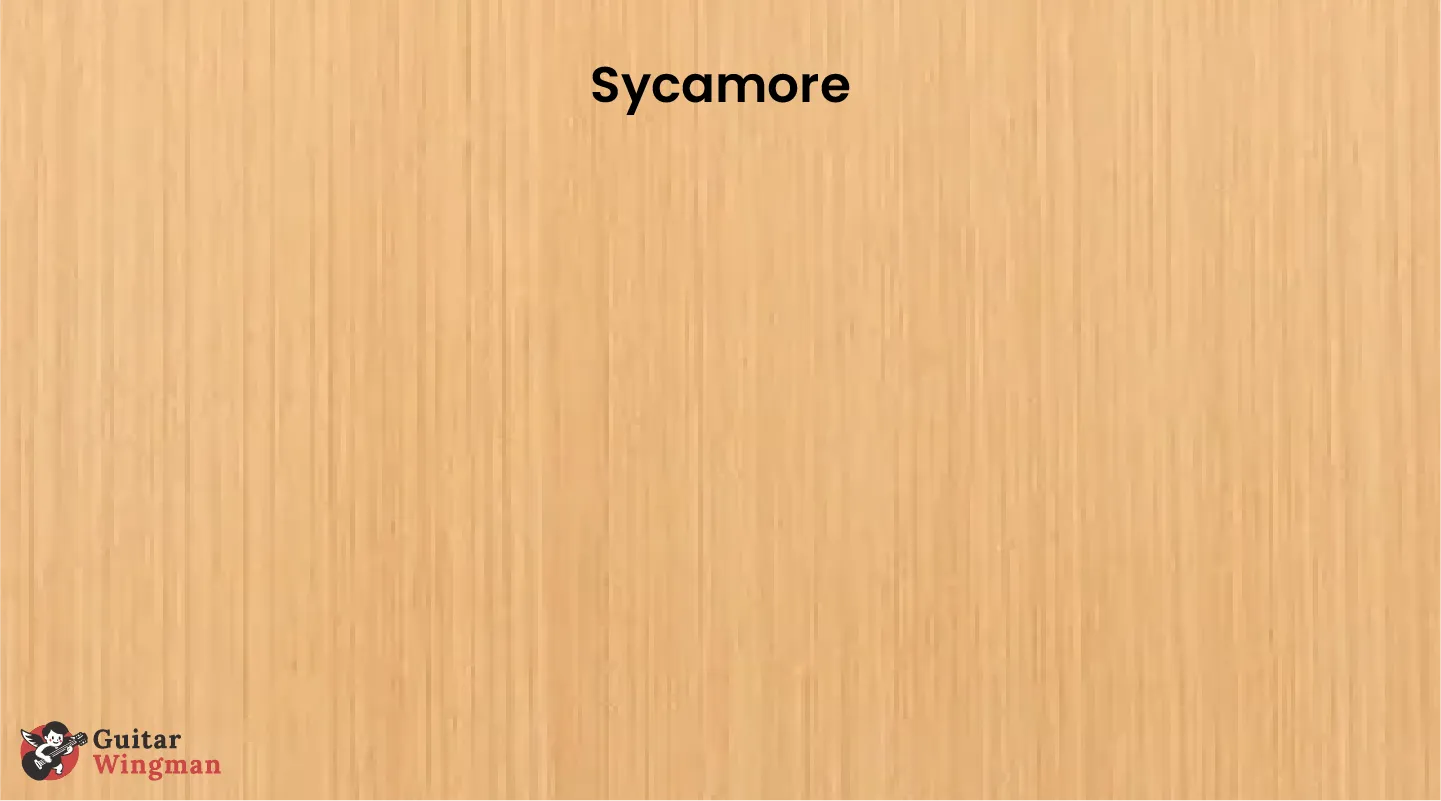
Description: Sycamore is a hardwood with a light cream to pale brown color and a straight grain. Sycamore’s bark is a distinctive mottled gray and white that peels off in patches. Native to eastern North America, Sycamore grows from Maine to Florida and extends west to Texas. Sycamore is a sustainable wood source due to its fast growth rate and wide availability.
Sound properties: Sycamore delivers a bright, punchy tone with considerable projection and sustain. Sycamore emphasizes the midrange frequencies, producing a clear and articulate sound. Sycamore has a brighter and more focused sound than Maple, yet warmer and fuller than Rosewood.
Uses of Sycamore in Acoustic Guitar Making: Sycamore is commonly chosen for the back and sides of acoustic guitars due to a combination of its density, hardness, and aesthetically pleasing light color and fine, even texture. Sycamore’s moderate density of 34 lbs/ft3 (545 kg/m3 ) strikes a desirable balance between weight and resonance. This means that Sycamore produces a resonant tone without making the acoustic guitar overly heavy. Sycamore’s hardness, measured at 770 lbf (349.266 kgf) on the Janka scale, makes Sycamore less prone to denting or scratching, ensuring the longevity of the guitar. Several well-known guitar brands, including Breedlove, Taylor, and Martin, utilize Sycamore in their acoustic guitar construction.
11. Ebony (Macassar Ebony)

Description: Macassar ebony is a dark hardwood with a rich, deep brown to black color with lighter streaks. The Macassar ebony wood displays a unique, striped grain pattern. Macassar ebony grows in Southeast Asia, particularly in Indonesia and the Philippines. Overharvesting and habitat loss led to Macassar ebony being listed as vulnerable on the IUCN Red List and prompted international regulations, such as CITES restrictions, to control its trade and ensure sustainability.
Sound properties: Macassar ebony has a bright and clear tone with an emphasis on higher frequencies, contributing to a crisp and articulate sound. Macassar ebony enhances the treble response while maintaining a balanced midrange, which is ideal for clarity in complex chord voicings. Macassar ebony also offers a strong attack and excellent sustain, making the ebony a favored choice for fingerstyle and percussive playing. Compared to other tonewoods like rosewood or mahogany, macassar ebony is brighter and more focused. While rosewood tends to produce a warmer, fuller sound, ebony’s tonal profile is often described as more direct and cutting, making it suitable for players seeking clarity and precision.
Uses of Macassar Ebony in Acoustic Guitar Making: Guitar makers use macassar ebony for fingerboards, bridges, and sometimes backs and sides in acoustic guitars. Macassar ebony is an excellent choice for wear-resistant areas like fretboards due to its Janka hardness rating of 3,220 lbf (1,460.559 kgf), which means that the Macassar ebony is highly resistant to wear and tear. However, the hardness of the ebony also requires sharper tools and more robust machinery to cut, shape, and finish the wood effectively without damaging the tonewood. Macassar ebony’s high density of 70 lbs/ft³ (1,120 kg/m³) also adds to the overall weight of the guitar. This means that when using the Macassar ebony luthiers carefully consider how much ebony to use and how the weight distribution impacts the player’s comfort and the guitar’s ergonomics.
12. Richlite

Description: Richlite is a composite material made from paper and resin. Richlite is not wood. The manufacturing process to create Richlite involves infusing layers of paper with phenolic resin, and then applying heat and pressure to create a dense and durable material. Richlite is made in the United States and is considered a highly sustainable material due to its use of recycled paper and phenolic resin. Richlite is also FSC (Forest Stewardship Council) certified, ensuring that the paper used comes from responsibly managed forests that provide environmental, social, and economic benefits.
Sound properties: Richlite’s tonal impact is subtle because it is primarily used for fretboards and bridges. However, some guitarists perceive a slight increase in brightness and clarity in the higher frequencies when comparing richlite fretboards to rosewood fretboards.
Uses of Richlite in Acoustic Guitar Making: Luthiers often use Richlite for fretboards and bridges because it has a hardness comparable to ebony. The hardness makes Richlite very resistant to wear from string contact and finger pressure. Therefore, Richlite fretboards and bridges keep their smoothness and shape, guaranteeing consistent playability and intonation. Also, manufacturers frequently choose Richlite as a less expensive and sustainable substitute for ebony. This is due to the comparable material properties of Richlite and ebony, allowing for similar functionality and reducing the environmental effects of harvesting slow-growing hardwoods. The density of Richlite is 78.04 lb/ft³ (1250kg/m3).
13. Granadillo

Description: Granadillo is a hardwood with a reddish-brown color that darkens to a brick-like hue over time, similar to Honduran rosewood. The grain of Granadillo is typically straight, with occasional streaking and pronounced figure. Granadillo is also sometimes referred to as Mexican Rosewood. Granadillo is not a type of rosewood, although it has similar properties to rosewood. Granadillo primarily grows in Central America, with trees reaching up to 80 feet (24.38 m) in height and trunk diameters up to 42 inches (106.68 cm). While not currently listed as an endangered species, Granadillo faces potential sustainability concerns due to its slow growth rate and increasing demand in various industries.
Sound properties: Granadillo is known for its broad frequency range, clear articulation, and a bell-like sparkle that enhances sustain. Granadillo provides a prominent bass response without sacrificing bell-like overtones. Compared to other tonewoods, Granadillo has a slightly brighter tone than Indian Rosewood but not as bright as Maple.
Uses of Granadillo in Acoustic Guitar Making: In acoustic guitar making, Granadillo is typically used for backs and sides, though it can also be found in fingerboards, bridges, and headstocks. With a Janka hardness rating of 2700 lbf (1,224.698 kgf), Granadillo is exceptionally durable and resistant to wear, making Granadillo well-suited for high-friction areas like the fretboard. However, this hardness also means it can dull tools more quickly during the building process. Granadillo is also harder and more challenging to work with compared to softer tonewoods like spruce or cedar because of the density of the tonewood. The density of Granadillo is 59.31 lb/ft³ (950 kg/m3). Denser woods, like Granadillo, can absorb finishes unevenly, requiring more coats and careful application to achieve a consistent appearance.
14. Katalox

Description: Katalox is a dark hardwood with a dark reddish-brown to nearly black color. Katalox wood typically has a straight grain, but it can also be found with irregular or interlocked grain patterns. Katalox is also sometimes referred to as Mexican ebony but Katalox is not a type of ebony. Katalox is a tropical hardwood that grows in Southern Mexico, Central America, and northern South America. Katalox is not currently listed as an endangered wood species.
Sound properties: Katalox provides a bright, well-defined sound with a strong attack and extended sustain. Katalox emphasizes the lower and upper frequencies, resulting in a balanced sound that delivers both rich bass and crisp trebles. Compared to other tonewoods, Katalox sits somewhere between rosewood and ebony in terms of its tonal characteristics. Kaatlox has the warmth and depth of rosewood but with the added brightness, clarity, and attack associated with ebony.
Uses of Katalox in Acoustic Guitar Making: In acoustic guitar crafting, Katalox is often chosen for fingerboards and bridges because its hardness of 3,660 lbf (1,660.145 kgf) makes Katalox incredibly durable and resistant to wear from string contact. However, the hardness of Katalox necessitates sharp tools and careful milling to prevent tear-out during the guitar-making process. Katalox is also a heavy and dense tonewood with a density of 71.6 lbs/ft3 (1,150 kg/m3). Katalox’s density can make it slightly more difficult to glue compared to less dense woods like maple or Sitka spruce. Despite these challenges, Martin incorporated Katalox into their 15 series guitars, showcasing the wood’s tonal potential as a fretboard and bridge material and its viability as a sustainable alternative to ebony.
15. Meranti (Light Red Meranti)

Description: Light red meranti is a hardwood with a pale brown to dark reddish-brown hue and a straight or interlocked grain. Light red meranti originates from Shorea tree species in Southeast Asia. Meranti is readily available and it is not currently listed as an endangered species.
Sound and Tone: The tone of light red meranti is often described as neutral. Light red meranti does not emphasize specific frequencies, resulting in an even response across the tonal spectrum. Compared to other tonewoods, light red meranti lacks a distinct tonal character, often described as bland or generic.
Uses of Light Red Meranti in Acoustic Guitar Making: Light red Meranti often appears in the back and sides of acoustic guitars, particularly in more affordable models. Light red meranti is relatively lightweight and easy to work with because of its light density of 30 lbs/ft3 (480 kg/m3) and a Janka hardness of 550 lbf (249.475 kgf). However, meranti can be challenging to bend into the curved shapes required for acoustic guitar bodies. Brands like Yamaha and Cort utilize light red Meranti in the construction of their entry-level acoustic guitars.
16. Okoume

Description: Okoume is a light hardwood with a pale pink to light brown color. Okoume’s grain can be straight, wavy, or slightly interlocked, and often resembles the appearance of mahogany. Okoume is native to Central Africa and primarily grows in Gabon. The International Union for Conservation of Nature (IUCN) lists Okoume as a vulnerable species due to over-exploitation and habitat loss.
Sound and Tone: Okoume has bright and balanced tone properties with an emphasis on the upper midrange frequencies. Okoume also delivers a balanced low-end response that is tight and controlled, without being boomy or overwhelming. Compared to other tonewoods, Okoume falls between mahogany and maple in terms of its sound characteristics. Okoume offers the warmth and midrange presence of mahogany with some of the clarity and articulation associated with maple.
Uses of Okoume in Acoustic Guitar Making: Okoume is typically used for the back and sides of acoustic guitars. 2. Okoume is relatively soft and lightweight for a hardwood, with a density of 27 lbs/ft3 (430 kg/m3) and a Janka hardness of 400 lbf (181.437 kgf). Okoume is easy to work with during manufacturing, but its softness requires careful handling to prevent dents and scratches. Several guitar brands, including Fender and PRS, have incorporated Okoume into their acoustic guitar models.
How are acoustic guitars made?
Acoustic guitars are made through a process that involves choosing tonewoods, shaping the body, bracing the top and back, crafting the neck, adding the fretboard, joining the neck and body, installing binding, sanding, finishing, and finally, assembling the completed components. The process of acoustic guitar making is shown in the picture below.

The process of acoustic guitar building begins with selecting the appropriate tonewoods for the guitar’s top, back, sides, and neck. Tonewoods are carefully chosen for their acoustic properties, such as resonance and sustain.
The next step is to bend the sides with heat and moisture to achieve the guitar’s curves. Once the body’s basic structure is formed, bracing patterns are strategically glued to the top and back to enhance structural integrity and influence the guitar’s sound.
The neck is crafted separately and often made of a different wood than the body. Crafting the neck involves carving the neck profile, attaching the fretboard, and installing frets. The neck is then carefully joined to the body.
After the guitar’s main components are assembled, the finishing process begins. This includes sanding, binding (decorating the edges), and applying a protective finish. The type of finish, such as lacquer or polyurethane, can also impact the guitar’s sound.
The final stages involve assembling the rest of the guitar’s components, installing tuning machines, stringing the instrument, and performing quality control checks to ensure optimal sound and playability of the acoustic guitar.
The final product is commonly called a solid wood acoustic guitar or laminate acoustic guitar, based on the tonewoods that were chosen for the body of the guitar.
Solid wood guitar vs Laminate Guitar
Solid wood guitars use a solid piece of wood for their top, back, and sides. Laminate guitars use layers of wood veneer glued together to form the top, back, and sides.
Solid wood guitars are known for their superior resonance, complex overtones, and tendency to sound better as they age. However, solid wood guitars are more expensive and susceptible to humidity and temperature changes.
Laminate guitars are more affordable, durable, and less sensitive to environmental changes. However, they often lack the tonal complexity and richness of solid wood guitars.
What tonewoods do the best high-end acoustic guitars use?
The best high-end acoustic guitars use a combination of tonewoods to achieve specific sound, tone, durability, and aesthetic appeal. A common pairing is a spruce top for its resonance and clarity, combined with rosewood for the back and sides, prized for its rich overtones and focused sound. Mahogany is another popular choice, often favored for its warmth and balanced tone. Mahogany is frequently used for both the back and sides and occasionally for the top.
The value of these tonewoods, particularly in high-end acoustic guitars, is sometimes further enhanced by the effect of aging. As these woods mature over time, exposure to temperature and humidity fluctuations, along with the constant vibration from playing, causes their cellular structure to change. This natural process typically results in a more resonant and harmonically complex tone, often described as “opened up” and highly sought after by guitarists. This is why vintage guitars, especially those crafted with high-quality spruce, rosewood, and mahogany, are often highly sought after.
What parts do acoustic guitars have?
Key acoustic guitar parts include the body, neck, headstock, bridge, soundhole, and bracing. The body, comprised of the top, back, and sides, acts as the instrument’s resonator. The neck holds the fretboard and allows the guitarist to access different notes by pressing down on the strings. The headstock, located at the end of the neck, houses the tuning pegs, used to adjust string tension and pitch. The bridge, usually made of hard dense wood like rosewood or ebony, secures the strings to the body and transmits their vibrations to the soundboard. The soundhole, an opening in the top, allows sound to project outward. Finally, internal bracing reinforces the top and back, critically influencing the guitar’s structural integrity and tonal response.