
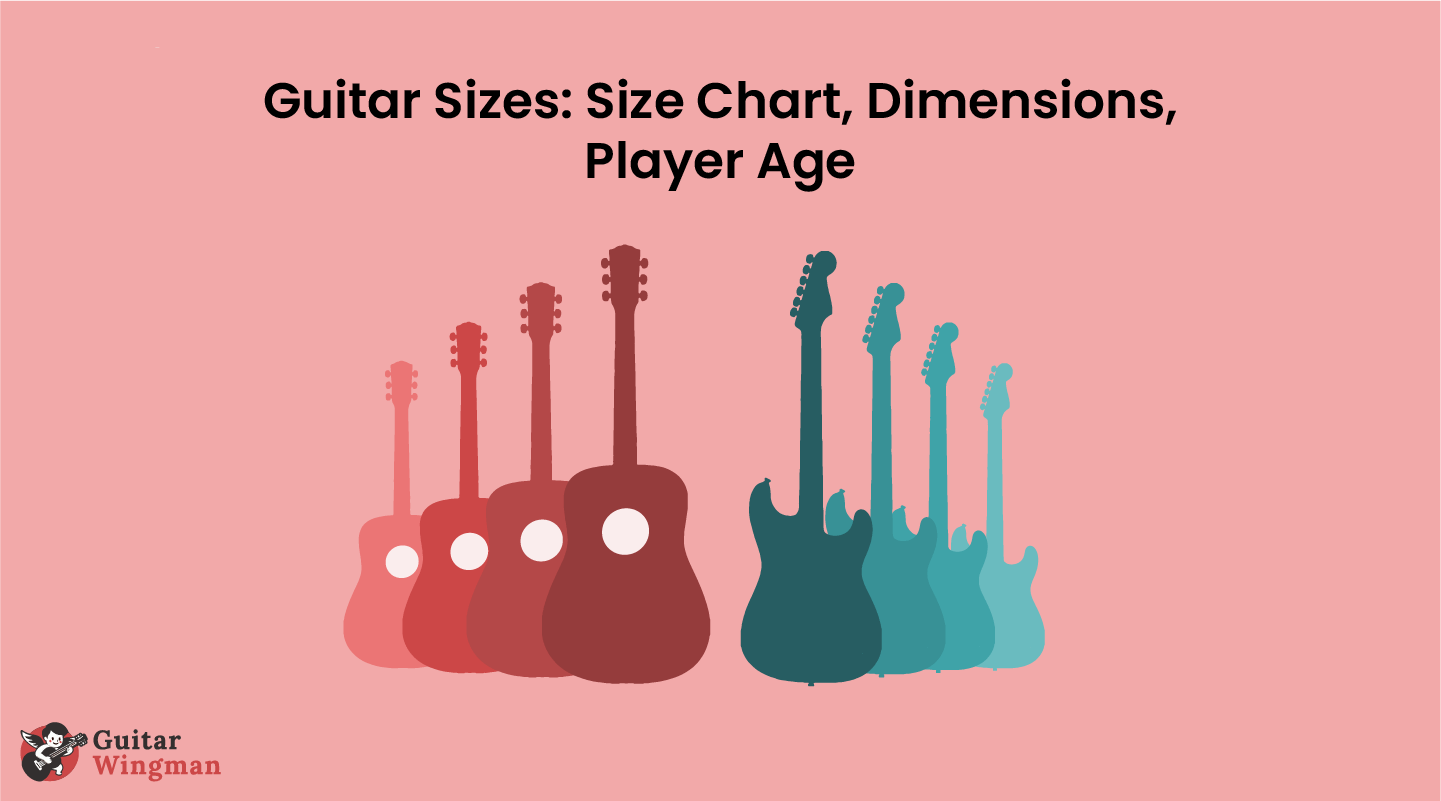
Guitar size refers to the overall dimensions of a guitar, particularly its length and scale length. The length or total length of a guitar is measured from the tip of the headstock to the bottom of the body. The scale length of a guitar is the vibrating length of the strings measured from the nut to the saddle.
The most common guitar sizes are 4/4 (full-size), 3/4, 1/2, and 1/4. A full-size guitar is the standard “normal” six-string guitar for adults, while smaller sizes are designed for children of different age groups. There is no difference in size between left-handed and right-handed guitars.
For each guitar size, we describe the specific size, explain the differences in dimensions between acoustic, electric, and classical guitar types, and provide recommendations for the age of the player that the guitar size is best suited for. While specific body dimensions like width and depth contribute to a guitar’s overall sound and feel, there is no standardized measurement for body dimensions across different body shapes. Therefore body measurements are not included because they vary significantly based on the specific body shape for each guitar type.
Choosing the correct guitar size is crucial for comfort and ease of learning, especially for beginners. Therefore it is crucial to understand answers to questions like “What guitar size should I get?” to make sure that you are choosing the best guitar size for the most optimal playing experience.

5 Step Checklist To Avoid Buying The Wrong Guitar
What to check before you buy
What features actually matter for beginners
What makes a guitar easy to play
The size chart below shows the differences in guitar sizes for acoustic, electric, and classical guitar types in inches and milimeters.

1. 4/4 Guitar Size

A 4/4 guitar, also known as a full-size, regular, or standard-size guitar, represents the largest common guitar size. The full sized 4/4 guitars produce a fuller, richer sound with greater volume and resonance when compared to smaller scale guitars like ¾, ½, and 1/4. The longer scale length of a 4/4 guitar also provides greater string tension, which contributes to better sustain and a wider range of dynamics. The exact size of a full-size guitar changes depending on the guitar type.
4/4 Sized Acoustic Guitar Dimensions: A 4/4 sized acoustic guitar typically measures 38″ to 40″ (1016 mm) in overall length with a scale length ranging from 24.9″ to 25.6″ (632.46 mm to 650.24 mm). The dimensions of the acoustic guitar body change based on specific body shapes. The most popular body shape called the dreadnought body shape has a body length of 19″-20″ (482.6 mm – 508 mm), a lower bout width of 15″-16″ (381 mm – 406.4 mm), an upper bout width of 11″-12″ (279.4 mm – 304.8 mm), and a depth of 4″- 5″ (101.6 mm – 127 mm) in the 4/4 sized version.
4/4 Sized Electric Guitar Dimensions: The total length of a full-size electric guitar measures around 38″ (965.2 mm). The scale length ranges from 24.75″ to 25.5” (628.65 – 647.7 mm). Electric guitars have more variation in body shapes and sizes than acoustic guitars, and the dimensions of the body like body length, width, and depth change with specific body shapes. For example, the Fender Stratocaster has different measurements than a Flying V body shape.
4/4 Sized Classical guitar dimensions: A 4/4 sized classical guitar typically measures around 39″ (990.6 mm) in length, with a standard scale length running from 25.6″ to 26″ (650.24 mm to 660.4 mm). A 4/4 sized classical guitar typically has a body length of 19.25″ (489 mm), according to Richard Mark French in the book “Acoustic Guitar Design.” Along with these standard measurements, a 4/4 classical guitar body usually has an upper bout width of 11.5″- 12″ (292.1 mm – 304.8 mm) and a lower bout width of 14.5″- 15″ (368.3 mm – 381 mm). The depth of the body typically falls within the range of 3.5″- 4.25″ (88.9 mm – 107.95 mm).
Player Age: A 4/4 guitar is considered an adult-size guitar, suitable for players aged 12 and above. Younger children might struggle to comfortably hold and play a full-size instrument due to its larger size and higher string tension.
2. 3/4 Guitar Size

A 3/4 guitar size is a medium-sized, scaled-down version of a full-size guitar, designed for players with smaller hands and shorter reach. However, the ¾ designation doesn’t mean the guitar is 75% of a full-size guitar according to the book “Acoustic Guitar Design” by Richard Mark French. According to the “Acoustic Guitar Design” book, a Taylor GS Mini has a scale length of 23.5 inches (597 mm) and is classified as a ¾ size, while most full-size Taylors have a 25.5-inch (647.7 mm) scale length. The scale length of the ¾ guitar size would have to be only 19.125 inches (485.8 mm), if a ¾ guitar size were 75% of the size of a full-size guitar. A 3/4 guitar size is a great fit for smaller players (particularly children) and players who prefer a smaller, more comfortable, travel-friendly guitar size.
3/4 sized Acoustic Guitar Dimensions: A 3/4 size acoustic guitar typically measures 36″ (914.4 mm) in total length. The scale length ranges from 20″ to 24″ (508 mm to 610 mm).
3/4 sized Electric Guitar Dimensions: The total length of a ¾ sized electric guitar also measures 36″ (914.4 mm). The scale length for a 3/4 size electric guitar ranges from 22″ to 24″ (558.8 mm to 609.6 mm).
3/4 sized Classical Guitar Dimensions: A 3/4 size classical guitar typically measures 36″ (914.4 mm) in total length with a has a scale length between 23″ to 24″ (584.2 mm to 609.6 mm). However, some classical 3/4 models have even shorter scale lengths, like the Yamaha CS40 with a scale length of 22.8″ (580 mm).
Player Age: 3/4 size guitars are generally suitable for children between the ages of 8 and 12. However, the ¾ guitar can also be a good option as a smaller guitar for adults or a more comfortable option for adults who have smaller hands.
3. 1/2 Guitar Size

A 1/2 guitar size, also called half-sized, is a scaled-down version of a full-size guitar, designed to make playing more comfortable for younger or smaller players. The smaller size and shorter scale length reduce strain on fingers and hands, allowing children to develop playing skills more easily. The lighter weight contributes to a more comfortable playing experience, especially for extended practice sessions.
1/2 Sized Acoustic Guitar Dimensions: A 1/2 size acoustic guitar typically measures 34 inches (863.6 mm) in total length with a scale length of 21-23 inches (535-584 mm).
1/2 Sized Electric Guitar Dimensions: The total electric guitar length is typically around 33-36 inches (838.2-914.4 mm) with a scale length of 21-23 inches (535-584 mm).
1/2 Sized Classical Guitar Dimensions: A 1/2 size classical guitar typically measures 33-34 inches (838.2-863.6 mm) in total length. The scale length is typically around 21 inches (535 mm).
Age Suitability: 1/2 scale sized guitars are generally recommended for children between the ages of 6 and 8 years old or for individuals around 4 feet (1219.2 mm) tall. The smaller size makes it easier for younger players to hold the guitar and reach the frets comfortably. A 1/2 size guitar is not typically recommended for adults as the neck may feel too small and cramped for larger hands.
4. 1/4 Guitar Size

A 1/4 guitar size is a scaled-down version of a full-size guitar, designed for beginner children guitarists. A 1/4 size guitar is the smallest size guitar available. The smaller size and scale length make it easier for small hands to navigate the fretboard and develop proper hand positioning. The lighter weight reduces strain and fatigue, allowing children to practice for longer periods. Additionally, a 1/4 guitar provides a more comfortable playing experience, encouraging children to stay engaged and enthusiastic about learning the instrument.
1/4 Sized Acoustic, Electric and Classical Guitar Dimensions: 1/4 size guitars, including acoustic, electric, and classical types, typically measure around 30″ (762 mm) in total length with a body width of approximately 10″ (254 mm). The ¼ scaled guitars usually have a scale length between 19″ and 20″ (482.6 mm and 508 mm).
Player Age: The ideal age range for a 1/4 guitar is between 4 and 6 years old. The ¼ guitar size is suitable for young children who are just starting to learn guitar and need an instrument that accommodates their smaller hands and shorter reach. A 1/4 size guitar is not recommended for adults as it would be too small to play comfortably.
What guitar size should I get?
You should get a guitar size that best suits your age, height, and hand size. In the table below the age ranges, player heights, and hand sizes are shown for each guitar size.
| Guitar Size | Age Range | Player Height | Hand Size | Other Considerations |
| 1/4 Size | 4-6 years | 3’1″ – 3’9″ (94cm – 114cm) | Very Small | Ideal for very young beginners. |
| 1/2 Size | 6-8 years | 3’10” – 4’5″ (117cm – 135cm) | Small | Compact and lightweight. Good transition size from the ¼ size. |
| 3/4 Size | 8-12 years | 4’6″ – 4’11” (137cm – 150cm) | Small to Average | Suitable for children and adults with smaller frames and smaller hands. Offers a balance of comfort and sound. |
| Full Size (4/4) | 12+ years | 5’0″ and taller (152cm+) | Average to Large | Standard size for adults and teenagers. Offers fuller sound and volume compared to smaller sizes. |
What are the key differences between a 3/4 size guitar vs a full-size guitar?
The key differences between a 3/4 size guitar and a full-size guitar are the dimensions and their impact on playability.
A 3/4 size guitar typically measures around 36″ (914.4 mm) in length, while a full-size guitar measures approximately 40″ (1016 mm). This size difference affects the scale length. 3/4 size guitars have a shorter scale length, making it easier for younger or smaller players to reach the frets comfortably.
The shorter scale length of a 3/4 size guitar also results in lower string tension. Lower string tension makes it easier to press down the strings when fretting chords and notes. The lower string tension can be beneficial for beginners who are still developing finger strength. However, the lower string tension on the ¾ sized guitar also leads to a slight decrease in volume and projection compared to a full-size guitar.
Full-size guitars, with their larger bodies and longer scale lengths, typically produce a louder and fuller sound with a greater bass response.
What are the key differences between a 1/2 size guitar vs a 3/4 size guitar?
The key differences between a 1/2 size guitar and a 3/4 size guitar are the dimensions and suitability for different age groups.
A 1/2 size guitar is smaller, measuring around 34″ (863.6 mm) in total length when compared to a 3/4 size guitar’s total length of 36″ (914.4 mm). This makes the 1/2 size guitar ideal for younger children, typically between the ages of 5 and 8, or those with smaller hands and shorter arms. The 3/4 size guitar, being slightly larger, is generally suitable for children aged 8 to 11 or adults with smaller frames who find a full-size guitar too cumbersome.
How to measure the dimensions of a guitar?
To measure the dimensions of a guitar, use a tape measure to determine the guitar’s total length, body width, body depth, and scale length.
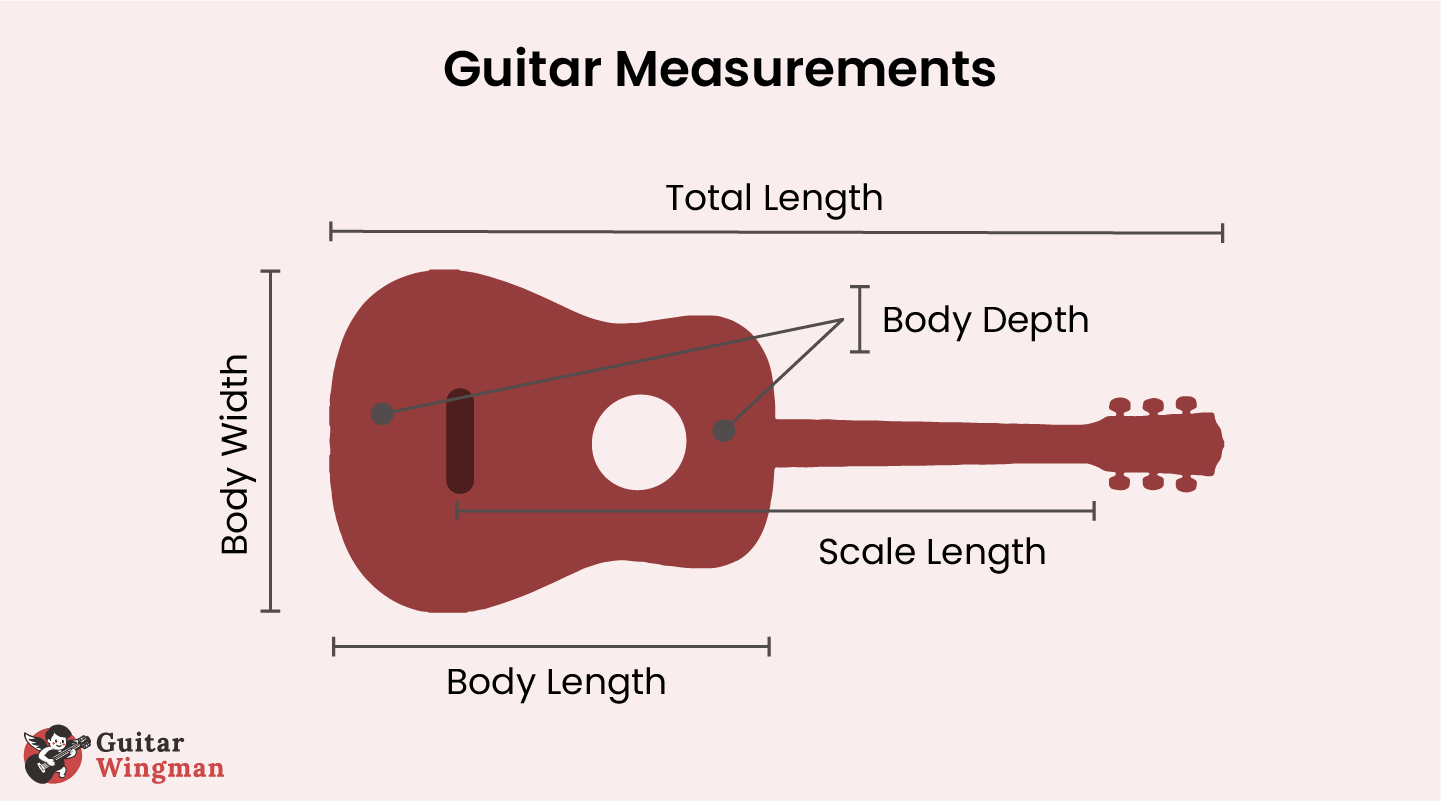
Measure the guitar’s total length from the tip of the headstock to the bottom of the body. The body width is measured across the widest part of the guitar’s body, typically at the lower bout. Measure the thickness of the guitar’s body at its deepest point to determine the body depth. Finally, determine the scale length by measuring the distance from the nut at the top of the fretboard to the saddle on the bridge.
Are guitar sizes different from acoustic guitar body shapes?
The guitar sizes are different from the acoustic guitar body shapes. Guitar size refers to the overall dimensions and scale of the instrument. Guitar body shape refers to the outline, curves, and dimensions of the guitar’s body. Therefore, a ¾ dreadnought might have dimensions that are comparable to a different guitar shape, however, the ¾ size dreadnought still has a dreadnought body shape even when the dimensions are scaled down to a smaller size.
How to choose a good 1st guitar for beginners?
To choose a good 1st guitar for beginners, you need to consider more than just the guitar size. Finding the right size ensures comfort and playability. However, factors like the type of guitar, your budget, and your musical goals are equally important when choosing your first guitar. Choosing the right type of guitar, such as an acoustic or electric, is crucial because guitar type determines the playing styles and the musical genres you can explore. Your budget influences the quality and features you can realistically afford, directly impacting the guitar’s sound and longevity. Aligning your guitar choice with your musical goals ensures that you’ll stay motivated to learn and practice. Additionally, understanding what makes a good quality guitar and the differences between guitar brands allows you to identify an instrument that sounds good, stays in tune, and will last for years.