

An acoustic guitar is any guitar that produces sound acoustically, without the need for external amplification. However, in common usage, the term “acoustic guitar” often refers specifically to steel-string acoustic guitar. Steel string acoustic guitar is a type of guitar that generates sound through the vibrations of its 6 steel strings, which are amplified by a hollow body. Steel-string acoustic guitars come in various body shapes and understanding the nuances of each body type is essential for selecting the right acoustic guitar.
An acoustic guitar body shape describes the outline, curves, and dimensions of the acoustic guitar body. Body types significantly influence the guitar’s sound, playing comfort, construction, and suitability for different musical styles. Body dimensions like body length, body width, and body depth directly impact acoustic guitar’s volume, tone, and projection.
Larger-bodied guitars, like Jumbos and Dreadnoughts, produce a louder sound with a greater emphasis on bass frequencies due to their larger size. Medium-bodied guitars, like Grand Auditorium and Orchestra Model guitars, offer a balance between volume and comfortable playing experience. Smaller-bodied guitars, such as Grand Concert and Concert guitars, prioritize a balanced tone with mid-range focus and a comfortable playing experience over loudness.
The development of acoustic guitar body shapes is heavily tied to companies like Martin Guitars and Taylor Guitars. Martin, established in 1833, popularized steel-string acoustics with iconic shapes like the Dreadnought, Orchestra Model, and Concert. Taylor, founded in 1974, brought modern approaches to design, prioritizing comfort and innovative techniques, which can be seen in body styles like the Grand Auditorium, Grand Symphony, and a modified shape like the GS Mini. Martin’s early designs are still commonly used as a standard, and replicated by guitar manufacturers worldwide.

5 Step Checklist To Avoid Buying The Wrong Guitar
What to check before you buy
What features actually matter for beginners
What makes a guitar easy to play
The most common acoustic guitar body shapes are listed below, from largest to smallest body size.
- Jumbo
- Dreadnought
- Grand Auditorium
- Auditorium (Orchestra Model/Triple 0)
- Grand Concert
- Concert
- Parlor
The dimensions, and shapes of each acoustic guitar body type are illustrated and compared on the body size chart below. The body size chart uses standard dimensions based on Martin Guitars and Taylor Guitars body shapes, presented in both inches and millimeters.

1. Jumbo

The Jumbo acoustic guitar shape features a large body with a wide lower and upper bout and a narrow waist. Jumbo is the largest standard body shape for steel string acoustic guitars.
In 1937 Gibson introduced the Jumbo acoustic guitar as a direct competitor to Martin’s increasingly popular Dreadnought model. Gibson designed the Jumbo with a large body to match the Dreadnought’s volume but aimed to deliver a more balanced tone with an even greater emphasis on overall loudness.
Dimensions: According to the book “Acoustic Guitar Design” by Richard Mark French the dimensions of Martin’s Jumbo (J) guitar shape with 14 frets are the following:
- Body Length: 20-1/8 inches (511.2 mm)
- Upper Bout Width: 11-11/16 inches (296.9 mm)
- Lower Bout Width: 16 inches (406.4 mm)
- Depth at Neck: 3-15/16 inches (100 mm)
- Depth at Tail: 4-7/8 inches (123.8 mm)
- Scale Length: 25.4 inches (645.2 mm)
- Total Guitar Length: 40-3/8 inches (1025.5 mm)
Weight: The Jumbo typically weighs between 5 to 6.5 pounds (2.27 to 3 kg), but the weight can vary depending on the wood and construction.
The dimensions and weight of a Jumbo guitar shape can also vary across different brands, designers, and models.
Sound, Tone, and Volume: The Jumbo delivers a powerful, boomy sound with a strong emphasis on the bass frequencies. However, the Jumbo’s large body also provides a balanced midrange and clear trebles. Jumbo has a loud, full sound that projects well, making it suitable for large venues. Jumbo guitars are generally louder than dreadnought guitars because the Jumbo shape is slightly bigger than dreadnought.
Comfort: The Jumbo shape is not very comfortable for players with smaller physiques, due to its size and weight. Jumbo’s large body can feel cumbersome when compared to smaller acoustic guitars, particularly when standing.
Versatility: The Jumbo guitar shape is commonly associated with genres like country, rock, and blues. Elvis Presley played Gibson J-200 on “Loving You” and Noel Gallagher used Epiphone EJ-200 to record “Wonderwall”. The powerful sound and projection of the Jumbo body are well-suited for both solo performances and playing alongside other instruments.
Jumbo Design Variations: Variations of the Jumbo include the Super Jumbo (SJ) and the Advanced Jumbo (AJ). The Super Jumbo is even larger than the Jumbo, with wider upper and lower bouts. This extra size contributes to an even louder and more resonant tone. The Advanced Jumbo falls between the Jumbo and Super Jumbo in size, providing a balanced compromise between the two.
Jumbo Guitar Models: Examples of good Jumbo guitar models include the Epiphone J-200, Yamaha LL6 ARE, and Guild F-240E.
Grand Symphony (GS)
The Grand Symphony guitar shape is a modern take on the jumbo acoustic guitar, introduced in 2006 by Taylor Guitars. The Grand Symphony guitar shape features a large body with a cutaway. The Grand Symphony has resonant sound, but with a more modern and balanced tonal response than traditional jumbo guitars.
The Grand Symphony shape is only slightly wider and slightly narrower than the traditional Jumbo Shape. According to the book “Acoustic Guitar Design” by Richard Mark French, the dimensions of Taylor’s Grand Symphony guitar shape are the following:
- Body Length: 20 inches (508 mm)
- Body Width: 16.25 inches (412.8 mm)
- Body Depth: 4.625 inches (117.5 mm)
- Scale Length: 24.875 inches (631.8 mm)
Grand Symphony dimensions can slightly vary across different brands, designers, and models.
2. Dreadnought
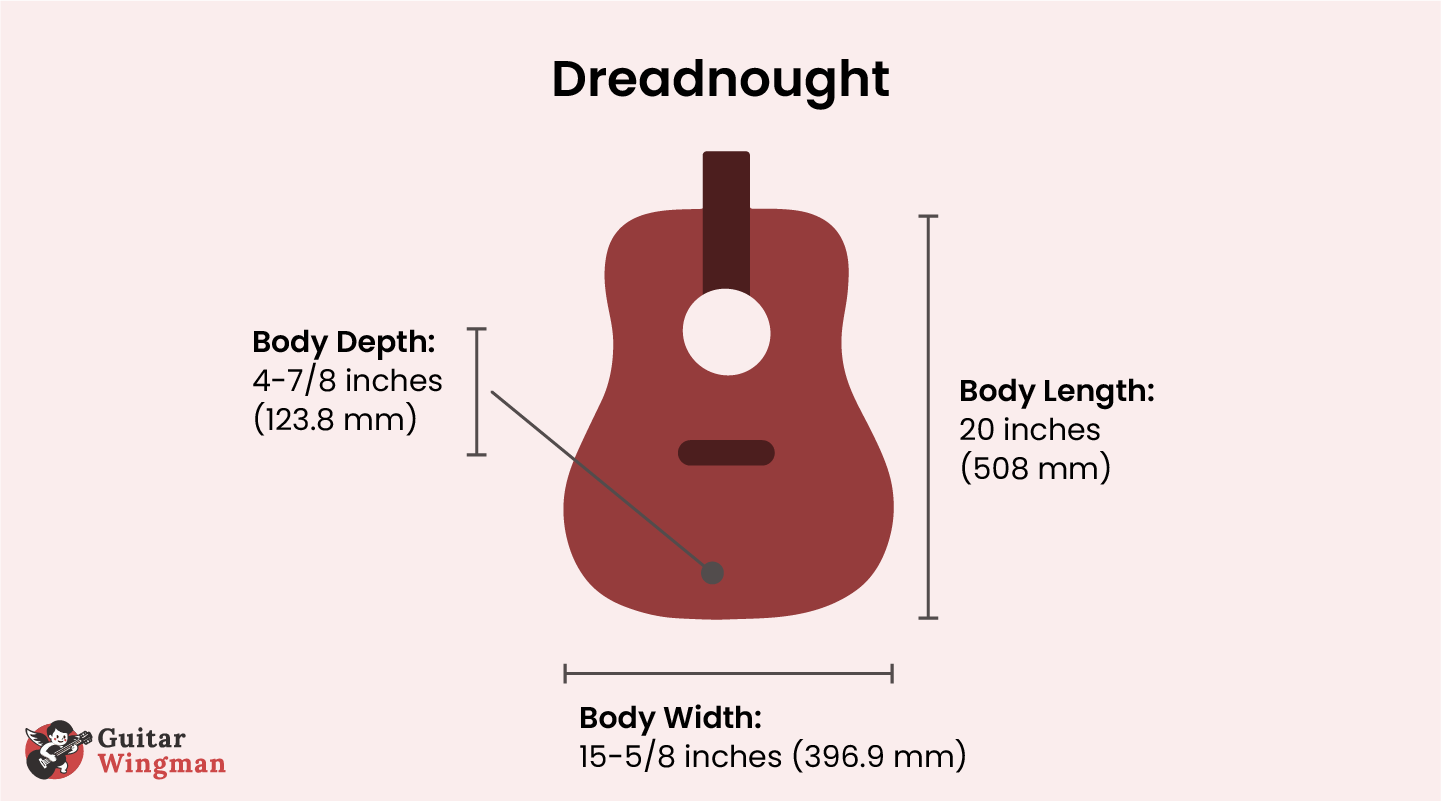
The Dreadnought acoustic guitar shape has a large body with a wider lower bout, wide waist, and squared or rounded shoulders. The Dreadnought was specifically designed to project a loud, full sound without amplification.
The Dreadnought acoustic body type was invented in 1916 through a collaboration between Martin Guitars and music publisher Oliver Ditson Company. Ditson desired a louder, more powerful guitar that could hold its own against the banjo and other instruments popular in early 20th-century music like mandolin, fiddle, and double bass. The body shape was named “Dreadnought” after the HMS Dreadnought. HMS Dreadnought was a British battleship launched in 1906 that set new standards in naval firepower, just like the Dreadnought design has set a new standard in guitar design.
Dimensions: According to the book “Acoustic Guitar Design” by Richard Mark French, the dimensions of Martin’s Dreadnought (D) guitar shape with 14 frets are the following:
- Body Length: 20 inches (508 mm)
- Upper Bout Width: 11-1/2 inches (292.1 mm)
- Lower Bout Width: 15-5/8 inches (396.9 mm)
- Depth at Neck: 3-15/16 inches (100 mm)
- Depth at Tail: 4-7/8 inches (123.8 mm)
- Scale Length: 25.4 inches (645.2 mm)
- Total Guitar Length: 40-1/4 inches (1022.4 mm)
For Martin’s Dreadnought (D) guitar shape version with 12 frets, the dimensions are the following:
- Body Length: 20-15/16 inches (531.8 mm)
- Upper Bout Width: 11-1/2 inches (292.1 mm)
- Lower Bout Width: 15-5/8 inches (396.9 mm)
- Depth at Neck: 3-15/16 inches (100 mm)
- Depth at Tail: 4-3/4 inches (120.7 mm)
- Scale Length: 25.4 inches (645.2 mm)
- Total Guitar Length: 39-9/16 inches (1004.9 mm)
Weight: The weight of the Dreadnought generally falls between 4.5 to 6 lbs (2 to 2.7 kg), but the weight can vary depending on the wood and construction.
Dreadnought dimensions and weight can also vary across different brands, designers, and models.
Sound, Tone, and Volume: The Dreadnought guitar shape produces a powerful, full sound with a strong emphasis on the bass frequencies. Dreadnought’s large body size allows for greater air displacement, resulting in a loud volume and a booming low-end. The Dreadnought’s tone is well-balanced, with a clear midrange and articulate treble. The combination of volume and balanced projection makes the Dreadnought suitable for a variety of playing styles, from aggressive strumming to delicate fingerpicking.
Comfort: The large size of the Dreadnought can impact playing comfort, particularly for guitarists with smaller physiques. The wide lower bout is bulky and may require adjustments in posture for comfortable playing. The Dreadnought’s weight can also lead to faster player fatigue during extended sessions as the bigger body is heavier than smaller acoustic guitar shapes.
Versatility: The Dreadnought guitar shape is commonly associated with genres like country, bluegrass, folk, and rock. Dreadnought’s powerful sound and projection make it well-suited for both solo performance and band playing. Specific artists and songs featuring the Dreadnought include Bob Dylan’s “Blowin’ in the Wind”, Paul McCartney’s “Blackbird” and Neil Youngs’s “Heart of Gold”. The Dreadnought’s ability to cut through a mix with its booming bass and articulate treble frequencies makes it ideal for driving the rhythm of a song or accompanying vocals. This, paired with its loud volume, made the Dreadnought a favorite for early country and bluegrass musicians who often performed without amplification.
Dreadnought Design Variations: Variations of the Dreadnought shape include slope-shouldered and square-shouldered designs. The main difference between the 2 designs is the shape of the upper bout of the guitar body.
Square-shouldered Dreadnoughts adhere to the original Dreadnought design with a more defined, sharper angle on the upper bout. This contributes to a powerful, bass-forward sound and greater volume.
Slope-shouldered Dreadnoughts have a softer, more rounded curve on the upper bout. This results in a slightly warmer and more balanced tone with less emphasis on the bass frequencies. Slope-shouldered Dreadnoughts are also sometimes referred to as curved-shouldered or round-shouldered.
The picture below showcases the difference between the slope-shouldered and square-shouldered Dreadnought design.

Dreadnought Guitar Models: Examples of good Dreadnought guitar models include the Yamaha FG830, Guild D-140, and Taylor Academy 10.
3. Grand Auditorium (GA)
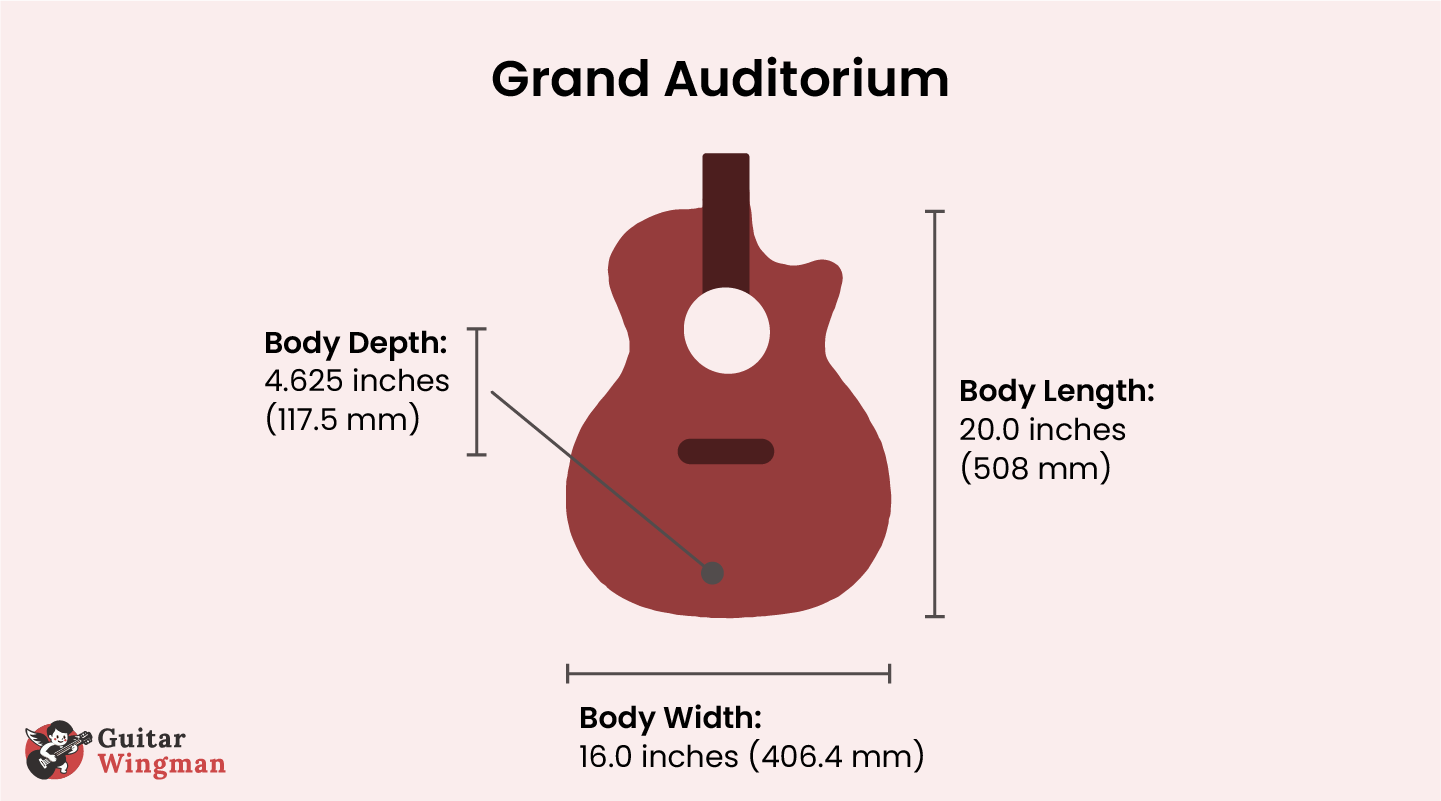
The Grand Auditorium guitar shape has a round hourglass-like body with curved bouts and pronounced waist. In 1994, Taylor Guitars designed the Grand Auditorium to provide a versatile size that could bridge the gap between the smaller Grand Concert and larger Dreadnought body types. The Grand Auditorium is Taylor’s best selling acoustic guitar body shape.
Dimensions: According to the book “Acoustic Guitar Design” by Richard Mark French, the dimensions of Taylor’s Grand Auditorium guitar shape are the following:
- Body Length: 20.0 inches (508 mm)
- Body Width: 16.0 inches (406.4 mm)
- Body Depth: 4.625 inches (117.5 mm)
- Scale Length: 25.5 inches (647.7 mm)
Weight: The weight of a Grand Auditorium guitar typically ranges from 4 to 5 pounds (1.8 to 2.2 kg), but the weight can vary depending on the wood and construction.
Grand Auditorium dimensions and weight can also vary across different brands, designers, and models.
Sound, Tone, and Volume: The Grand Auditorium shape produces a well-balanced sound with a focus on clarity. GA delivers a strong midrange, clear treble, and a controlled bass response that avoids excessive boominess. This balanced frequency response makes it suitable for a wide range of musical styles. The Grand Auditorium’s volume is louder than a Grand Concert but not as loud as a Dreadnought.
Comfort: Grand Auditorium’s smaller waist and rounded curves make it comfortable to hold and play for guitarists of all sizes. Grand Auditorium’s narrower waist reduces strain for players with shorter arms, while its slightly smaller body size enhances overall comfort, especially when sitting. The Grand Auditorium’s weight is lighter than larger body shapes like Dreadnoughts or Jumbos, which reduces fatigue during longer playing sessions.
Versatility: The Grand Auditorium guitar shape is very versatile and associated with a wide range of genres, including pop, rock, country, and folk. Artists such as Taylor Swift, James Taylor, and Ed Sheeran have used Grand Auditorium guitars. The Grand Auditorium is a good fit for various playing styles because of its balanced sound and ability to easily handle a mix of flatpicking, strumming, and fingerstyle playing.
Grand Auditorium Design Variations: Variations of the Grand Auditorium shape include designs with a cutaway. Cutaway is a sculpted section on the upper bout that allows for easier access to the higher frets. The Grand Auditorium shape with a cutaway is the same size as the Grand Auditorium shape without a cutaway. The variation with a cutaway often appeals to lead guitarists who need to reach higher notes comfortably.
Grand Auditorium Guitar Models: Examples of good Grand Auditorium guitar models include the Taylor 114ce, Takamine GN20, and Takamine GN93CE.
4. Orchestra Model (OM), Triple O (000) and Auditorium

The Orchestra Model (OM) and Triple O (000) are 2 names for the same acoustic guitar body shape. The 2 names exist because the Martin Guitar Company, the originator of the OM design in 1929, decided to trademark the name “Orchestra Model” and its abbreviation “OM.” Since only Martin could officially call their guitars “OM” guitars, other companies wanting to make guitars in the same style used the name “Triple O” or “000” to avoid legal issues. The OM and 000 body shapes are also sometimes referred to as Auditorium body shapes.
The Orchestra Model (OM) features a distinct pear-like shape with a round lower bout and a smaller upper bout. C.F. Martin & Co. introduced the Orchestra Model in 1929 as a modern steel-string acoustic guitar with a balanced tone that could be still heard among louder instruments in an orchestra setting.
Dimensions: According to the book “Acoustic Guitar Design” by Richard Mark French, the dimensions of Martin’s OM and 000 guitar shapes with 14 frets are the following:
- Body Length: 19-3/8 inches (492.1 mm)
- Upper Bout Width: 11-13/32 inches (289.7 mm)
- Lower Bout Width: 15-1/4 inches (387.4 mm)
- Depth at Neck: 3-1/4 inches (82.6 mm)
- Depth at Tail: 4-1/8 inches (104.8 mm)
- OM Scale Length: 25.4 inches (645.2 mm)
- OM Total Guitar Length: 39-1/2 inches (1003.3 mm)
- 000 Scale Length: 24.9 inches (632.5 mm)
- 000 Total Guitar Length: 39-3/8 inches (1000.1 mm)
Therefore Martin Guitar Company’s OM and 000 body dimensions are the same, but the scale length of Martin’s 000 acoustic guitars is shorter than the scale length of Martin’s OM guitars.
Weight: OM and 000 guitars typically weigh between 4 lbs (1.8 kg) and 4.5 lbs (2 kg), but the weight can vary depending on the wood and construction.
OM and 000 dimensions and weight can also vary across different brands, designers, and models.
Sound, Tone, and Volume: The Orchestra Model (OM) is known for a balanced and articulate tone with a strong midrange presence. The Orchestra model emphasizes midrange frequencies, delivering a clear and focused sound. While not as loud as a Dreadnought, the OM still offers enough volume and projection for solo and group performances.
Comfort: The OM’s smaller body and narrower waist allow for comfortable playing whether seated or standing. Additionally, OM’s lighter weight reduces fatigue during longer playing sessions when compared to heavier shapes like jumbo or dreadnought.
Versatility: The Orchestra Model (OM) excels in genres like folk, blues, and Americana because of its balanced tone and articulate sound, making OM well-suited for both fingerpicking and strumming. John Mayer uses an OM guitar to play his song “Neon”, showcasing OM’s clear, articulate tone in fingerstyle blues. Paul Simon’s “The Boxer,” played on a Martin OM-22, demonstrates the suitability of the OM and 000 models for folk strumming and vocal backing. The OM’s midrange emphasis and controlled bass provide clarity for fingerpicking, while still offering enough projection for group performances.
Orchestra Model Design Variations: OMc (Orchestra Model Concert) is a variation of the OM body shape. The OMc typically features a slightly shallower body depth than the standard OM, measuring around 4 1/8″ (105 mm) to 4 1/2″ (114 mm), resulting in a slightly more focused sound with a bit less low-end emphasis.
Auditorium Guitar Models: Examples of good Auditorium guitar models include the Recording King RO-328, Guild OM-240e, and Martin 000-10e.
5. Grand Concert (00)

The Grand Concert (00) guitar shape has a smaller body, rounded upper and lower bout, and a narrow waist. Grand Concert and 00 refer to the same acoustic guitar body shape. C.F. Martin & Co. introduced the 00 shape in 1877 as a steel-string alternative to the classical guitar. Other manufacturers then adopted the term “Grand Concert” to describe guitars with similar dimensions and tonal characteristics.
Dimensions: The dimensions of Martin’s 00 guitar shape with 14 frets are the following:
- Body Length: 18-7/8 inches (479.4 mm)
- Upper Bout Width: 10-7/8 inches (276.2 mm)
- Lower Bout Width: 14-5/6 inches (376.8 mm)
- Depth at Neck: 3-11/32 inches (84.9 mm)
- Depth at Tail: 4-1/8 inches (104.8 mm)
- Scale Length: 24.9 inches (632.5 mm)
- Total Guitar Length: 38-5/8 inches (981.1 mm)
For Martin’s 00 guitar shape version with 12 frets, the dimensions are the following:
- Body Length: 19-5/8 inches (498.5 mm)
- Upper Bout Width: 9-3/4 inches (247.7 mm)
- Lower Bout Width: 14-1/8 inches (358.8 mm)
- Depth at Neck: 3-1/4 inches (82.6 mm)
- Depth at Tail: 4-1/16 inches (103.2 mm)
- Scale Length: 24.9 inches (632.5 mm)
- Total Guitar Length: 37-3/4 inches (958.9 mm)
Grand Concert’s dimensions can vary across different brands, designers, and models. For example, Taylor’s Grand Concert shape’s dimensions are closer to the dimensions of a 000 shape than to the dimensions of a 00 shape. Instead, Taylor Guitars have a Grand Theater shape that is a closer match to the 00 shape than Taylor’s Grand Concert body type. According to the guitar manufacturer Taylor Guitars, the dimensions of the Grand Theater shape are the following:
- Body Length: 18 1/2 inches (469.9 mm)
- Body Width: 15 inches (381 mm)
- Body Depth: 4 1/8 inches (120.65 mm)
- Scale Length: 24.125 inches (612.8 mm)
Weight: The weight of a Grand Concert guitar generally ranges from 3.5 to 4.5 pounds, but the weight can vary depending on the wood and construction.
Sound, Tone, and Volume: The Grand Concert body style produces a balanced tone with a focused midrange, clear highs, and a warm, controlled bass response. The Grand Concert (00) guitar shape has a slightly boxy sound with midrange emphasis. While not as loud as larger-bodied guitars, the Grand Concert offers a focused projection ideal for small venues.
Comfort: The Grand Concert’s compact size and lighter weight contribute to its comfortable playing experience. Grand Concert’s smaller proportions make it easier to hold and play for extended periods, especially for guitarists with smaller frames. The reduced weight, compared to larger acoustic guitars, minimizes strain on the player’s shoulder and back, making Grand Concert body style a comfortable option for both sitting and standing playing positions.
Versatility: The 00, or Grand Concert, is often associated with folk and fingerstyle-heavy genres like blues, Americana, and singer-songwriter styles. Legends like Elizabeth Cotten, Muddy Waters, and Steve Howe have played 00 guitars in some of their songs. This 00’s focused sound, articulate response, and midrange emphasis are great for both fingerstyle and lighter strumming styles.
Grand Concert (00) Design Variations: Some grand concert guitar designs have a cutaway for easier access to higher frets.
Grand Concert (00) Guitar Models: Examples of good Grand Concert (00) guitar models include the Taylor Academy 12, and Martin 00-28.
6. Concert (0)

The Concert (0) guitar shape features a small body with a rounded figure. The Concert (0) body style is C.F. Martin & Co’s smallest standardized body type. The “0” body type and “Concert” body type refer to the same acoustic guitar body shape. “0” is the name used by Martin Guitar Company. The name “Concert” describes acoustic guitars with similar dimensions and characteristics as Martin’s “0” shape. Martin’s “0” body shapes were originally designed with 12 frets instead of 14 frets.
Dimensions: According to the book “Acoustic Guitar Design” by Richard Mark French, the dimensions of Martin’s 0 guitar shape with 12 frets are the following:
- Body Length: 19-1/8 inches (485.8 mm)
- Upper Bout Width: 9-1/2 inches (241.3 mm)
- Lower Bout Width: 13-1/2 inches (342.9 mm)
- Depth at Neck: 3-3/8 inches (85.7 mm)
- Depth at Tail: 4-3/16 inches (106.4 mm)
- Scale Length: 24.9 inches (632.5 mm)
- Total Guitar Length: 37-3/4 inches (958.9 mm)
For Martin’s 0 guitar shape version with 14 frets, the dimensions are the following:
- Body Length: 18-3/8 inches (466.7 mm)
- Upper Bout Width: 10 inches (254 mm)
- Lower Bout Width: 13-1/2 inches (342.9 mm)
- Depth at Neck: 3-13/32 inches (86.5 mm)
- Depth at Tail: 4-1/4 inches (108 mm)
- Scale Length: 24.9 inches (632.5 mm)
- Total Guitar Length: 38-3/8 inches (974.7 mm)
Weight: The Concert body type typically weighs between 3.5 pounds (1.6 kg) and 4.5 pounds (2 kg), but the weight can vary depending on the wood and construction used.
Concert (0) dimensions and weight can also vary across different brands, designers, and models.
Sound, Tone, and Volume: The Concert (0) produces a balanced, clear tone with a warm, focused midrange. The Concert body shape emphasizes the midrange frequencies. Compared to the Grand Concert (00) shape, the Concert (0) has fewer overtones and highs, creating a more “boxy” tone when strummed. This contributes to a smaller, more focused sound projection that is very audible and moves the listener in a particular way. The Concert shape has less volume than the Grand Concert but Concert’s lower volume still makes the guitar shape suitable for smaller venues and recording.
Comfort: The smaller body size of the Concert (0) shape makes it comfortable to play for guitarists of all sizes, particularly those with smaller frames. Concert’s lighter weight, also reduces fatigue during extended playing sessions, compared to larger shapes like the Dreadnought or OM.
Versatility: The Concert (0) guitar shape commonly appears in folk, blues, and Americana music. Artists like Mark Ronson, Eddie Vedder, and Buck Meek have used Concert (O) guitars in their music. The Concert’s balanced tone and comfortable size make it well-suited for fingerpicking and backing vocals.
Concert (0) Design Variations: Some Concert guitar designs have a cutaway for easier access to higher frets.
Concert (0) Guitar Models: Examples of good Concert (0) guitar models include the Recording King RPS-11-FE3-TBR, Yamaha FS830, and Martin 0-18.
7. Parlor

The parlor guitar shape refers to a small-bodied acoustic guitar. Parlor guitars originated in the mid-19th century, around the 1860s, as a response to the growing demand for performances in small to medium-sized venues called “parlors” or “parlours”, which were reception and entertainment rooms in homes and businesses.
Dimensions: Today the Parlor name can refer to any small-bodied acoustic guitar. The Parlor shape is typically a Concert (0) shaped guitar or a guitar with a smaller body than the Single 0 Concert body type. However, the Parlor name is also sometimes used for guitars bigger than the Concert (0) size, with dimensions that can reach the size of the Grand Concert (00) body type.
For example, Goodall’s Parlor guitar shape features a body length of 19-3/8″ (492 mm), a body width of 14″ (356 mm), and a body depth of 4-1/8″ (105 mm), which is larger than Martin’s standard Concert (0) shape. On the other hand, Colling’s Parlor shape (Parlor 1 T) has a body length of 18 5/16″ (465 mm), a body width of 12 1/4″ (311 mm), and a body depth of 4″ (102 mm), which is smaller than Martin’s standard Concert (0) shape. Therefore, you should always check the dimensions of a Parlor guitar to know how big or small the guitar actually is.
Sound and Tone: Parlor guitars have a warm, balanced tone with a focused midrange and a slightly “boxy” sound. Parlor guitars are not particularly loud, instead, the parlor shapes are designed to be only loud enough to accommodate small venues like the performances in parlors.
Comfort: Parlor guitars are small and comfortable to hold and play, especially for a guitarist with smaller hands or a smaller build.
Versatility: The Parlor guitar is commonly associated with blues, folk, and traditional American music genres. Artists like Robert Johnson, Blind Lemon Jefferson, and Lead Belly have all used Parlor guitars in their music. The Parlor guitar’s focused midrange and balanced tone make it well-suited for fingerpicking styles and the smaller body also makes it easier to play fast blues riffs and slide techniques.
Parlor Guitar Models: Examples of good Parlor guitar models include the Gretsch G9500 Jim Dandy, Guild M120, and Alvarez MPA66SHB.
Modified shapes
Modified guitar shapes are variations of traditional acoustic guitar body shapes, altered to achieve specific sound characteristics, playing experiences, ergonomics, aesthetics, or size requirements.
Luthiers modify shapes to target specific player needs, such as players looking for a smaller, more portable instrument without sacrificing sound quality and volume.
To create a modified guitar shape, luthiers carefully consider the specific qualities they want the guitar to have. Guitar makers then experiment with different dimensions, bracing patterns, construction techniques, materials, and other design choices to achieve the desired qualities of the modified body shape. The luthiers and manufacturers then use a combination of experience, acoustic principles, and computer modeling to create prototypes and test the sound and playability of the design. Finally, they refine the design until the body shape meets the desired requirements.
Some modified guitar shapes include Little Martin (LX1) and Dreadnought Junior ( DJr-10) by Martin Guitars as well as the Big Baby Taylor and GS Mini by Taylor Guitars.
Little Martin is a scaled-down modified Dreadnought shape. The Little Martin measures 15″ in length, 12″ in width, and 3″ in depth. The little Martin also has a shorter 23″ scale length. This modification makes it extremely portable and easy to play, making it a popular choice for travel and casual playing.
Martin Dreadnought (D) Junior is a modified Dreadnought shape. The D Junior shape measures 18 1/16″ in length, 10 7/16″ in upper bout width, 14 3/16″ in lower bout width, 3 1/2″ in upper bout depth, and 4″ in lower bout depth. The D junior also has a shorter scale length of 24″. These modifications result in a guitar that is easier to play and has a slightly brighter tone than a full-sized Martin Dreadnought.
Big Baby Taylor is also a modified Dreadnought shape. Big Baby Taylor is slightly smaller than a full-sized Dreadnought. This modification provides a balance between volume and portability. The Big Baby Taylor measures 19 1/2″ in length, 15 1/10″ in width, and 4″ in depth. This size makes it a good option for players who want a more portable dreadnought without sacrificing too much volume and bass.
GS Mini is a modified Grand Symphony shape. GS Mini is smaller than a full-sized Grand Symphony, making the GS Mini more portable and comfortable to play than the Grand Symphony shape. The GS Mini measures 17 5/8″ in length, 14 3/8″ in width, and 4 7/16″ in depth. This modification makes GS Mini a popular choice for both beginners and experienced players looking for a travel-friendly instrument.
Unique Shapes
Unique acoustic guitar shapes are unconventional designs that don’t resemble traditional body shapes like Dreadnought, Jumbo or Concert (0). Luthiers create unique shapes to achieve specific functionalities that standard shapes don’t provide.
Unlike modified shapes, which are variations of traditional designs, unique shapes often involve a complete reimagining of the guitar’s body design. An example of a unique shape by Martin Guitars is the Martin Backpacker.
Martin Backpacker has a long, narrow body and a small soundhole. The Martin Backpacker measures 16″ in body length, 2-1/2″ in upper bout width, 8″ in lower bout width, and 2″ in both upper and lower bout depths. This unique design makes the Martin Backpacker incredibly compact and portable, compared to the traditional acoustic guitar shapes.
How to choose the right acoustic guitar body shape?
To choose the right acoustic guitar body shape, consider your musical taste, playing style, the volume you need, the comfort of the guitar’s body size, and your level as a player.
Music Taste and Playing Style: The shape of an acoustic guitar significantly influences its tonal character and suitability for different musical genres and playing styles. For example, larger-bodied guitars like dreadnoughts produce a louder, fuller sound with strong bass frequencies, making them ideal for strumming and genres like bluegrass and country. Smaller-bodied guitars, such as Concert or Grand Concert, emphasize clarity and note definition, making them more suitable for fingerstyle playing and genres like folk and blues.
Volume: Larger guitar bodies generally produce a higher volume due to their greater air displacement. This increased volume makes dreadnoughts and jumbo guitars well-suited for stage performance or playing with other instruments. However, smaller-bodied guitars offer a more balanced volume, making them suitable for practice at home or in smaller venues.
Body Size and Comfort: The dimensions of the body shape directly influence the comfort level for players with different builds and features. For a taller player with long arms, a larger guitar like the Dreadnought provides ample space and comfort. However, a smaller player might find the Dreadnought bulky and uncomfortable, preferring the smaller-bodied Grand Concert or OM shape.
Player Level: Beginners may benefit from starting with more versatile body shapes like the dreadnought, grand auditorium or OM (000). These shapes provide a balanced tone and projection suitable for exploring various genres and playing styles. More specialized shapes, like jumbo or small-bodied guitars, might limit a beginner’s ability to experiment with different techniques and genres.
What are the key differences between Dreadnought, Grand Auditorium, Concert (0), Grand Concert (00), Jumbo, and Auditorium (OM, OOO) body shapes?
The key differences between Dreadnought, Grand Auditorium, Concert (0), Grand Concert (00), Jumbo, and Auditorium (OM, OOO) body shapes include differences in dimensions, volume, comfort, and music genre suitability. The differences are visible in the table below.
| Body Shape | Body Length | Body Width | Body Depth | Volume | Comfort | Music Genres |
| Jumbo | 20-1/8″ (511.2 mm) | 16″ (406.4 mm) | 4-7/8″ (123.8 mm) | Very Loud | Less Comfortable (Large, Bulky) | Country, Rock, Blues |
| Dreadnought | 20″ (508 mm) | 15-5/8″ (396.9 mm) | 4-7/8″ (123.8 mm) | Very Loud | Less Comfortable (Large, Bulky) | Country, Bluegrass, Folk, Rock |
| Grand Auditorium | 20″ (508 mm) | 16″ (406.4 mm) | 4.625″ (117.5 mm) | Loud | Comfortable (Balanced Size) | Pop, Rock, Country, Folk |
| Auditorium (OM, 000) | 19-3/8″ (492.1 mm) | 15-1/4″ (387.4 mm) | 4-1/8″ (104.8 mm) | Medium | Comfortable (Mid-Sized) | Folk, Blues, Americana |
| Grand Concert (00) | 18-7/8″ (479.4 mm) | 14-5/6″ (376.8 mm) | 4-1/8″ (104.8 mm) | Medium-Low | Comfortable (Small) | Folk, Blues |
| Concert (0) | 18-3/8″ (466.7 mm) | 13-1/2″ (342.9 mm) | 4-1/4″ (108 mm) | Medium-Low | Very Comfortable (Small, Compact) | Folk, Blues, Americana |
Dimensions can vary across different brands and models. This table provides a general comparison based on common characteristics of acoustic guitar body shapes.
What is the difference between body shape and guitar size?
Guitar body shape refers to the outline, curves, and dimensions of the guitar’s body. Guitar size refers to the overall dimensions and scale of the instrument.
What are the different guitar sizes?
The different guitar sizes include 4/4 (full-size), 3/4, 1/2, and ¼ size.
4/4 (Full-size) guitars have a standard scale length and are suitable for most adults and teenagers. The total length of an average full-size guitar is between 38″ to 40″.
3/4 size guitars are smaller than full-sized guitars. ¾ size guitars are suitable for children between 8 and 12 years old.
1/2 size guitars are even smaller than 3/4 guitars, designed for younger children between 6 and 8 years old.
1/4 size guitars are the smallest size, intended for children under 6 years old.
How to choose a good 1st acoustic guitar for beginners?
To choose a good 1st acoustic guitar for beginners, you need to consider more than just the type of acoustic guitar body. Factors like your budget, guitar size, quality of components, and brand can all make a difference between a good and bad acoustic guitar. A suitable budget helps find an instrument that balances cost and quality. Choosing the correct guitar size is crucial for comfortable playing and developing proper technique. The quality of components, such as the soundboard and tuners, directly affects the guitar’s sound, longevity, and overall playing experience. Finally, the brand’s reputation for quality control and craftsmanship can play a big part in the sound, durability, and playability of the acoustic guitar.
What are the best acoustic guitars?
The best acoustic guitars include the Martin D-28, Yamaha FG830, and Eastman E1D.
The Martin D-28 has a full, balanced tone and exceptional craftsmanship. The D-28 is considered a top choice for professional musicians. The Yamaha FG830 offers great value for a low price, making the FG830 an excellent option for beginners. The Eastman E1D features a solid wood body and high-quality construction. The E1D is a great option for intermediate players who want a higher-quality sound.
What acoustic guitar parts are important to know when choosing an acoustic guitar?
The acoustic guitar parts that are important to know when choosing a guitar include the body, top, and bracing.
The size, shape, and depth of the acoustic guitar body all influence the volume and tone of the guitar. Larger bodies generally produce a louder, fuller sound with more bass, while smaller bodies produce a quieter, more mid-range focused sound.
The top vibrates when the strings are played, and the type of wood used for the top significantly affects the vibrations and the tone of the acoustic guitar.
Bracing adds structural strength to the top and influences its vibration pattern, which directly impacts the guitar’s tone, volume, and projection.
How much does a good acoustic guitar cost?
A good acoustic guitars costs at least $200. Acoustic guitars priced between $50-$200 frequently use laminated wood tops, which generally produce a less resonant and less complex sound compared to solid wood tops.
Guitars in the $200-$500 range often incorporate solid wood tops, which provide better resonance and a richer, more complex sound compared to laminates. Acoustic guitars priced above $200 also typically come with better quality hardware, leading to improved tuning stability and durability.
What are the best acoustic guitar brands?
The best acoustic guitar brands include C.F. Martin, Collings Guitars, and Yamaha.
C.F. Martin has crafted high-quality instruments for many famous musicians like Bob Dylan, Neil Young, or John Mayer and popularized steel string acoustic guitars.
Collings Guitars are known for their attention to detail, exceptional tone, and high-end quality guitars.
Yamaha consistently delivers reliable and affordable guitars for players of all levels.
What are other types of guitar besides acoustic guitar?
Other types of guitar, besides acoustic guitar, include an electric guitar, acoustic electric guitar, and classical guitar.Electric guitars can shape their tone in various ways thanks to effects pedals, amplifiers, and tone controls. Acoustic electric guitars combine the resonant qualities of an acoustic guitar with the ability to be amplified electronically. Classical guitars, known for their nylon strings and wide necks, produce a warm, mellow tone ideal for classical and flamenco music.