


High-end acoustic guitars are expensive musical instruments that are crafted to deliver exceptional tone, playability, craftsmanship, and aesthetic appeal for professional guitar players.
High-end acoustics feature premium, carefully selected solid woods, meticulously designed bracing patterns to optimize resonance and structural integrity, high-quality craftsmanship with attention to detail, and an expensive price tag. High-end acoustic models also often feature handcrafted parts and possibilities for customization to meet the specific tonal and aesthetic preferences of the player.
This article explores the top 10 finest high-end acoustic guitars, examining their unique sound signatures, playability, and quality of construction. From the powerful projection of the Martin D-28 to the balanced tone of the Gibson Hummingbird and the resonant clarity of the Alvarez Yairi DYMR70. Each of the acoustic guitars listed in the article offers a unique playing experience, which caters to specific musical styles and player preferences. You can see the top 3 acoustics from the article highlighted in the table below.
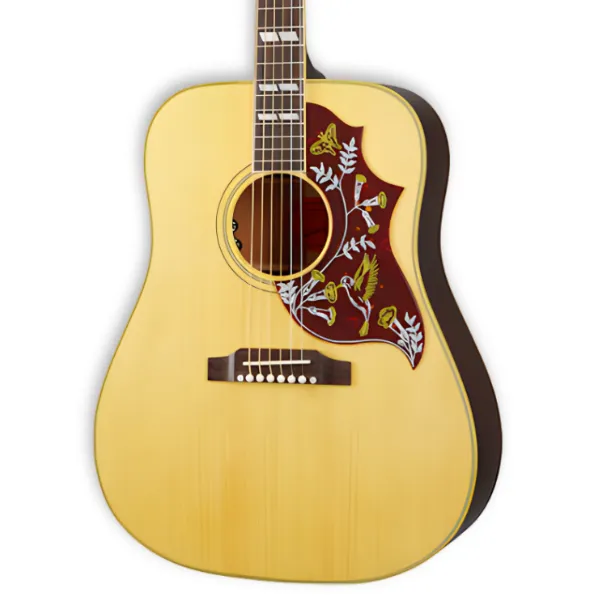
Thermally Aged Top
Balanced, Articulate Tone
Fixed Bridge
Vintage Aesthetics
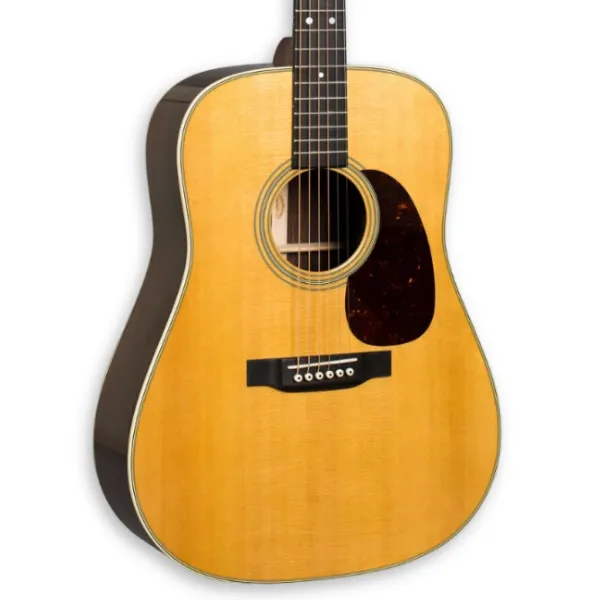
Powerful Projection
Balanced Tone
Non-Scalloped Bracing
East Indian Rosewood
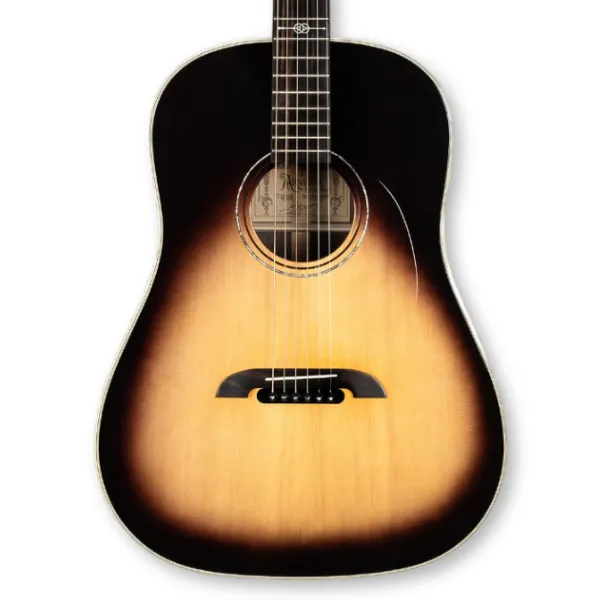
AAA Sitka Spruce Top
FST6 Bracing
Direct-Coupled Bridge
Hand-Voiced in Japan
Beyond professional acoustic guitar models, the article delves into the world of custom-built guitars and the brands that lead the way, including Bourgeois, Collings, and Santa Cruz, highlighting differences between boutique luthier shops and established brands with custom shops.
The top 10 best high-end acoustic guitars for professional musicians are ranked and listed below.
- Martin D-28
- Gibson Hummingbird 1960 (Fixed Bridge)
- Alvarez Yairi DYMR70
- Martin D18
- Collings CJ35
- Martin D-42
- Guild F-55 Natural
- Guild D-40 Traditional
- Bourgeois Touchstone Country Boy Dreadnought
- Huss & Dalton 00-SP
1. Martin D-28
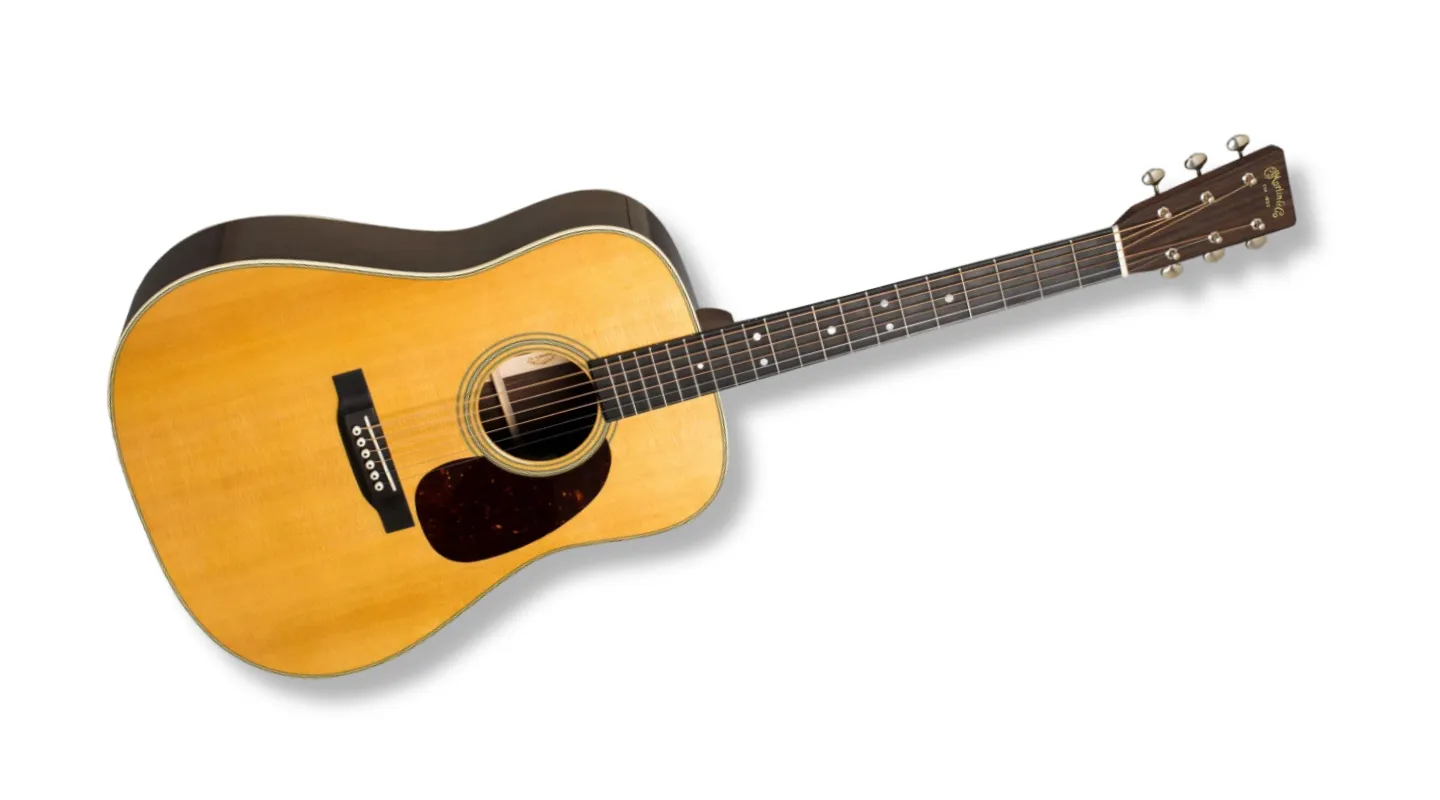
The Martin D28 is a dreadnought acoustic guitar with a solid Sitka spruce top and East Indian rosewood back and sides.
The D28 is a part of Martin’s Standard Series. The Standard Series represents Martin’s core line of guitars known for their traditional designs and high-quality craftsmanship.
The D28 transitioned from using endangered Brazilian rosewood to Indian rosewood in 1970 while retaining the traditional straight bracing found in mid-20th century Martins.
The Martin D28 has been used by many influential professional musicians, including Hank Williams, The Beatles, Johnny Cash, Neil Young, Bob Dylan, and countless others.
The price of a new D28 starts at $2799 (prices may vary). The Martin D28 is American-made, manufactured in Nazareth, Pennsylvania, USA.
Sound and Tone (5/5):
The Martin D28 has a full, balanced nice sounding tone. The highs are clear and articulate, providing wonderful definition to the ringing notes without becoming overly bright.
The rosewood back and sides contribute warm and complex midrange frequencies, giving the D28 a rich rosewood resonance.
The lows are deep and focused, thanks to the guitar’s bracing pattern.
The D28’s volume easily fills a room, producing a powerful sound that carries well. The D28’s sustain is equally impressive, allowing single notes to ring out with clarity with smooth gradual decay.
The Martin D28 earns a 5/5 rating for its sound and tone.
Playability and Comfort (4/5):
The Martin D28’s “modified low oval” neck profile features a shallower oval shape compared to a traditional low oval neck, resulting in a slimmer profile. This modification strikes a good balance between the comfortable feel of an oval neck while allowing for faster playability than traditional low oval necks.
The satin finish on the back of the neck provides a smooth feel, enabling comfortable hand movement along the neck.
The D28 has a 25.4″ (645.16 mm) scale length. This scale length provides familiar string tension that makes the D28 easy to play and fret.
The nut width of the D28 is 1.75″ (44.45 mm). This nut width provides ample space between strings and makes the D28 a good fit for fingerstyle playing and guitarists with larger hands.
The D28 weighs around 4.7 lbs (2.13 kg) and the weight is distributed evenly, contributing to a balanced feel during both seated and standing play.
The Martin D28 earns a 4/5 rating for its playability and comfort.
Versatility (4/5):
The Martin D-28 excels in genres like bluegrass and country. The D28’s powerful projection is driven by the forward-shifted X-bracing. The forward-shifted X-bracing enhances D-28’s lower frequencies and allows it to cut through a band setting. The D28’s articulate note definition also suits the fast tempos and intricate flatpicking common in the bluegrass and country genres.
The D28 excels at strumming thanks to its full-bodied tone and projection. The D28 also performs well for fingerstyle playing because its clear, articulate notes allow individual notes to ring out clearly.
The Martin D28 earns a 4/5 rating for its versatility.
Construction and Design (5/5):
The Martin D28’s weight of 4.7 lbs (2.13 kg) places it in the middle range for acoustic guitars—not as heavy as some dreadnoughts, which can exceed 5 lbs (2.27 kg), yet not as light as smaller-bodied guitars, which can be under 4 lbs (1.81 kg). However, the weight can vary across models due to variations in the density of the wood used on that specific model.
The D28’s body is 15 5/8″ (396.88 mm) wide at the lower bout and 4 3/4″ (120.65 mm) deep. The Martin D28, with a standard dreadnought body shape, features a forward-shifted, non-scalloped X-bracing pattern. This bracing system supports the guitar’s solid Sitka spruce top, enhancing projection and volume without sacrificing tonal balance.
The D-28 incorporates East Indian Rosewood for its back and sides. This specific rosewood species, originating from India, is prized for its density and hardness. These qualities make it structurally sound, able to withstand the tension of the strings, and contribute to the guitar’s durability. East Indian Rosewood’s tight grain and small pores also enhance its strength and dimensional stability, making it less susceptible to humidity and temperature changes.
The top of the D28 has an aged toner finish, giving the D28 a cool vintage design. The D28 features a multi-stripe rosette, adding beautiful visual appeal to the guitar’s design.
The Martin D28 earns a 5/5 rating for its construction and design.
Martin D28 Pros: Powerful projection, balanced tone, articulate highs, warm mids, deep lows, comfortable modified low oval neck, smooth satin neck finish, iconic and classic design, high-quality tonewoods, renowned bracing pattern, excellent craftsmanship
Martin D28 Cons: Dreadnought body size may be bulky for some players

Recommendation for Martin D28
The Martin D28 is a high-quality acoustic guitar with a powerful sound, comfortable playability, and classic good looks.
Choose the Martin D28 if you’re seeking a versatile and well-crafted instrument with a rich history.
Avoid the Martin D28 if you prefer a guitar with a more modern sound or a slimmer body style.
| Martin D-28 Specifications | |
| Guitar model | Martin D-28 |
| Body Type | Dreadnought (D-14 Fret) |
| Top Material | Sitka Spruce |
| Back and Sides Material | East Indian Rosewood |
| Bracing | Forward-Shifted X-Brace (Non-Scalloped) |
| Neck Material | Select Hardwood |
| Scale Length | 25.4″ (645.16 mm) |
| Fingerboard Material | Ebony |
| Saddle/Nut Material | Bone |
| Frets | 20 (14 frets in the clear) |
| Finish | Gloss |
| Typical price in the USA | Around $2,799 (prices may vary) |
| Where to Buy | Martin Guitar authorized dealers, Sweetwater, Guitar Center |
2. Gibson Hummingbird 1960 (Fixed Bridge)
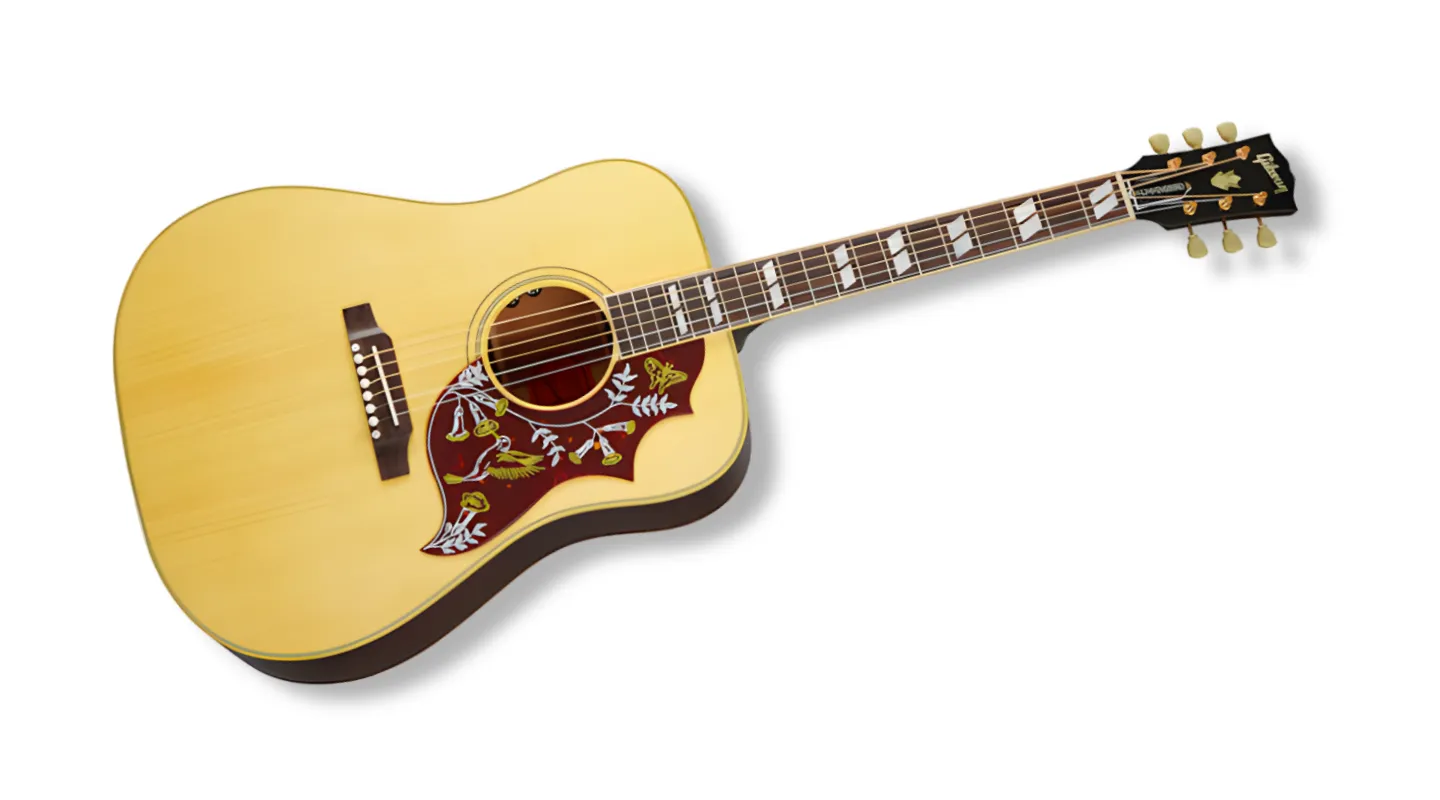
The Gibson Hummingbird 1960 Fixed Bridge is a square-shouldered dreadnought acoustic guitar with a thermally aged Sitka spruce top, mahogany back and sides, and a fixed bridge for enhanced resonance and sustain.
The Hummingbird 1960 is a faithful recreation of the original 1960 Hummingbird model, which was Gibson’s first entry into the world of square-shouldered dreadnoughts. While the original 1960 Hummingbird featured an adjustable saddle, the modern 1960 Fixed Bridge iteration incorporates a fixed bridge for a more vintage-inspired design and sound.
The Gibson Hummingbird, as a model line, has been used by numerous renowned professional musicians like Keith Richards, Jimmy Page, and Gram Parsons.
The Gibson Hummingbird 1960 (Fixed Bridge) is handcrafted in the USA in Bozeman, Montana, and costs around $5199 (prices may vary).
Sound and Tone (4/5):
The Gibson Hummingbird 1960 delivers a balanced and articulate great sounding tone, characterized by its warmth and clarity.
The highs are bright and clear due to the thermally aged Sitka spruce top. The aging process enhances the wood’s stiffness, resulting in greater clarity.
The midrange frequencies are full, giving the guitar a balanced sound. The mahogany back and sides contribute to the warmth and depth of the lows. However, the low-end is less pronounced when compared to dreadnoughts like the Martin D28 or D18.
The sustain of the guitar is quite impressive, allowing notes and chords to resonate for an extended period. The Gibson Hummingbird 1960 Fixed Bridge earns a 4/5 rating for its sound and tone.
Playability and Comfort (5/5):
The Hummingbird 1960 weighs 3 lb 14.2 oz (1.76 kg), making the Hummingbird 1960 Fixed Bridge relatively lightweight and comfortable for both short and extended playing sessions. However, the weight can vary from model to model due to the varying density of the solid wood.
The slimmer profile of the neck allows for quick transitions between chords and single notes. However, players with larger hands might find the neck too slim, which can lead to their grip feeling less secure.
The satin nitrocellulose finish feels smooth and comfortable and allows for smooth gliding along the neck.
The 24.75″ (628.65 mm) scale length contributes to comfortable string tension. This shorter scale length requires slightly less force to fret the strings.
The nut width of the Gibson Hummingbird 1960 Fixed Bridge is 1.73″ (43.94 mm), which is slightly on the wider side than a typical nut width between 1 11/16 inches (42.86 mm) to 1.75 inches (44.5 mm). The wider nut width provides ample space between the strings, benefiting fingerstyle players or those with larger fingers.
The Gibson Hummingbird 1960 Fixed Bridge earns a 5/5 rating for its playability and comfort.
Versatility (4/5):
The Gibson Hummingbird 1960 excels in genres like folk and Americana, thanks to the Gibson Hummingbird 1960’s balanced tone and comfortable playability for both strumming and fingerpicking.
The Hummingbird’s responsiveness to dynamics allows the guitar to transition from delicate passages to powerful strumming. While the Hummingbird can handle lighter styles of rock, it may not be the most suitable for heavier genres. This is due to the guitar’s balanced tonal response which does not cut through a dense mix as effectively as guitars with a more pronounced midrange.
The Hummingbird’s tone and comfortable playability make it handy for flatpicking, which relies on the guitar’s clear and articulate tone to deliver precise note definition. The Hummingbird 1960 is also great for bluegrass crosspicking, which benefits from the Hummingbird’s ability to project individual notes within complex passages.
The Gibson Hummingbird 1960 earns a 4/5 rating for its versatility.
Construction and Design (5/5):
The top of the Gibson Hummingbird 1960 is crafted from thermally aged Sitka spruce. The thermal aging process alters the wood’s cellular structure, reducing its moisture content and increasing its stiffness. This results in a top that vibrates more freely and produces a mature and resonant tone, which is often associated with vintage instruments. The back and sides of the Hummingbird 1960 feature mahogany, a durable hardwood prized for its stability and workability.
The bracing pattern of the Gibson Hummingbird 1960 Fixed Bridge features traditional hand-scalloped X-bracing. Hand-scalloped braces, strategically shaved for optimal flexibility, contribute to the guitar’s resonance and tonal responsiveness by allowing the top to vibrate more freely.
The Gibson 1960 Hummingbird has a thin nitrocellulose lacquer finish. Nitrocellulose lacquer allows the guitar to age and breathe while enhancing the natural resonance of the wood.
The guitar’s awesome design is enhanced by the beautiful Heritage Cherry Sunburst finish, which showcases the wood’s grain patterns. The mother-of-pearl parallelogram inlays on the rosewood fretboard give the Hummingbird a unique vintage feel.
The Gibson Hummingbird 1960 earns a 5/5 rating for its construction and design.
Gibson Hummingbird 1960 Pros: Balanced tone, clear highs, impressive sustain, lightweight, high-quality craftsmanship, thermally aged top, vintage aesthetics.
Gibson Hummingbird 1960 Cons: Less pronounced low-end, slim neck might not suit players with larger hands, versatility limited for heavier genres.
Recommendation for Gibson Hummingbird 1960
The Gibson Hummingbird 1960 Fixed Bridge is a well-crafted guitar with a balanced tone and a comfortable playing experience.
Choose the Gibson Hummingbird 1960 if you value a classic design with vintage-inspired aesthetics and need a guitar that can deliver both powerful strumming and delicate fingerstyle playing.
Avoid the Gibson Hummingbird 1960 if you prefer a guitar with a more pronounced low-end for genres like blues.
| Gibson 1960 Hummingbird Fixed Bridge Specifications | |
| Guitar model | Gibson 1960 Hummingbird Fixed Bridge |
| Body Type | Dreadnought |
| Top Material | Thermally Aged Sitka Spruce |
| Back and Sides Material | Mahogany |
| Bracing | Traditional Hand Scalloped X-bracing |
| Neck Material | Mahogany |
| Scale Length | 24.75″ (628.65 mm) |
| Fingerboard Material | Rosewood |
| Saddle/Nut Material | Bone |
| Frets | 20 |
| Finish | Heritage Cherry Sunburst |
| Typical price in the USA | Around $5199 (prices may vary) |
| Where to Buy | Gibson authorized dealers, Guitar Center, Sweetwater |
3. Alvarez Yairi DYMR70
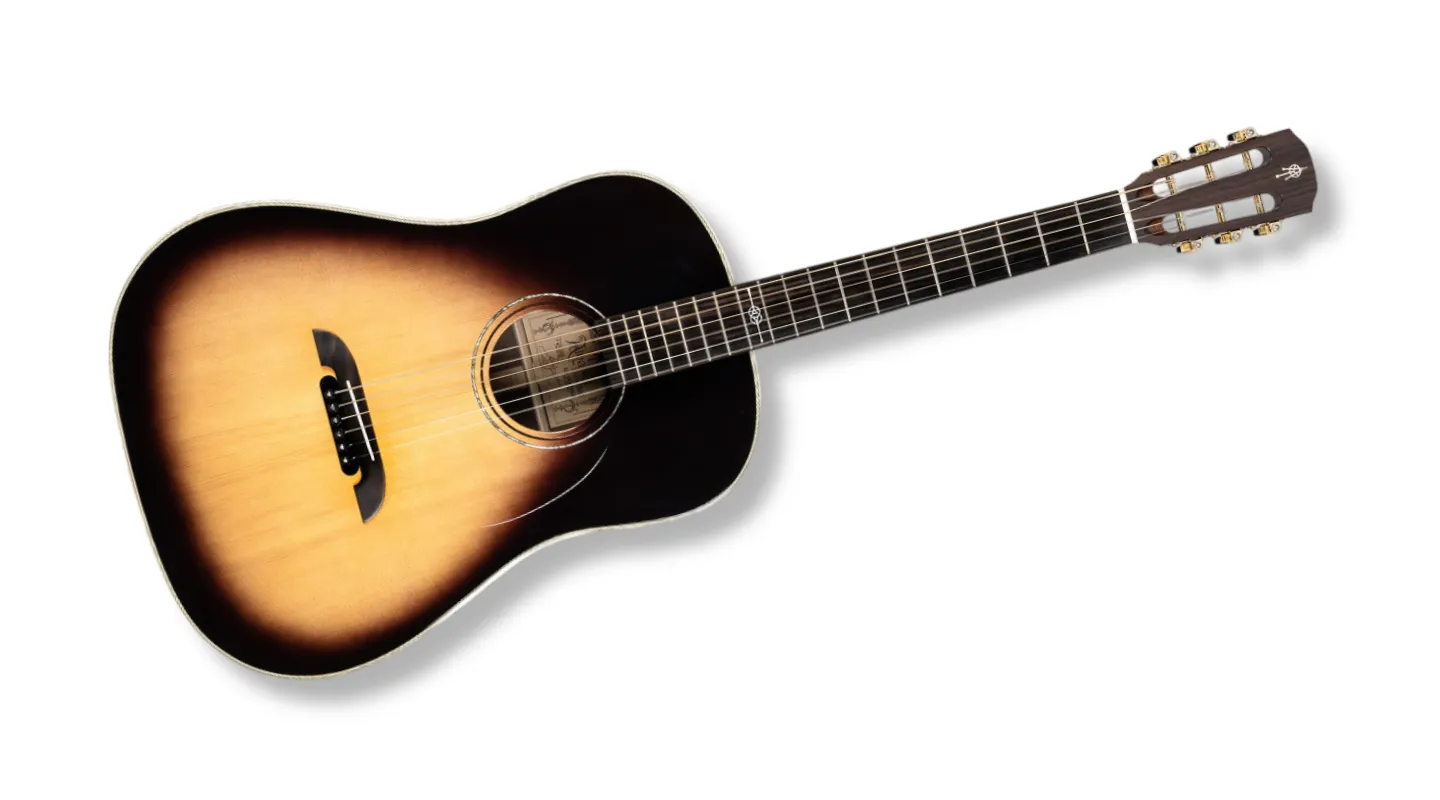
The Alvarez Yairi DYMR70 is a 12-fret slope-shouldered dreadnought acoustic guitar, handcrafted in Kani, Japan.
The Yairi DYMR70 features a solid AAA Sitka Spruce top, solid East Indian Rosewood back and sides, hand-carved FST6 bracing pattern, and an ebony direct-coupled bridge.
The Alvarez Yairi DYMR70 is part of the Yairi Masterworks Series, known for its Japanese high-quality handcrafted acoustic guitars that use premium materials and meticulous construction techniques.
The Alvarez Yairi DYMR70 typically retails between $2,500 and $3,000 (prices may vary).
Sound and Tone (5/5):
The Alvarez Yairi DYMR70 delivers a balanced tone with notable clarity. The highs are both bright and clear, thanks to the AAA Sitka Spruce top. This brightness makes the Yairi DYMR70 sound lively, and the clarity ensures that each note rings true, even in complex chords.
The midrange possesses a full and well-defined quality. The East Indian Rosewood back and sides contribute a balanced midrange, providing the Alvarez Yairi DYMR70 with a strong fundamental character.
The lows are warm and deep, adding richness and complexity to the guitar’s overall sound. This warmth comes from the natural resonance of the rosewood.
The Alvarez Yairi DYMR70 earns a 5/5 rating for its sound and tone.
Playability and Comfort (4/5):
The Alvarez Yairi DYMR70 weighs around 4.4 lbs (2 kg) (weight can vary between models). This is lightweight for a rosewood dreadnought and makes the Alvarez Yairi DYMR70 comfortable to hold and play for extended periods.
The neck profile transitions from a soft V-shape to a C-shape, offering a comfortable grip for both players with smaller hands who prefer a slimmer neck and those with larger hands seeking a fuller feel.
The semi-gloss finish on the neck balances between a slick feel for effortless slides and a bit of grip to prevent accidental slippage during quick movements.
The 25.5″ (648 mm) scale length is around the standard scale length with a familiar string tension. The 1.718″ (44 mm) nut width, provides ample space between the strings, making it comfortable for fingerstyle playing and accommodating players with larger fingers.
The Alvarez Yairi DYMR70 earns a 4/5 rating for its playability and comfort.
Versatility (4/5):
The Alvarez Yairi DYMR70 is a great fit for playing folk music. The balanced tone and clear, articulate notes, especially in the midrange, suit folk music’s emphasis on vocal accompaniment and intricate fingerpicking patterns. On the other hand, the Alvarez Yairi DYMR70 is not the best fit for more aggressive genres like rock. The bright and articulate “Yairi tone,” while pleasing in many contexts, could become overly prominent and less desirable in a dense rock mix.
Beyond genre, the Alvarez Yairi DYMR70 lends itself well to drop-tuning techniques. The 25.5″ (648 mm) scale length provides adequate string tension even when tuned down. The solid East Indian Rosewood back and sides contribute to a focused low-end that remains clear and articulate, preventing muddiness that can occur with lower tunings.
The Alvarez Yairi DYMR70 earns a 4/5 rating for its versatility.
Construction and Design (5/5):
The Alvarez Yairi DYMR70’s round-shouldered dreadnought body measures 15.75″ (400 mm) wide at the lower bout, 3.94″ (100 mm) deep at the heel, and 4.92″ (125 mm) deep at the base.
The top is crafted from solid AAA Sitka Spruce. The AAA rating represents the highest grade of Sitka Spruce, surpassing AA and A grades. The AAA grade indicates that the wood has exceptional qualities, including tight, even grain patterns and minimal imperfections. This results in enhanced resonance and tonal clarity.
The DYMR70 features a hand-carved FST6 (Forward Shifted, Asymmetric Tone Bars) bracing pattern. This unique bracing system, with its forward-shifted position and asymmetrical tone bars, allows for greater flexibility in the lower bout of the top, enhancing bass response without sacrificing clarity.
The DYMR70 features a handmade ebony direct-coupled bridge. The bridge pins are inserted into a separate section of the bridge, resulting in a steeper break angle over the saddle. This design choice enhances energy transfer from the strings to the soundboard, contributing to the guitar’s volume, sustain, and responsiveness.
The Alvarez Yairi DYMR70 earns a 5/5 rating for its construction and design.
Alvarez Yairi DYMR70 Pros: Exceptional tone clarity, bright and articulate sound, comfortable neck profile, lightweight, high-quality materials like the AAA Sitka Spruce and East Indian Rosewood, hand-carved bracing and handmade ebony direct-coupled bridge, high quality craftsmanship.
Alvarez Yairi DYMR70 Cons: Bright sound may not suit players seeking a traditional dreadnought tone.
Recommendation for Alvarez Yairi DYMR70
The Alvarez Yairi DYMR70 is a high-quality acoustic guitar that impresses with its craftsmanship, tone, and playability.
Choose the Alvarez Yairi DYMR70 if you are searching for a well-crafted, versatile instrument that caters to both fingerstyle and flatpicking approaches.
Avoid the Alvarez Yairi DYMR70 if you prefer a guitar with a more traditional dreadnought tonal character, as the DYMR70 leans towards a brighter and more articulate sound.
| Alvarez Yairi DYMR70 Specifications | |
| Body Type | Dreadnought |
| Top Material | Solid AAA Sitka Spruce |
| Back and Sides Material | Solid East Indian Rosewood |
| Bracing | Hand Carved FST6 |
| Neck Material | One piece mahogany |
| Scale Length | 25 1/2 inches (648 mm) |
| Fingerboard Material | Ebony |
| Saddle/Nut Material | Bone |
| Frets | 20 |
| Finish | Sunburst/Gloss |
| Typical price in the USA | Around $2500-$3000 (prices may vary) |
| Where to Buy | Alvarez Authorized Dealers, Sweetwater, Guitar Center |
4. Martin D18
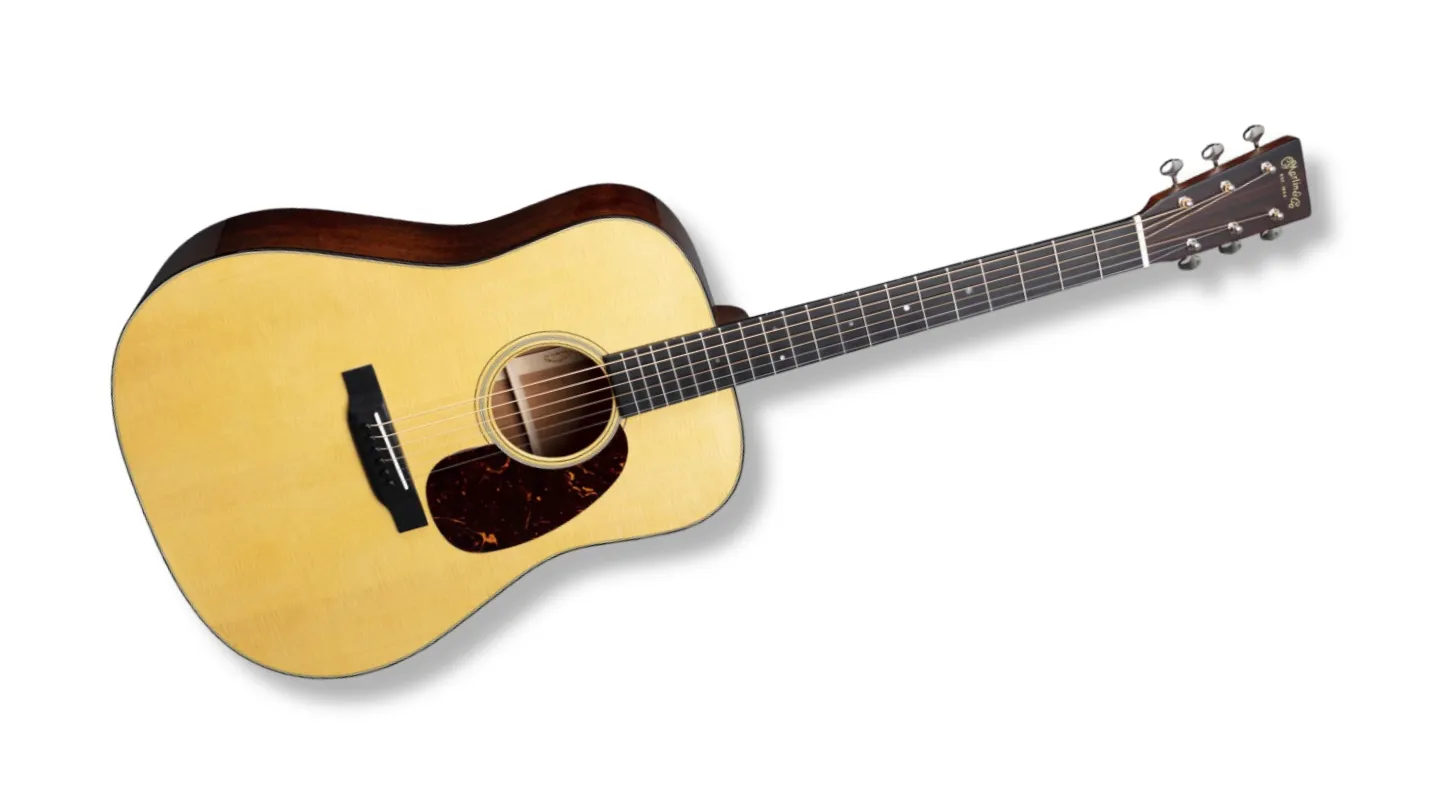
The Martin D18 is a dreadnought acoustic guitar with a solid Sitka spruce top, solid mahogany back and sides, and a scalloped forward-shifted X bracing.
Modern D18s feature ebony for their fretboards and bridges, similar to pre-war D18s from the 1940s. However, D18 models manufactured between 1947 and 2011 used rosewood for their fingerboards and bridges because of cost-cutting measures that Martin implemented after the 2nd World War.
The Martin D18 has been a popular acoustic for decades, played by famous musicians like Elvis Presley, Clarence White, and Paul Simon. The Martin D18 is priced around $2799 (prices may vary) and is made in the USA in Nazareth, Pennsylvania.
Sound and Tone (5/5):
The Martin D18 produces a full and resonant acoustic sound. The D18’s highs are clear and articulate, without being overly bright. The solid spruce top contributes to this clarity in the high-end frequencies.
The Martin D18’s midrange is full and well-balanced, where the mahogany back and sides add warmth and depth to the midrange frequencies.
The D18’s lows are warm and well-defined, providing a solid foundation for the overall tone. The combination of a large body and forward-shifted X-bracing results in a strong low-end response.
The Martin D18 earns a 5/5 rating for its sound and tone.
Playability and Comfort (4/5):
The D18 is lightweight and balanced, weighing 4.1 lbs (1.86 kg). However, the weight can vary from model to model because of the varying density of the solid wood.
The D18’s dreadnought body size delivers a substantial sound but can feel bulky for players with smaller frames, particularly during extended playing sessions.
The modified low oval neck profile fills the hand enough to provide a secure grip for players with larger hands. The D18’s satin neck finish provides a smooth and fast playing experience.
With a 25.4″ (645.16 mm) scale length, the D18 requires a familiar string tension and a comfortable amount of finger stretch for fretting.
The 1 3/4″ (44.45 mm) nut width is on the wider side, providing adequate spacing between strings, even for players who prefer fingerstyle. Standard nut widths typically range from 1.6875″ (42.86 mm) to 1.75″ (44.5 mm).
The Martin D18 earns a 4/5 rating for its playability and comfort.
Versatility (5/5):
The Martin D18 is a versatile acoustic guitar suitable for a variety of genres, including bluegrass, country, folk, and rock. The D18 is particularly great for bluegrass because the D18’s balanced tone and strong projection work really well in bluegrass flatpicking.
The D18 also excels at fingerstyle playing due to its responsive touch and clear note separation. The D18 handles strumming well, producing a full and balanced sound. The D18 responds well to dynamics, allowing players to achieve both delicate and powerful sounds when strumming.
The Martin D18 earns a 5/5 rating for its versatility.
Construction and Design (5/5):
The Martin D18 measures 15.6″ (396.24 mm) in width, 20″ (508 mm) in length, and 4.8″ (121.92 mm) in depth.
The Martin D18 features a solid Sitka spruce top, prized for its lightweight yet stiff nature, fine grain, and efficient vibration transmission. Its back and sides are crafted from solid mahogany, a moderately dense hardwood known for stability, workability, and resilience to humidity and temperature changes.
The D18 utilizes a forward-shifted X-bracing pattern. Scalloped braces, resembling suspension bridges, are strategically placed to enhance the top’s flexibility and resonance without compromising structural integrity.
The D18 features a polished gloss finish, achieved through the application and buffing of multiple layers of nitrocellulose lacquer. This process results in a finish that enhances the wood’s visual appeal while allowing it to resonate more freely compared to thicker polyurethane finishes. Over time, exposure to air and light causes the nitrocellulose to cure and harden, further enhancing vibration transmission and often resulting in a more desirable, “played-in” tone.
The D18 features an understated aesthetic, with simple appointments that highlight the beauty of the wood. The Martin D18 earns a 5/5 rating for its construction and design.
Martin D18 Pros: Balanced and resonant tone, clear and articulate highs, full and well-defined lows, comfortable neck profile, smooth satin finish on the neck, versatile across multiple genres, high-quality build with solid tonewoods.
Martin D18 Cons: Dreadnought body size may be bulky for some players, some players may prefer a glossier neck finish.
Recommendation for Martin D18
The Martin D18 is an exceptional acoustic guitar prized for its iconic sound, excellent craftsmanship, and versatility.
Choose the Martin D18 if you seek a versatile instrument with a classic sound and exceptional craftsmanship.
Avoid the Martin D18 if you prefer a guitar with a more modern design.
| Martin D-18 Specifications | |
| Guitar model | D-18 |
| Body Type | Dreadnought (D-14 Fret) |
| Top Material | Spruce |
| Back and Sides Material | Genuine Mahogany |
| Bracing | Forward-Shifted X-Brace, Scalloped |
| Neck Material | Select Hardwood |
| Scale Length | 25.4″ (645.16 mm) |
| Fingerboard Material | Ebony |
| Saddle/Nut Material | Bone |
| Frets | 20 Total |
| Finish | Gloss |
| Typical price in the USA | Around $2,799 (prices may vary) |
| Where to Buy | Available at Martin Guitar dealers and online at MartinGuitar.com |
5. Collings CJ35
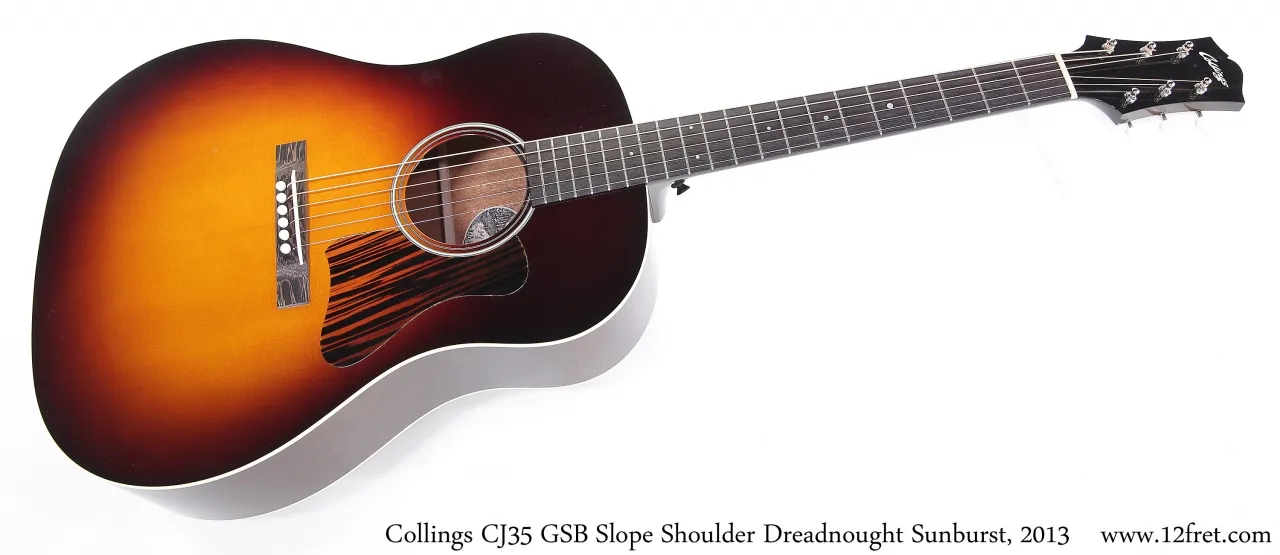
The Collings CJ35 is a slope-shoulder jumbo acoustic guitar crafted with a Sitka spruce top, Honduran mahogany back sides, and non-scalloped X-bracing with 3 tone bars.
The CJ35 belongs to the Collings Traditional Series. The Collings Traditional Series draws inspiration from the iconic designs and craftsmanship of pre-war acoustic guitars, prioritizing classic aesthetics and tonal characteristics.
The CJ35 represents a departure from the standard Collings CJ, incorporating a slope-shouldered body and a unique bracing pattern for a distinct tonal character.
The Collings CJ35 is American made, handcrafted in Austin, Texas. The price of the CJ35 starts at around $5,150 (prices may vary).
Sound and Tone (5/5)
The Collings CJ35 has a balanced tonal spectrum with a focus on the midrange. The highs are both bright and clear, producing a lively and articulate sound without being overly harsh.
The mahogany back and sides contribute to the CJ35’s warm and full midrange, giving the CJ35 a strong presence and a “woody” character. This warmth extends to the lows, which are deep and resonant without becoming boomy or undefined.
The non-scalloped bracing pattern contributes to the CJ35’s focused dynamic range, allowing for even note projection and a responsive feel.
The Collings CJ35 earns a 5/5 rating for its sound and tone.
Playability and Comfort (4/5)
The CJ35, weighing approximately 4-5 lbs (1.81 – 2.27 kg), is lightweight for a jumbo-sized guitar making the CJ35 comfortable to hold and play for extended periods.
The CJ35’s “Vintage Now” rounded neck profile contour and moderate depth provide a balanced feel. The neck is 1.802″ (45.77 mm) wide and 0.861″ (21.87 mm) deep at the 1st fret and 2.125″ (53.98 mm) wide and 0.979″ (24.87 mm) deep at the 9th fret. The neck’s slimmer profile at the first fret is especially accommodating for players with smaller hands, making it easier and more comfortable to fret the chords.
The high-gloss polyester resin finish on the neck feels a tad sticky, especially during long playing sessions or fast arpeggios.
The 24 7/8″ (631.75 mm) scale length makes for lower string tension compared to a standard 25.5″ (647.7 mm) scale, easing fretting and bending.
The 1 3/4″ (44.45 mm) nut width offers ample spacing between strings, making the CJ35 comfortable for fingerstyle playing and accommodating players with larger fingers.
The Collings CJ35 earns a 4/5 rating for its playability and comfort.
Versatility (4/5)
The CJ35 excels in genres like Americana and roots music, where its warm tone, strong midrange, and focused projection shine. These genres often highlight the natural voice of the acoustic guitar, emphasizing vocal accompaniment and a balanced, full-bodied sound that the CJ35 delivers effortlessly.
The CJ35’s responsiveness to playing dynamics makes the CJ35 equally adept at handling delicate fingerstyle passages and strummed chords with power and clarity. The shorter scale length and comfortable neck make the CJ35 particularly well-suited for fingerstyle playing, allowing for effortless string bending and intricate fretwork.
The Collings CJ35 earns a 4/5 rating for its versatility.
Construction and Design (5/5)
While the Collings CJ35’s 20 1/8″ (511.15 mm) body length and 16″ (406.4 mm) lower bout width align with typical jumbo acoustic guitar dimensions, its 4 7/8″ (123.81 mm) body depth is slightly shallower than some jumbo models. The shallower depth offers a slightly more comfortable playing experience without sacrificing projection.
The CJ35 utilizes Sitka spruce for its top, a wood prized for its strength-to-weight ratio and resilience. The back and sides are crafted from Honduran mahogany. Honduran mahogany is a dense and stable tonewood known for its moderate weight, relatively open pores, and good resistance to humidity and temperature changes. Honduran mahogany’s good rot resilience and hardness contribute to the longevity and structural integrity of the guitar.
The CJ35 features a non-scalloped X-brace design with 3 tone bars deviating from the standard CJ model’s bracing with 2 tone bars. The 3rd tone bar in the CJ35’s bracing design acts like an extra reinforcement beam, subtly shaping the way the guitar’s top moves and vibrates to produce sound.
The CJ35 features a nitrocellulose lacquer finish, a thin coating ranging from .005″ (.13 mm) to .007″ (.18 mm) thick. This thin finish enhances the guitar’s resonance by allowing the wood to vibrate more freely. However, the thin finish provides less protection against scratches and dings compared to thicker finishes.
The Collings CJ35 earns a 5/5 rating for its construction and design.
Collings CJ35 Pros:
Warm and balanced tone, deep and resonant lows, comfortable short-scale length, high-quality craftsmanship, premium tonewoods, comfortable neck profile.
Collings CJ35 Cons:
Large body size may be cumbersome for some players, neck profile may feel too slim for some players.
Recommendation for Collings CJ35
The Collings CJ35 is a premium acoustic guitar that delivers exceptional tone, playability, and craftsmanship.
Choose the Collings CJ35 if you’re looking for a versatile instrument with a warm, vintage-inspired sound and prioritize a comfortable playing experience.
Avoid the Collings CJ35 if you prefer a guitar with a modern, bright tone or require a guitar with a slimmer body and a more substantial neck profile.
| Collings CJ-35 Specifications | |
| Body Type | Slope Shoulder Jumbo |
| Top Material | Sitka spruce |
| Back and Sides Material | Honduran mahogany |
| Bracing | Non-scalloped X-brace (3 tone bars) |
| Neck Material | Honduran mahogany |
| Scale Length | 24 7/8″ (631.75 mm) |
| Fingerboard Material | Wenge with MOP long dots |
| Saddle/Nut Material | Bone |
| Frets | 20 (neck joining the body at the 14th fret) |
| Finish | High gloss nitrocellulose lacquer |
| Typical price in the USA | Starting at $5150 (prices may vary) |
| Where to Buy | Collings Guitars dealers |
6. Martin D-42
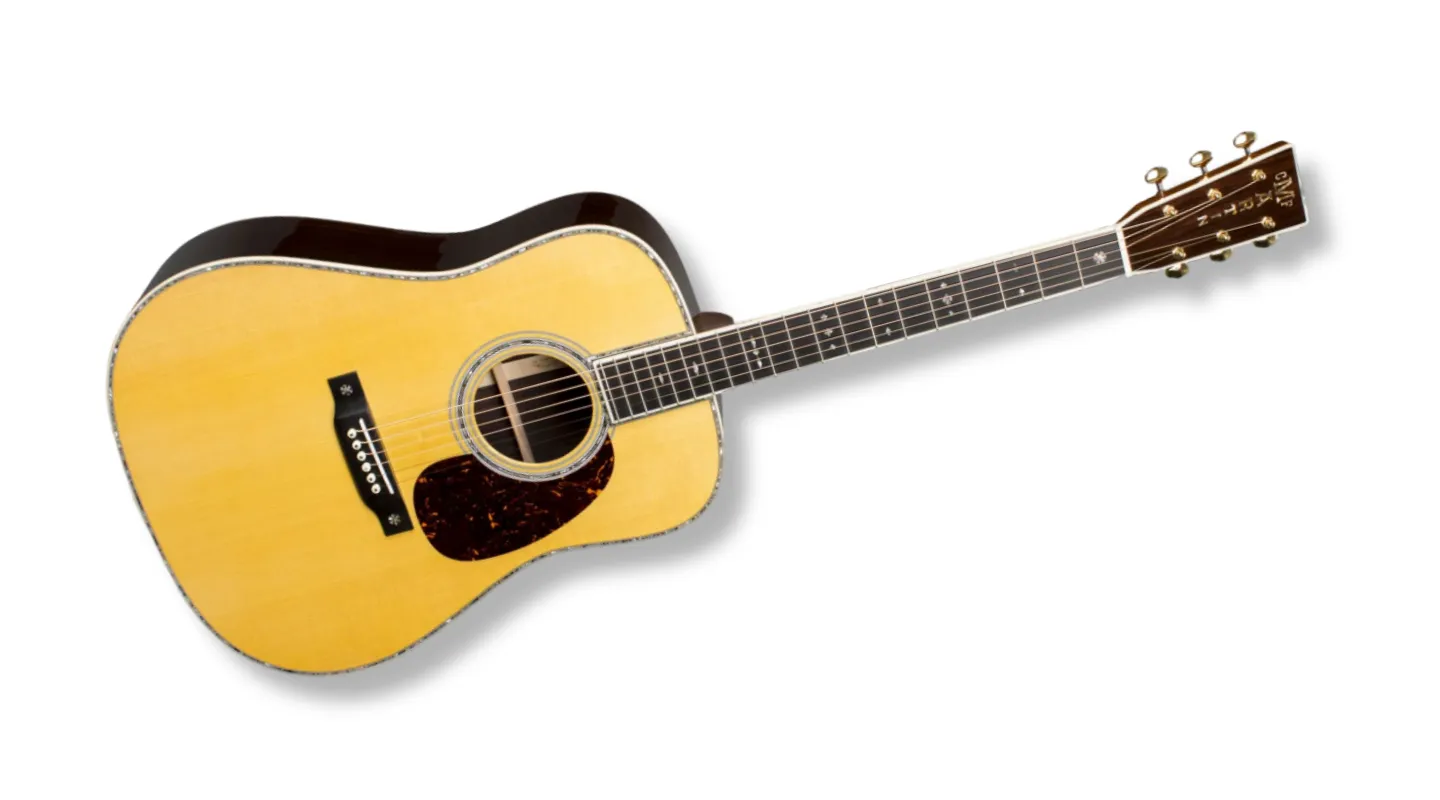
The Martin D42 is a dreadnought acoustic guitar with a solid Sitka spruce top, East Indian rosewood back and sides, and a forward-shifted, scalloped X-bracing pattern.
The Martin D42 is a part of the Martin’s Standard Series. The Standard Series represents Martin’s core lineup of guitars that are known for their exceptional quality and craftsmanship.
The D42’s design has remained consistent over the years, reflecting Martin’s dedication to acoustic guitar designs that withstand the test of time and continue to be sought after by musicians worldwide.
The D42 is made in Nazareth, Pennsylvania, USA, and costs approximately $6399 (prices may vary).
Sound and Tone (5/5):
The Martin D42 has a full, balanced, and articulate tone.
The highs on the Martin D42 are clear and bright. The highs give individual notes a sharp, defined quality without sounding harsh. The top contributes to D42’s lively and present treble range and bright highs because the solid Sitka spruce tonewood vibrates efficiently at higher frequencies.
The midrange is full and well-defined. The midrange provides the Martin D42 with a strong fundamental character and warmth. This warmth in the midrange comes from the East Indian rosewood back and sides that emphasize the midrange frequencies, contributing to the D42’s balanced and articulate tone.
The lows are deep and resonant, adding warmth and depth to the overall sound. The forward-shifted scalloped X-bracing pattern contributes to the D42’s deep lows. This is partly due to the scalloped bracing pattern, which allows the guitar’s top to vibrate more freely, resulting in a more pronounced bass response. This bracing pattern, combined with the natural low-end resonance of the rosewood back and sides, creates a powerful and well-defined low-end.
The Martin D42 earns a 5/5 rating for its sound and tone.
Playability and Comfort (4/5):
The D-42 weighs 4.6 lbs (2.09 kg), which is lightweight for a dreadnought and makes the D42 comfortable to hold and play for extended periods. However, the specific weight may vary from model to model due to the varying density of the solid wood used to construct the body.
The D42’s Modified Low Oval neck profile, with its High-Performance Taper, comfortably fills the hand while providing a secure grip, even for players with larger hands. The neck has a smooth gloss finish, which enhances grip security and allows for controlled hand movements along the neck. Although, the gloss finish can feel a bit sticky, especially in humid conditions.
The D-42 has a 25.4″ (645.16 mm) scale length, a standard scale length for steel-string acoustics, making for familiar string tension and fret spacing for experienced players.
With a nut width of 1.75″ (44.45 mm), the D-42 provides ample space between strings, a feature appreciated by fingerstyle players as it allows for precise picking and reduced chances of accidentally muting adjacent strings. However, players with smaller hands might find the 1.75″ (44.45 mm) nut width a bit wide for comfortable fretting.
Versatility (4/5):
The Martin D42 excels in genres like bluegrass and Americana because of the D 42’s powerful projection, balanced tone, and articulate note definition. The wide dynamic range makes the Martin D42 particularly well-suited to the dynamic shifts of bluegrass music.
The D42 is not the best choice for players seeking a more delicate and nuanced sound often favored in genres like jazz or classical, where guitars with a tighter, more focused tonal range are more commonly used.
The D42’s traditional design and tonal characteristics make it particularly well-suited for rhythm playing, providing a solid harmonic and rhythmic foundation. The D42, while capable of fingerstyle playing, is not ideal for fingerstyle techniques that demand a high degree of note separation and clarity, especially in the lower register, due to its tonal characteristics that emphasize a strong bass response and a full midrange.
The Martin D42 earns a 4/5 rating for its versatility.
Construction and Design (5/5):
The Martin D42 is built with a deep understanding of traditional guitar construction techniques.
The D42 features a forward-shifted, 5/16″ scalloped X-bracing pattern. This bracing system, where the braces are carefully carved and shaped to reduce their mass while maintaining structural integrity, is glued to the underside of the top, creating a resonant structure that allows the top to vibrate more freely. This increases the guitar’s volume and projection while contributing to its rich tonal complexity.
The top is crafted from solid Sitka spruce, a lightweight and stiff wood that is highly resonant and responsive to vibrations.
East Indian rosewood, a dense and durable hardwood favored for its stability and resistance to humidity and temperature changes, is used for the back and sides. Originating from India and Southeast Asia, East Indian rosewood is characterized by its closed pores and tightly packed grain lines, contributing to its resonant properties and rich visual appeal.
The D42’s body finish is a smooth, high-gloss nitrocellulose lacquer. This finish, applied in thin layers to allow the wood to resonate freely, enhances the guitar’s natural beauty while providing protection.
The Martin D42 is decorated with Style 45 snowflake inlays made from abalone. These inlays, meticulously inlaid into the ebony fretboard and headstock, demonstrate Martin’s attention to detail and craftsmanship.
The Martin D42 earns a 5/5 rating for its construction and design.
Martin D42 Pros:
Full and balanced tone, clear and bright highs, warm and defined midrange, deep and resonant lows, comfortable neck profile, generally lightweight, excellent projection, suitable for bluegrass and Americana, premium tonewoods, meticulous craftsmanship, abalone inlays.
Martin D42 Cons:
Large body size may not suit smaller players, not the best choice for genres like jazz or classical, and strong bass response could muddy intricate fingerstyle playing.
Recommendation for Martin D42
The Martin D42 is a premium acoustic guitar that delivers exceptional tone, playability, and craftsmanship.
Choose the Martin D42 if you value a powerful and articulate sound suitable for both rhythm and lead playing in genres like bluegrass and Americana.
Avoid the Martin D 42 if you prefer a guitar with a more delicate sound, suitable for genres like jazz or classical, or require an instrument specifically voiced for intricate fingerstyle playing.
| Martin D-42 Specifications | |
| Body Type | Dreadnought |
| Top Material | Sitka Spruce |
| Back and Sides Material | East Indian Rosewood |
| Bracing | Forward-Shifted X-Brace |
| Neck Material | Genuine Mahogany |
| Scale Length | 25.4″ (645.16 mm) |
| Fingerboard Material | Ebony |
| Saddle/Nut Material | Bone |
| Frets | 20 total (14 frets in the clear) |
| Finish | Gloss |
| Typical price in the USA | Around $6,399 (prices may vary) |
| Where to Buy | Authorized Martin Guitar dealers |
7. Guild F-55 Natural
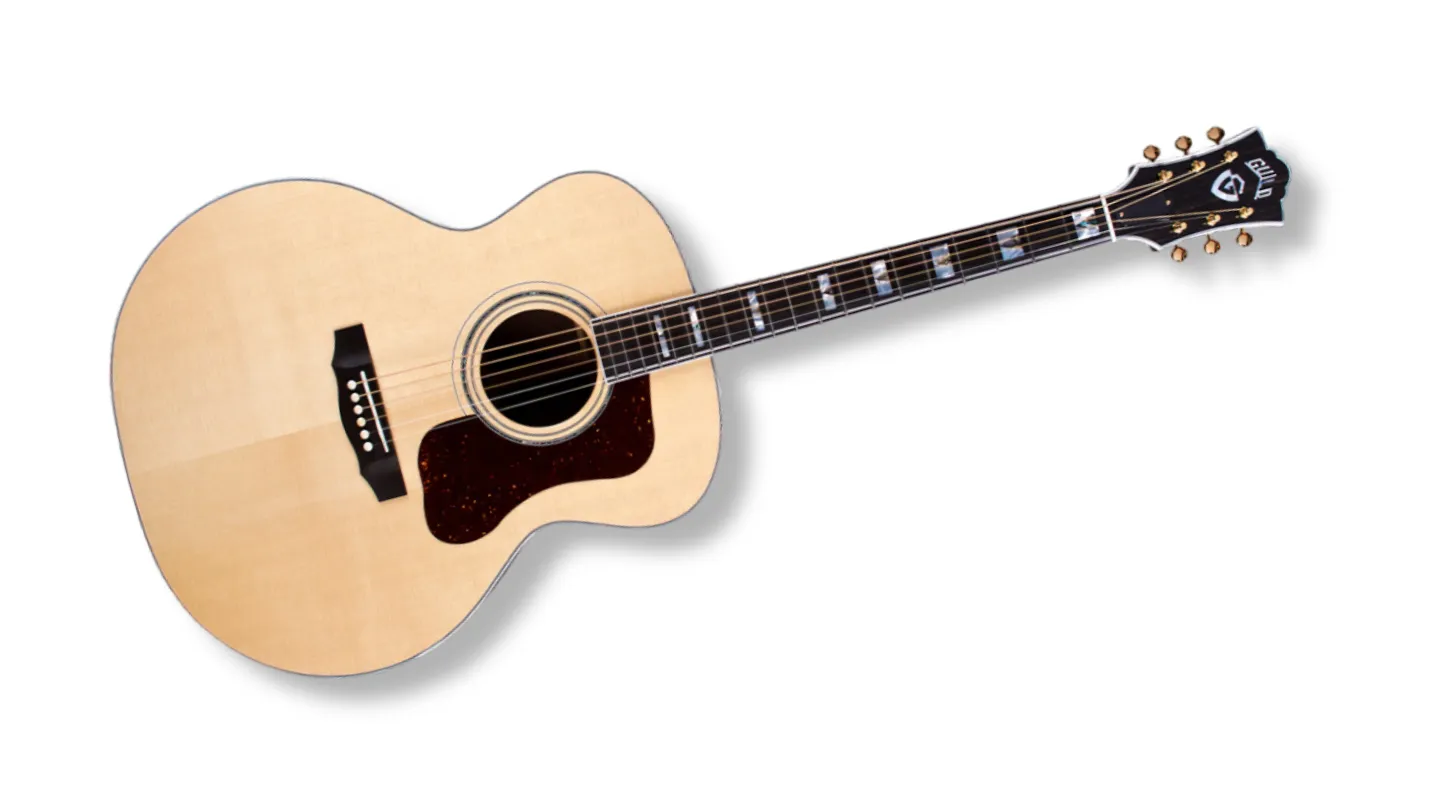
The Guild F-55 is a jumbo acoustic guitar crafted with a solid Sitka spruce top and solid Indian rosewood back and sides.
The F-55 is part of Guild’s USA series, a line of acoustic guitars handcrafted in the United States that represent the pinnacle of Guild’s craftsmanship and heritage. These guitars are known for their exceptional build quality, premium materials, and dedication to traditional guitar-making techniques.
The F-55 replaces the previous F-50R model, with notable differences including a smaller pickguard on the F-55. Additionally, the F-55 features an abalone rosette and an ebony bridge, that are not found on the F-50R.
The Guild F-55 is made in the USA. The current price for the Guild F-55 is around $3899 (prices may vary).
Sound and Tone (4/5):
The Guild F-55 produces a powerful and resonant sound. The main characteristic of the F55’s sound is its great aesthetic tightness in the bass and treble.
The highs are crisp and clear. The solid Sitka spruce top contributes to the articulate nature of the trebles.
The midrange is well-balanced and warm. The midrange contributes to the guitar’s overall warmth and harmonic richness.
The lows are deep and focused. The lows have a “tighter” bass response that avoids excessive boominess. This focused low-end allows for clear note definition even when playing low notes or complex chords.
The Guild F-55 earns a 4/5 rating for its sound and tone.
Playability and Comfort (4/5):
The jumbo body shape can feel unwieldy for players with smaller frames, especially when seated. The Guild F55 weighs 4 lbs 10 oz (2.12 kg). While not overly heavy, F-55’s weight distribution feels slightly neck-heavy.
The F-55’s neck profile transitions from a rounded “C” at the lower frets to a flatter “D” towards the body, offering comfortable chording and increased support for lead playing as you move up the neck.
The 1 11/16″ (43 mm) nut width might feel slightly cramped for players accustomed to wider nut widths, potentially posing challenges for fingerstyle playing or those with larger hands.
The 25 5/8″ (651 mm) scale length creates a balanced string tension. The string tension is not uncomfortable however it is noticeable when switching between F55 and acoustic with shorter scale length like Martin D28 or Collings CJ35.
The Guild F-55 earns a 4/5 rating for its playability and comfort.
Versatility (3/5):
The Guild F-55 is well-suited for genres like country and folk. The Guild F-55’s powerful sound and focused tonal response, particularly in the lower frequencies, make it a great fit for these genres.
However, the Guild F-55 is not an ideal choice for fingerstyle blues. Fingerstyle blues often utilizes many open tunings and slide playing. The Guild F-55’s tighter bass response does not provide the optimal level of resonance and sustain for these techniques.
On the other hand, the Guild F-55’s clear note separation makes it easy to hear each note in a fast run, when it comes to flatpicking.
The Guild F-55 earns a 3/5 rating for its versatility.
Construction and Design (5/5):
The Guild F-55 measures 42 1/2″ (1,080 mm) in overall length, with body dimensions including an upper bout width of 12 1/2″ (318 mm), a lower bout width of 17 1/4″ (438 mm), a body depth of 3 3/4″ (95 mm) at the upper bout and 4 3/4″ (119 mm) at the lower bout, and a body length of 20 1/2″ (521 mm).
The nitrocellulose finish on the F-55 requires careful maintenance and it is more prone to scratches and dings when compared to thicker polyurethane finishes. However, the nitrocellulose finish allows the wood to breathe and age naturally, enhancing the guitar’s resonance over time.
The Guild F-55 wouldn’t be complete without Guild’s classic “V-block” inlays. The ebony fretboard features mother-of-pearl and abalone inlays, that add a touch of elegance that elevates the F-55’s overall aesthetic.
The Guild F-55 earns a 5/5 rating for its construction and design.
Guild F-55 Pros: Powerful and balanced sound, clear and articulate highs, warm midrange, focused bass response, good string spacing for fingerpicking, high-quality tonewoods, and scalloped bracing for enhanced resonance.
Guild F-55 Cons: Jumbo body size may feel unwieldy to some players, not ideal for genres requiring delicate touch or exceptional articulation.
Recommendation for Guild F-55
The Guild F-55 is a well-crafted jumbo acoustic guitar that delivers a powerful, balanced sound and a comfortable playing experience.
Choose the Guild F-55 if you’re looking for a high-quality jumbo acoustic with a classic sound and modern playability.
Avoid the Guild F-55 if you prefer a smaller-bodied guitar or need an instrument specifically voiced for genres that demand exceptional articulation and delicate dynamics.
| F-55 Natural Specifications | |
| Body Type | Jumbo |
| Top Material | Solid Sitka Spruce |
| Back and Sides Material | Solid Indian Rosewood |
| Bracing | Scalloped X |
| Neck Material | Mahogany with Walnut Center Strip |
| Scale Length | 25 5/8″ (651mm) |
| Fingerboard Material | Ebony |
| Saddle/Nut Material | Bone |
| Frets | 20 |
| Finish | Gloss Nitrocellulose Lacquer |
| Typical price in the USA | Around $3899 (prices may vary) |
| Where to Buy | Sweetwater, Musician’s Friend, Guitar Center, American Musical Supply, Chicago Music Exchange |
8. Guild D-40 Traditional
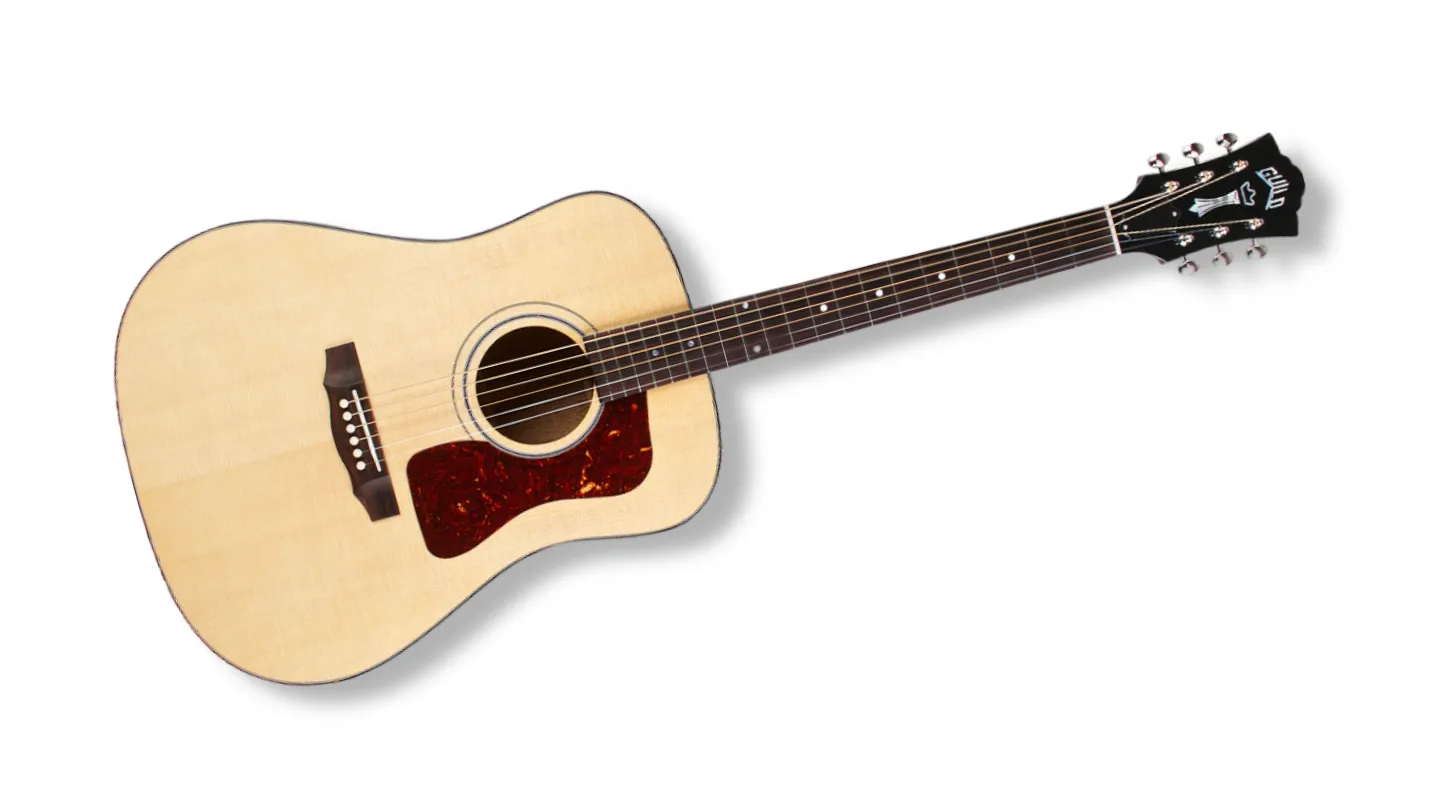
The Guild D-40 Traditional is a dreadnought acoustic guitar built with a solid Sitka spruce top, solid African mahogany back and sides, and scalloped Adirondack bracing.
The Guild D-40 Traditional is a part of the Guild USA series. The Guild USA series represents the brand’s commitment to American craftsmanship and high-quality instruments.
The D-40 Traditional takes inspiration from the iconic D-40 models of the 1960s and 1970s, incorporating features like a dovetail neck joint and a nitrocellulose lacquer finish.
The D-40 Traditional is manufactured in the USA and costs around $2799 (prices may vary).
Sound and Tone (4/5):
The Guild D-40 Traditional produces a full and rich acoustic tone, characterized by warm mahogany depth and a touch of spruce-driven sparkle in the high-end.
The highs are clear and articulate, allowing individual notes to ring out even with a driving strumming hand. The trebles have a shimmer, adding a layer of complexity to the guitar’s voice.
The mids are present and well-balanced. The mid-range has a forward presence, without overpowering the other frequencies. The result is a tone that is both articulate and powerful.
The lows provide a solid foundation without being overpowering. The bass frequencies are well-defined, providing a strong foundation for the overall tone.
The D-40 Traditional responds well to shifts in playing intensity, delivering both delicate and powerful sounds. However, the D-40’s dynamic range doesn’t offer as much variety and nuance in its sound as the Martin D-28.
The Guild D-40 Traditional earns a 4/5 rating for its sound and tone.
Playability and Comfort (4/5):
The Guild D-40 Traditional, with its dreadnought body, offers a comfortable playing experience, but guitarists with smaller frames should keep in mind that the dreadnought body is bulky and can become uncomfortable during extended seated playing.
The D-40 Traditional weighs 4.5 lbs (2.04 kg), which is lightweight for a dreadnought, and contributes to a comfortable playing experience.
The D-40 Traditional features a C-shaped neck profile that feels substantial and fills the hand enough to provide a secure grip, even for players with larger hands.
The neck has a gloss finish. The gloss finish, while visually appealing, may feel sticky to some players.
The nut width of the D-40 Traditional is 1 11/16″ (43 mm). Some fingerstyle players might find this nut width a bit cramped, especially when playing intricate chord voicings.
The Guild D-40 Traditional earns a 4/5 rating for its playability and comfort.
Versatility (4/5):
The D-40 Traditional is particularly well-suited for bluegrass music because the D-40 Traditional’s bright, articulate highs and strong midrange projection allow the D-40 Traditional to cut through the mix of banjos and fiddles.
The D-40 Traditional is also well-suited to folk music thanks to the D-40 Traditional’s warm, balanced tone that complements vocals beautifully, making the D-40 Traditional ideal for singer-songwriters.
However, the D-40 Traditional is not the best choice for aggressive strumming styles due to its tendency towards a more balanced, less percussive response.
When it comes to techniques, the D-40 Traditional is a great fit for fingerstyle playing. the D-40’s balanced tonal response ensures that both the lower and higher notes in a fingerstyle arrangement are heard clearly and with equal emphasis. However, the 1 11/16″ (43 mm) nut width might feel cramped for some players, potentially hindering their ability to execute complex fingerpicking patterns comfortably.
The Guild D-40 Traditional earns a 4/5 rating for its versatility.
Construction and Design (5/5):
The Guild D-40 Traditional measures 16″ (406.4 mm) wide at the lower bout, 11 5/8″ (295.3 mm) wide at the upper bout, and 20″ (508 mm) in body length. The body depth measures 4″ (101 mm) at the upper bout and 5″ (127 mm) at the lower bout.
The D-40 Traditional utilizes a pairing of Sitka spruce and African mahogany. The solid Sitka spruce top, often sourced from colder climates in North America, is known for its remarkable strength-to-weight ratio. In contrast, the solid African mahogany used for the back and sides is denser and heavier than spruce. Originating from warmer regions, mahogany is prized for its stability and resistance to fluctuations in humidity and temperature, making it an excellent choice for a guitar’s back and sides.
The D-40 Traditional employs a scalloped Adirondack spruce bracing pattern. The braces are scalloped, meaning they are shaved down in certain areas to reduce mass. This allows the guitar’s top to vibrate more freely, resulting in greater volume and responsiveness. The Adirondack spruce, with its superior cross-grain stiffness, allows for deeper scalloping without compromising structural integrity, resulting in a more responsive top and enhanced projection.
Aesthetics are classic Guild, with a tortoiseshell pickguard, rosette, and binding. The Indian rosewood fingerboard has mother-of-pearl dot inlays. The headstock features a mother-of-pearl inlaid logo. These design elements, while subtle, contribute to the guitar’s visual appeal and reinforce its traditional aesthetic.
The Guild D-40 Traditional earns a 5/5 rating for its construction and design.
Guild D-40 Traditional Pros: Well-balanced tone, clear and articulate highs, comfortable C-shaped neck, lightweight for a dreadnought, excellent for fingerstyle, high-quality materials (solid Sitka spruce top, solid African mahogany back and sides), scalloped Adirondack spruce bracing, American made.
Guild D-40 Traditional Cons: Narrow nut width may not suit all fingerstyle players, and dreadnought body size may feel bulky to smaller players.
Recommendation for Guild D-40 Traditional
The Guild D-40 Traditional is a well-crafted acoustic guitar that stands out for its powerful and well-balanced tone, comfortable playability, and classic design.
Choose the Guild D-40 Traditional if you need a versatile dreadnought with a powerful voice that excels in a variety of genres, particularly bluegrass and folk.
Avoid the Guild D-40 Traditional if you prioritize a guitar with a wider nut width for comfortable fingerstyle playing.
| Guild D-40 Traditional Specifications | |
| Guitar model | D-40 Traditional |
| Body Type | Dreadnought |
| Top Material | Solid Sitka Spruce |
| Back and Sides Material | Solid Mahogany |
| Bracing | Scalloped Adirondack Spruce |
| Neck Material | 3-piece Mahogany/Walnut/Mahogany |
| Scale Length | 25 5/8″ (650.9 mm) |
| Fingerboard Material | Indian Rosewood |
| Saddle/Nut Material | Bone |
| Frets | 20 |
| Finish | Gloss Nitrocellulose in Natural |
| Typical Price in the USA | Around $2799 (prices may vary) |
| Where to Buy | Sweetwater, Musician’s Friend, Guitar Center, American Musical Supply, Chicago Music Exchange |
9. Bourgeois Touchstone Country Boy Dreadnought
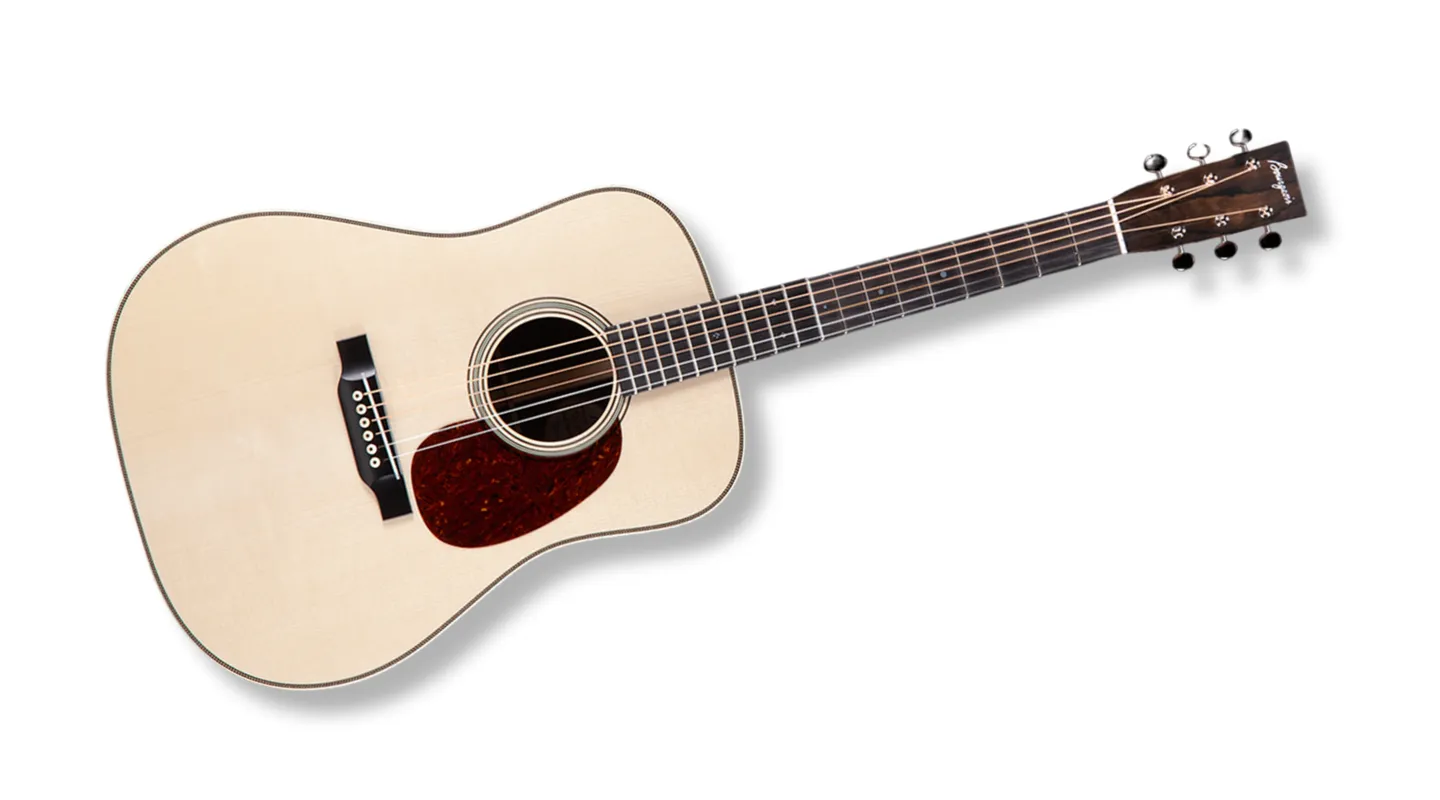
The Touchstone Country Boy Dreadnought is a dreadnought acoustic guitar with an Alaskan Sitka Spruce top, mahogany back and sides, and Adirondack Spruce bracing.
The Touchstone series is a collaboration between Bourgeois Guitars and Eastman Music Company, bringing boutique-level craftsmanship to a more accessible price point. The Country Boy Dreadnought distinguishes itself within the series by utilizing mahogany for its back and sides, as opposed to the Indian rosewood found in the Vintage series.
The Touchstone Country Boy Dreadnought, priced at around $2,799 (prices may vary), is made in the USA where the top is made by Bourgeois, the back/sides are made by Eastman, and the final assembly and voicing are done by Bourgeois in Maine.
Sound and Tone (4/5):
The Touchstone Country Boy Dreadnought offers a balanced tonal spectrum, with notable clarity and articulation.
The highs are bright and clear, cutting through a mix effectively without becoming overly sharp.
The mahogany back and sides contribute to a warm and full midrange. This warmth prevents the guitar from sounding thin or overly bright, ensuring a well-rounded tonal character.
While the lows provide a good foundation for the overall sound, the bass response is slightly less prominent when compared to acoustics with a more pronounced low-end emphasis like the Martin D18.
The Touchstone Country Boy Dreadnought earns a 4/5 rating for its sound and tone.
Playability and Comfort (4/5):
The Touchstone Country Boy Dreadnought weighs around 4 lbs 8 oz (2.03 kg). The Country Boy Dreadnought is not overly heavy for a dreadnought, but the weight distribution feels slightly neck-heavy.
The neck features a “C” shape, characterized by its rounded profile. This specific shape creates a fuller feel in the hand compared to flatter neck profiles. While comfortable for fretting chords, the rounded shape can feel slightly bulky for players with smaller hands, when performing intricate maneuvers like thumb-over grips or wide stretches.
The neck features a satin finish. The satin finish provides a smooth and fast playing surface, allowing for effortless hand movement along the neck.
The Touchstone Country Boy has a 25.5″ (647.7 mm) scale length. This scale length provides a familiar feel for players accustomed to standard dreadnought guitars.
The nut width of 1 23/32″ (44.45 mm) provides ample space between strings, accommodating fingerstyle players or those who prefer a wider string spacing for individual note articulation.
The Touchstone Country Boy Dreadnought earns a 4/5 rating for its playability and comfort.
Versatility (4/5):
The Touchstone Country Boy Dreadnought excels in genres like bluegrass and country due to its balanced tone and responsive articulation. The clarity in the highs and the warmth in the mids make the Touchstone Country Boy Dreadnought well-suited for the fast-paced picking and intricate chord progressions commonly found in these genres.
The Touchstone Country Boy Dreadnought’s dynamic range allows for expressive playing, capturing the nuances of both delicate passages and powerful strumming.
The Touchstone Country Boy Dreadnought is not the ideal choice for guitarists seeking a guitar specifically voiced for more percussive genres like hard strumming or aggressive rhythm playing. This is because, while the touchstone Country Boy handles strumming effectively, the guitar’s strength lies in its balanced tonal response, which does not provide the extreme low-end punch or aggressive attack desired for such styles.
The Touchstone Country Boy Dreadnought earns a 4/5 rating for its versatility.
Construction and Design (5/5):
The Touchstone Country Boy Dreadnought body measures 11 3/8″ (288.93 mm) at the upper bout, 10 5/8″ (269.88 mm) at the waist, and 15 1/2″ (393.70 mm) at the lower bout. The total length of the body is 40 1/8″ (1019.05 mm), with a depth of 3 7/8″ (98.43 mm) at the neck.
The Touchstone Country Boy Dreadnought features an Alaskan Sitka Spruce top. The Alaskan Sitka Spruce is prized for its high stiffness-to-weight ratio, is characterized by its tight, even grain and light color. This robust wood, originating from old-growth trees in Alaska, contributes to the guitar’s structural integrity and ability to withstand string tension.
The back and sides of the Country Boy Dreadnought feature mahogany, a tropical hardwood known for its moderate weight, open pores, and reddish-brown hue. Mahogany’s dimensional stability makes it less susceptible to fluctuations in humidity and temperature, contributing to the instrument’s long-term stability and resistance to warping. Mahogany is also known for its stiffness and resilience, contributing to the guitar’s bright tone and projection.
The bracing pattern of the Touchstone Country Boy Dreadnought utilizes Adirondack Spruce, a stiff and lightweight tonewood, in a popular X-bracing configuration. The X-bracing pattern, unlike ladder bracing which restricts top vibration, allows for a larger vibrating surface area, resulting in a louder and more resonant sound with greater projection. The Adirondack braces are carefully shaped and glued to the underside of the top, ensuring structural integrity and optimal resonance.
Aesthetically, the Touchstone Country Boy Dreadnought embraces a classic and understated design. The combination of a natural finish, simple rosette, and minimal ornamentation allows the beauty of the wood grain to take center stage.
The Touchstone Country Boy Dreadnought earns a 5/5 rating for its construction and design.
Touchstone Country Boy Dreadnought Pros: Balanced tone, articulate sound, comfortable “C” shaped neck, smooth satin neck finish, familiar 25.5″ scale length, wide dynamic range, high-quality materials (Alaskan Sitka Spruce top, mahogany back and sides, Adirondack Spruce bracing), classic aesthetic.
Touchstone Country Boy Dreadnought Cons: Less prominent bass response, dreadnought body size might be bulky for some players, weight distribution is slightly neck-heavy, not ideal for percussive playing styles.
Recommendation for Touchstone Country Boy Dreadnought
The Touchstone Country Boy Dreadnought is a well-crafted instrument that excels in delivering a balanced and articulate tone.
Choose the Touchstone Country Boy Dreadnought if you’re seeking a versatile guitar that’s well-suited for bluegrass, country, and similar genres. Its build quality and attention to detail make it a worthwhile investment.
Avoid the Touchstone Country Boy Dreadnought if a particularly strong low-end response is your top priority, or if you primarily play percussive styles.
| Bourgeois Touchstone Country Boy D Specifications | |
| Body Type | Dreadnought |
| Top Material | Alaskan Sitka Spruce |
| Back and Sides Material | Mahogany |
| Bracing | Adirondack Spruce X bracing |
| Neck Material | Mahogany |
| Scale Length | 25.5″ (647.7 mm) |
| Fingerboard Material | Ebony |
| Saddle/Nut Material | Bone |
| Frets | 20 (14 in the clear) |
| Finish | High Gloss |
| Typical price in the USA | Around $2,799 (prices may vary) |
| Where to Buy | Reverb, Authorized Bourgeois Dealers |
10. Huss & Dalton 00-SP
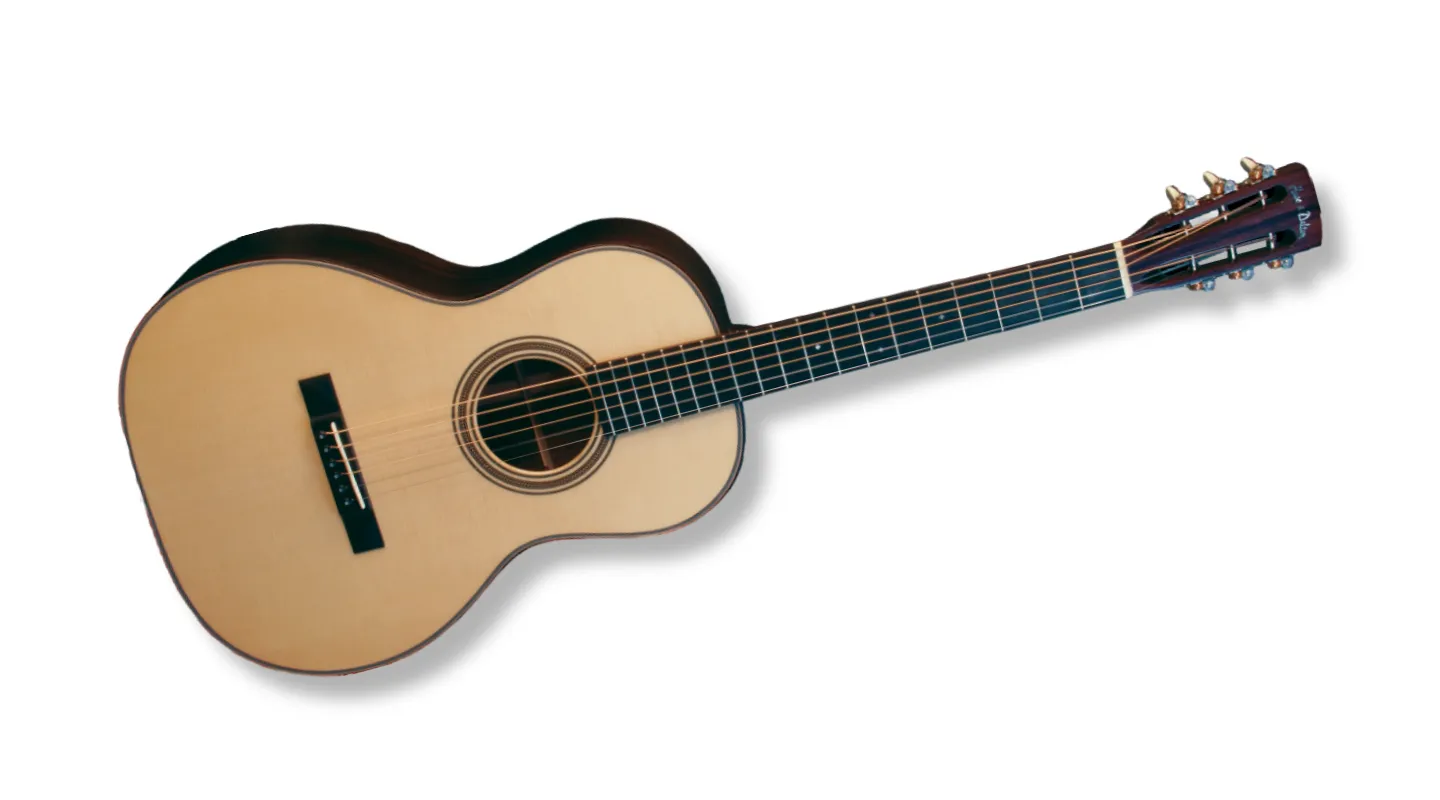
The Huss & Dalton 00-SP is a small-body acoustic guitar, featuring a 00-sized body with an Engelmann spruce top and Indian rosewood back and sides.
The 00-SP belongs to Huss & Dalton’s lineup of handcrafted instruments. The lineup includes parlor-style models like the 0 and 00, 000-style guitars, concert-bodied models with a modern approach, and traditional flat-top designs, all featuring premium tonewoods, elegant appointments, and meticulous craftsmanship.
The Huss & Dalton 00-SP is handcrafted in Staunton, Virginia, and the guitar’s price is around $4500 (prices may vary).
Sound and Tone (5/5):
The Huss & Dalton 00-SP offers a balanced tonal spectrum with notable warmth and clarity.
The highs are sweet and round, adding a touch of sparkle without being overly bright. The Engelmann spruce top contributes to a stronger low-mid presence while maintaining balance across the tonal spectrum.
The midrange is full and well-defined, contributing to the guitar’s overall warmth and providing a solid foundation for chords and melodies.
The lows are surprisingly robust for a small-bodied guitar, offering depth and warmth without becoming boomy. This low-end presence is particularly noticeable in 00-SP models with East Indian rosewood back and sides, which are known for their resonant properties.
The Huss & Dalton 00-SP earns a 5/5 rating for its sound and tone.
Playability and Comfort (4/5):
The Huss & Dalton 00-SP’s 00 body size is comfortable and easy to play for both seated and standing playing positions. Guitarists with smaller frames might find the compact dimensions less cumbersome than larger-bodied guitars.
The weight of the 00-SP is around 3 lbs 11 oz (1.67 kg) but the weight can vary depending on the specific woods used. The 00-SP is lightweight and well-balanced at around, which reduces fatigue during extended playing sessions.
The 24.9″ scale length, falling between the shorter scale lengths often found on vintage guitars and the longer scales of modern instruments, offers a balanced feel with comfortable string tension for both fingerpicking and strumming.
The ebony fretboard contributes to precise fretting because the hardness of ebony minimizes wear from string contact, keeping the frets from grooving prematurely. The satin finish on the neck offers a smooth feel that allows the player’s hand to glide effortlessly along the neck, facilitating faster playing.
The Huss & Dalton 00-SP earns a 4/5 rating for its playability and comfort.
Versatility (4/5):
The Huss & Dalton 00-SP is a great fit for fingerstyle blues and folk. The Huss & Dalton 00-SP is a great fingerstyle guitar because its balanced tonal response ensures that both bass runs and melody lines ring out clearly. This balance is essential for fingerstyle blues, as the style often blends bass lines and melodic phrases simultaneously. The articulate nature of the 00-SP lends itself well to the nuanced dynamics of folk music, allowing the subtler tones of the guitar to shine through.
The 00-SP can handle strumming, but its smaller body lacks the projection needed for genres like bluegrass, where a powerful, full-bodied sound is desired. For drop-tuning, which requires a guitar capable of handling lowered tunings without excessive fret buzz, the 00-SP performs admirably. The 24.9″ scale length provides a balance between string tension and intonation, even when tuned down. However, aggressive strumming techniques, like those often employed in rock music, can overwhelm the 00-SP’s smaller body, leading to a somewhat boxy sound.
The Huss & Dalton 00-SP earns a 4/5 rating for its versatility.
Construction and Design (5/5):
The Huss & Dalton 00-SP’s body dimensions adhere to the classic 00-size specifications, with a body width of 14 1/8″ (358.77 mm), a body length of 19 3/8″ (492.125 mm), and a body depth of 4 1/8″ (104.775 mm). These dimensions contribute to the guitar’s comfortable feel and balanced tonal response.
The 00-SP combines an Engelmann spruce top known for its lightweight yet stiff nature, with Indian rosewood back and sides, a dense wood prized for its resistance to humidity changes.
The finish on the 00-SP can vary depending on the specific model, but it is typically a thin, nitrocellulose lacquer finish that allows the wood to resonate freely and age naturally over time.
The 00-SP, while understated, incorporates visually appealing details. The slotted headstock, often adorned with a pyramid bridge and Waverly tuners, showcases the luthiers’ attention to detail.
The Huss & Dalton 00-SP earns a 5/5 rating for its construction and design.
Huss & Dalton 00-SP Pros: Balanced tone, warm and clear highs, full mids, robust lows, comfortable size, suitable for blues and folk, high-quality craftsmanship, premium tonewoods, elegant aesthetics.
Huss & Dalton 00-SP Cons: Not ideal for aggressive strumming, smaller body limits projection.
Recommendation for Huss & Dalton 00-SP
The Huss & Dalton 00-SP is an exceptional guitar for players who seek a handcrafted instrument with a balanced tone, comfortable playability, and elegant aesthetics.
Choose the Huss & Dalton 00-SP if you value a guitar that excels in fingerstyle playing, offers a warm and resonant tone, and embodies traditional craftsmanship.
Avoid the Huss & Dalton 00-SP if you primarily play genres requiring a guitar with a large body size or if you prefer a guitar with a more modern design.
| Huss & Dalton 00-SP Specifications | |
| Body Type | 00 Body |
| Top Material | Engelmann spruce |
| Back and Sides Material | Indian rosewood |
| Scale Length | 24.9″ (632.46 mm) |
| Fingerboard Material | Ebony |
| Typical price in the USA | Around $4500 (prices may vary) |
| Where to Buy | Reverb, Huss & Dalton Authorized Dealers |
What brands make the best custom-built high-end acoustic guitars?
The brands that make the best custom-built high-end acoustic guitars are listed below.
- Bourgeois Guitars
- Collings Guitars
- Santa Cruz Guitar Company
- Froggy Bottom Guitars
- Olson Guitars
- Martin Custom Shop
- Taylor Custom Shop
- Gibson Acoustic Custom Shop
The above list of brands provides a combination of small luthier shops and established brands with custom shops.
Small luthier shops are often one-person operations or employ a handful of artisans. They prioritize personalized interaction with clients and meticulously tailor instruments to the player’s specifications and tonal preferences. They focus on unique craftsmanship and hand-selected tonewoods, often resulting in a one-of-a-kind guitar.
Established companies with custom shops leverage their experience, brand recognition, and access to a wider variety of premium materials, including rare or historically significant tonewoods. They offer a structured yet extensive range of customization options within the framework of their established models.
Bourgeois Guitars is a boutique luthier shop located in Lewiston, Maine that specializes in crafting high-end acoustic guitars known for their exceptional tonal balance, responsiveness, and elegant aesthetics. They prioritize hand-voicing techniques and meticulous attention to detail in every aspect of construction, from wood selection to bracing and finish work.
Collings Guitars is an established company located in Austin, Texas, founded in 1973, that specializes in crafting high-quality guitars recognized for their exceptional build quality, vintage-inspired designs, and powerful, articulate sound. Their commitment to traditional craftsmanship and attention to detail, such as hand-carving the braces for their instruments, have earned them a loyal following.
Santa Cruz Guitar Company is a small luthier shop located in Santa Cruz, California, that specializes in building premium acoustic guitars known for their warm, resonant tone, exceptional responsiveness, and comfortable playability. They emphasize traditional hand-crafting techniques and the use of high-quality tonewoods to create instruments prized for their rich, complex sound.
Froggy Bottom Guitars is a small guitar maker based in Chelsea, Vermont, that specializes in handcrafting high-end custom-made acoustic guitars celebrated for their exceptional clarity, balanced tone, and intricate inlay work. Their use of unique tonal shaping techniques and focus on achieving optimal resonance contribute to their guitars’ distinctive sound and responsive feel.
Olson Guitars is a small luthier shop founded by James Olson in Circle Pines, Minnesota, that specializes in crafting exceptional steel-string acoustic guitars renowned for their responsiveness, dynamic range, and rich, complex tone. Favored by many fingerstyle players, Olson guitars are known for their articulate voice and sensitivity to the player’s touch.
The Martin Custom Shop is an established guitar manufacturer with a custom shop located in Nazareth, Pennsylvania that allows guitarists to collaborate with experienced artisans to create their dream Martin guitar. They offer a wide array of options for customization, drawing upon the company’s long heritage and expertise in acoustic guitar construction to craft personalized instruments of exceptional quality.
Taylor Custom Shop is an established brand with a custom shop located in El Cajon, California that provides guitarists with the opportunity to design and build a personalized Taylor guitar using a wide selection of tonewoods, appointments, and features. Their custom shop is known for its innovative designs and commitment to using sustainable materials and building techniques.
Gibson Acoustic Custom Shop is an established brand with a custom shop located in Bozeman, Montana that carries forward Gibson’s legacy of crafting iconic guitars. Their custom shop offers a range of options for recreating vintage models or designing unique instruments using premium materials and traditional craftsmanship, appealing to guitarists seeking a piece of Gibson’s history tailored to their preferences.
When it comes to price several factors influence the cost of custom-built high-end acoustic guitars. The selection of rare or highly figured tonewoods, such as Brazilian rosewood, Adirondack spruce, or flamed Hawaiian koa, significantly increases the price. Customization options, including body size and shape, neck profile, fretboard radius, and headstock design, contribute to the labor and materials required. Unique features, such as intricate pearl or abalone inlays, custom wood bindings and purflings, and elaborate hand-engraved designs, add to the artisan’s time and skill invested, therefore affecting the price of a final guitar as well.
For guitarists seeking high-quality instruments without the custom price tag, standard models offer an attractive alternative. Standardized high-end acoustic guitars, often handcrafted with meticulous attention to detail and high-grade materials, provide exceptional tone, playability, and craftsmanship at a more accessible price point. By utilizing standardized designs and production processes, luthiers and manufacturers can streamline production and offer these high-quality instruments at a lower cost compared to fully custom builds.
What are the best acoustic guitar brands?
The best acoustic guitar brands include Martin, Yamaha, and Gibson.
Martin has set the standard for quality and tone for over 190 years. Known for their balanced, clear, and resonant sound, Martin guitars are favored by musicians across genres, from folk and bluegrass to country and rock.
Yamaha earns its place among the best due to its consistent quality, affordability, and wide range of options catering to beginners and experienced players. Yamaha’s commitment to innovation and craftsmanship is evident in their guitars, which offer exceptional value for their price point.
Gibson is another iconic American brand that holds a rich history and legacy, in guitar production. Gibson acoustics are renowned for their warm, rich, and full-bodied tone. Gibson guitars have been also used on countless recordings and stages worldwide.
How do Gibson, Taylor, and Martin differ from each other?
Gibson, Taylor, and Martin differ from each other primarily in their sonic characteristics, design philosophies, and historical legacies within acoustic guitar evolution.
Gibson acoustic guitars are known for their excellent bass response. Gibson acoustics are often described as warm, rich, and full-bodied, with strong projection. Their heritage is deeply rooted in bluegrass, country, and blues genres.
Taylor guitars are known for their bright, articulate, and modern sound with well-defined highs. This sonic character translates exceptionally well to their electro-acoustic models, which are praised for their clear and balanced amplified tone. They focus on a comfortable playing experience, often featuring smaller body sizes, armrests, and cutaways. Taylor pioneered the use of alternative woods and innovative construction techniques like the bolt-on neck.
Martin guitars are considered the benchmark for traditional acoustic tone, known for their balanced, clear, and resonant sound. They are known for their classic dreadnought and smaller-bodied guitars, often with spruce tops and traditional bracing patterns. With a long and influential history, Martin is closely associated with the evolution of American folk and popular music.
What is the best electro-acoustic guitar brand?
The best electro-acoustic guitar brand is Taylor Guitars. Taylor’s dedication to innovation, quality, and playability shines through in their electro-acoustic models, making them the top choice for musicians seeking amplified acoustic sound.
Taylor’s proprietary Expression System 2 (ES2) pickup system accurately captures the guitar’s natural tone, delivering a rich and dynamic amplified sound.
Taylor’s focus on innovative design, including comfortable body shapes, meticulous bracing patterns, and the use of sustainable woods, results in instruments that are both sonically pleasing and environmentally conscious.
Breedlove guitars share this commitment to quality with Taylor. Both manufacturers are recognized for their excellent build quality and attention to detail. However, players often praise Taylor guitars for their comfort and playability. Tonally, Taylor leans towards a brighter, more pronounced sound, while Breedlove guitars offer a more focused sound with blended overtones.
What are the best acoustic guitars?
The best acoustic guitars include the Martin D-28, Yamaha FG830, and Eastman E1D.
The Martin D-28, with its balanced tone and projection, represents a benchmark in acoustic guitar craftsmanship and is favored by professionals across genres like bluegrass and folk. The Yamaha FG830, with its solid Sitka spruce top and budget-friendly price, offers an excellent entry point for players on a budget seeking a quality instrument. The Eastman E1D, featuring an all-solid wood construction and a powerful, resonant tone, delivers exceptional value for intermediate players looking to upgrade. However, ultimately the best acoustic guitar is a guitar that best suits a specific player’s individual needs.
What are the best mid-range acoustic guitars under $1000?
The best mid-range acoustic guitars under $1000 include the Guild D-140, Yamaha FG3, and Eastman E1D.
The Guild D-140, constructed with a solid Sitka spruce top and solid African mahogany back and sides, produces a full, rich tone ideal for a variety of playing styles. The Yamaha FG3, featuring a solid Sitka spruce top enhanced with Yamaha’s A.R.E. treatment and solid mahogany back and sides, delivers a vintage-inspired tone with exceptional sustain and a balanced sound. The Eastman E1D, crafted with a solid Sitka spruce top and solid sapele back and sides, offers a powerful, balanced tone with a punchy midrange.
What are the best acoustic guitars under $2000?
The best acoustic guitars under $2000 include the Martin D-15M, Martin 000-16SM, and Yamaha FG5.
The Martin D-15M, crafted entirely from mahogany, offers a warm, balanced tone with a strong midrange presence, making it well-suited for folk, blues, and Americana styles. The Martin 000-16SM features an Adirondack spruce top treated with Martin’s Vintage Tone System (VTS), producing a classic Martin warmth with enhanced maturity and complexity. The Yamaha FG5, has a solid Sitka spruce top and solid mahogany back and sides. THe FG5 delivers a powerful, balanced tone with clear highs and a robust low-end.
What are the best cheap acoustic guitars under $500?
The best cheap acoustic guitars under $500 include the Yamaha FG830, Yamaha FG800J, and Gretsch G9500 Jim Dandy.
The Yamaha FG830, with its solid Sitka spruce top, delivers a balanced tone with impressive volume and projection. The Yamaha FG800J features a solid spruce top and scalloped bracing, resulting in a loud and strong sound. The Gretsch G9500 Jim Dandy, crafted with a laminate basswood body, has a small parlor style body size, making the G9500 comfortable and portable option with an old-time country and blues music sound.