

The main difference between acoustic and electric guitars is how each guitar type produces sound. Acoustic guitars produce sound acoustically, meaning they amplify string vibrations through their hollow body without needing external amplification. Electric guitars, on the other hand, require an amplifier to produce sound. Electric guitars use electromagnetic pickups to convert string vibrations into electrical signals. The electric signals are then amplified externally. Both acoustic and electric guitars can be used by beginners, but they offer very different playing experiences.
For beginners, the electric guitars are more comfortable to play due to their lighter strings, lower string tension, and lower action. This design makes it easier to press down on the strings and fret notes. Acoustic guitars are more challenging to fret, but they can help develop finger strength and control due to their heavier strings, higher action, and string tension. Acoustic guitars are also more affordable than electric guitars because acoustic guitars require no external equipment to produce sound. The additional equipment for electric guitars, such as amplifiers and cables, adds to the overall cost for the beginner. On the other hand, the amplifiers and effect pedals offer a wider range of sounds for electric guitars, making the electric guitars more versatile across different musical styles.
To choose a guitar for beginners, consider their musical preferences, budget, and comfort level that the guitar provides. Some beginners are drawn to the raw, natural sound of an acoustic guitar. The sound of an acoustic guitar is often preferred for genres like folk and country. Other beginners may be excited by the sound effects and tone possibilities achievable with an electric guitar. Electric guitars are commonly used in rock, blues, and metal genres. Ultimately, the best guitar for a beginner is the one that best suits their individual needs and goals.

5 Step Checklist To Avoid Buying The Wrong Guitar
What to check before you buy
What features actually matter for beginners
What makes a guitar easy to play
What is an acoustic guitar (steel string acoustic guitar)?

An acoustic guitar is a guitar type that produces sound acoustically, meaning without electrical amplification. While this technically includes any guitar that generates sound without needing electronic pickups or amplifiers, the term “acoustic guitar” often refers to a steel-string acoustic guitar.
An acoustic guitar produces sound through the vibrations of its strings. When a string is plucked, it vibrates, and this vibration is transmitted through the bridge and saddle to the soundboard. The soundboard is a large resonant surface commonly made from wood like spruce or cedar. The soundboard receives the vibrations from the saddle and sets the air inside the acoustic’s hollow body in motion, creating sound waves. These sound waves then travel out of the guitar through a soundhole, creating the sound we hear when we play the acoustic guitar. The sound, tone, and volume of the guitar also change significantly with the different shapes and sizes of the acoustic guitar’s body because the larger the body, the more air it moves, resulting in a louder and often deeper sound.
Steel-string acoustic guitars come in various body shapes and types, each with unique sound and tone characteristics. For example, the dreadnought, known for its large body and powerful projection, has a full, booming sound, making it well-suited for bluegrass and folk music. On the other hand, concert guitars are smaller than dreadnoughts and produce a more balanced and focused tone, well-suited to fingerstyle playing and lighter genres.
Aside from steel string acoustic guitars, other types of acoustic guitars include the nylon string acoustic guitars called classical guitars. Classical guitars produce sound acoustically, just like steel string acoustic guitars. However, classical guitars feature nylon strings instead of steel strings. The nylon strings provide a warmer, mellower tone that is often associated with classical, flamenco, and Spanish guitar music.
The modern flat top acoustic guitar didn’t fully emerge until the late 19th and early 20th centuries. The earliest guitars appeared in Spain during the 15th and 16th centuries. Classical guitars, with their nylon strings and mellow sound, developed from these early instruments. It is important to note that while classical guitars are technically acoustic guitars, they are not commonly referred to as acoustic guitars and differ significantly from steel-string acoustic guitars in terms of construction, sound, and playing style. The late 19th and early 20th centuries saw key innovations in steel-string acoustic guitar design. Luthiers introduced X-bracing for the soundboard, adopted steel strings for greater volume and projection, and standardized body shapes like the dreadnought and concert. These advancements resulted in louder, more powerful instruments, that created the modern acoustic guitar designs we know today.
What is an electric guitar (solid-body electric guitar)?

An electric guitar is a type of guitar that uses electromagnetic pickups to convert string vibrations into an electrical signal. This signal is then amplified through an amplifier to produce sound. While technically any guitar with pickups that reproduce sound electronically can be considered an electric guitar, the term “electric guitar” often refers to a solid-body electric guitar.
To play an electric guitar you need an amplifier and a cable to connect the guitar to the amplifier. The cable passes the electric signal from the electric guitar’s electromagnetic pickups to an amplifier. The amplifier then converts the electric signal into sound waves that are amplified through a speaker.
Essential guitar parts that help the electric guitar produce sound include the pickups, volume and tone controls, and an output jack. Pickups capture string vibrations and convert them into electrical signals. Different pickup types produce slightly different sounds and tones. Single-coil pickups are known for a bright and clear sound. On the other hand, humbucker pickups have a warm and full tone. Volume and tone controls allow guitarists to shape the guitar’s output signal, affecting the loudness and tone of the guitar. The output jack serves as a connection point for the cable, allowing the signal to travel from the guitar to the amplifier.
The solid-body electric guitars feature solid wooden bodies to minimize unwanted feedback because high levels of amplification can cause hollow-body instruments to produce harsh, uncontrolled noises. The body of a solid-body electric guitar is 1.5 inches (38 mm) to 2 inches (51 mm) thick and the standard thickness of a solid-body electric guitar is 1.75 inches (44 mm).
Solid-body electric guitars come in different body shapes and body types like the Fender’s double-cutaway Stratocaster, Gibson’s flying V, and Gibson’s Les Paul. Each body shape has a distinctive look and sound. However, the body itself only has a slight impact on the overall tone of the electric guitar. The differences in body types are mainly for aesthetic and ergonomic purposes, influencing how the guitar feels and looks rather than how the guitar sounds. The differences in sound are mainly caused by the different types of pickups used in each body shape. These are the common pickup types together with the changes in sound that they produce for the solid body electric guitar.
- Solid-body guitars with single-coil pickups produce a bright and clear tone with a distinct attack. These guitars are often favored for genres such as blues, country, and funk. Fender Stratocaster and Telecaster are good examples of guitars with single-coil pickups.
- Solid-body guitars with humbucker pickups produce a thick, warm tone with a higher output, making them well-suited for rock and metal genres. Gibson Les Paul is a good example of a guitar with humbucker pickups.
- Solid-body guitars with active pickups utilize a pre-amp within the guitar that requires a battery to operate. Active pickups provide a higher output signal with more clarity and sustain, making them suitable for genres such as metal and hard rock.
In the video below you can hear the differences in sound between single coil and humbucker pickups with different effects and in different music genres.
Aside from solid-body electric guitars, other types of electric guitars include semi-hollow body and hollow-body electric guitars. Semi-hollow body and hollow body electric guitars also use pickups and amplifiers to produce sound, just like the solid-body electric guitars. However, semi-hollow body and hollow body electric guitars feature a hollow cavity within their body, which provides a warmer, more resonant tone compared to solid-body electric guitars.
The electric guitar’s development traces back to the 1930s. Driven by the demand for louder instruments in musical ensembles, George Beauchamp and Adolph Rickenbacker pioneered the “Frying Pan” lap steel guitar. The “Frying Pan” guitar was an early example of an electrically amplified guitar. As technology advanced, solid-body electric guitars emerged. The Fender Telecaster (originally called the Broadcaster) in 1950 and the Gibson Les Paul in 1952 solidified electric guitars as iconic instruments. The invention of the solid-body electric guitar revolutionized popular music, expanded sound and tone possibilities, and led to the development of new musical genres.
What are the differences between acoustic guitar and electric guitar for beginners?
The differences between acoustic guitar and electric guitar for beginners include the sound, playability, and cost of the guitar.
Acoustic guitars produce a full, resonant sound without amplification, making them suitable for various musical styles such as folk, country, and blues. Electric guitars, on the other hand, require an amplifier to produce their sound, making them well-suited for rock, blues, jazz, and many other genres.
Electric guitars are easier to fret than acoustic guitars due to their lighter string gauge, lower action height, and slimmer neck profile. In the book “The Guitar Handbook” Ralph Denyer explains that electric guitar necks are designed to be both narrower (measuring from the 1st string to the 6th string) and shallower (measuring from the fingerboard to the back of the neck) than acoustic guitar necks. This slimmer neck profile on electric guitars reduces the amount of hand stretching required to form chords, making it easier for beginners to develop proper finger positioning and transition between chords smoothly
Acoustic guitars for beginners are generally less expensive than electric guitars, especially when considering the additional cost of an amplifier, cables, and other accessories required for electric guitars. A decent acoustic guitar for beginners starts at around $200. Electric guitars, while also starting at around $200, require an amplifier and a cable, which add an additional $100 or more to the overall cost for a beginner player.
1. Learning to play differences between acoustic guitar and electric guitar
Is it easier to learn acoustic or electric guitar? While electric guitars are easier to fret and play, acoustic guitars, with their larger gauge strings, can help beginners develop better endurance and finger strength for more complex techniques and longer compositions. When learning how to play the guitar the initial experience should be enjoyable and encouraging. Therefore, motivation and playability are the most important factors that differentiate acoustic guitars and electric guitars for beginner guitar players who are learning how to play.
Motivation: The acoustic guitar motivates learners who prioritize building a strong foundation. The absence of electronics and effects encourages focus on core elements like strumming patterns, open chord transitions, and developing a keen ear for natural tone. Electric guitars, in contrast, motivate players who want a more immediate path to exploring advanced techniques and sound possibilities. The use of amplifiers and effect pedals with the electric guitar unlocks the sound effects that many beginner players want to start using as soon as possible because their favorite band or artist is using the sound modulations. However, the availability of effects on the electric guitars can lead beginners to rely on the effects during practice. This reliance on effects can hinder the development of precise playing when compared to practicing with only a clean tone on an acoustic guitar. Learning to play with the electric guitar’s sound effects as a crutch can then be demotivating in the future when attempting to play more complicated songs.
Playability: Beginners who learn how to play on acoustic guitar often experience very sore fingertips and need a longer time to develop proper calluses due to the higher string tension and action. Electric guitars have lighter gauge strings and a typically lower action that make it physically easier to press down the strings. Therefore, beginners learning to play an electric guitar can often practice for longer periods of time than acoustic guitar newbies. While the fretting on an acoustic guitar is more challenging at first, the higher action and heavier strings on an acoustic guitar promote the development of robust finger strength and hand coordination which are both essential skills for guitar playing.
Acoustic guitars are not harder to learn than electric guitars. Electric guitars are not harder to learn than acoustic guitars. The best guitar type to learn on depends on your musical goals, preferred genres, and learning style. You should learn acoustic guitar before electric guitar if your musical inspiration primarily comes from acoustic-driven genres like folk, country, or bluegrass. You can learn electric guitar before acoustic guitar if you find the heavier strings and higher action of acoustic guitars discouraging and you’re drawn to genres like rock, blues, or metal. When choosing the guitar type to learn first, it is also important to consider the beginner songs that motivate you to learn and practice guitar playing. Best beginner acoustic guitar songs that are easy to play and learn include those with basic strumming patterns and open chords, such as “Blowin’ in the Wind” by Bob Dylan, “Brown Eyed Girl” by Van Morrison, or “Ring of Fire” by Johnny Cash. Best beginner electric guitar songs that are easy to play and learn include those with simple power chords and riffs, like “Smoke on the Water” by Deep Purple, “Seven Nation Army” by The White Stripes, or “Sunshine of Your Love” by Cream.
The differences in skills that beginners learn when they start to play on an acoustic guitar compared to when they start to play on an electric guitar are minimal. Acoustic guitar skills transfer to electric guitar seamlessly. All fundamental guitar skills, such as chord shapes, scales, and rhythm, directly transfer between acoustic and electric guitars. However, players may need to adjust their attack and volume when transitioning from acoustic to electric guitar because electric guitars require less force to produce sound. On the other hand, electric guitar techniques like string bending, vibrato, and pinch harmonics are easier to play with amplification, making the techniques less pronounced and more challenging to execute on an acoustic guitar. For example, achieving a wide vibrato on an acoustic guitar requires more finger strength and precision than on an electric guitar due to the acoustic’s heavier strings and higher action.
2. Comfort and playability differences between acoustic guitar and electric guitar
The differences in comfort and playability between acoustic and electric guitars include string properties like gauge and tension, the size and shape of the neck, the spacing between the strings, the overall size and weight of the instrument, comfort during different playing positions, and the techniques that are easier to learn on each type of guitar.
The picture below showcases the factors that affect the comfort and playability for the player on an acoustic vs electric guitar.
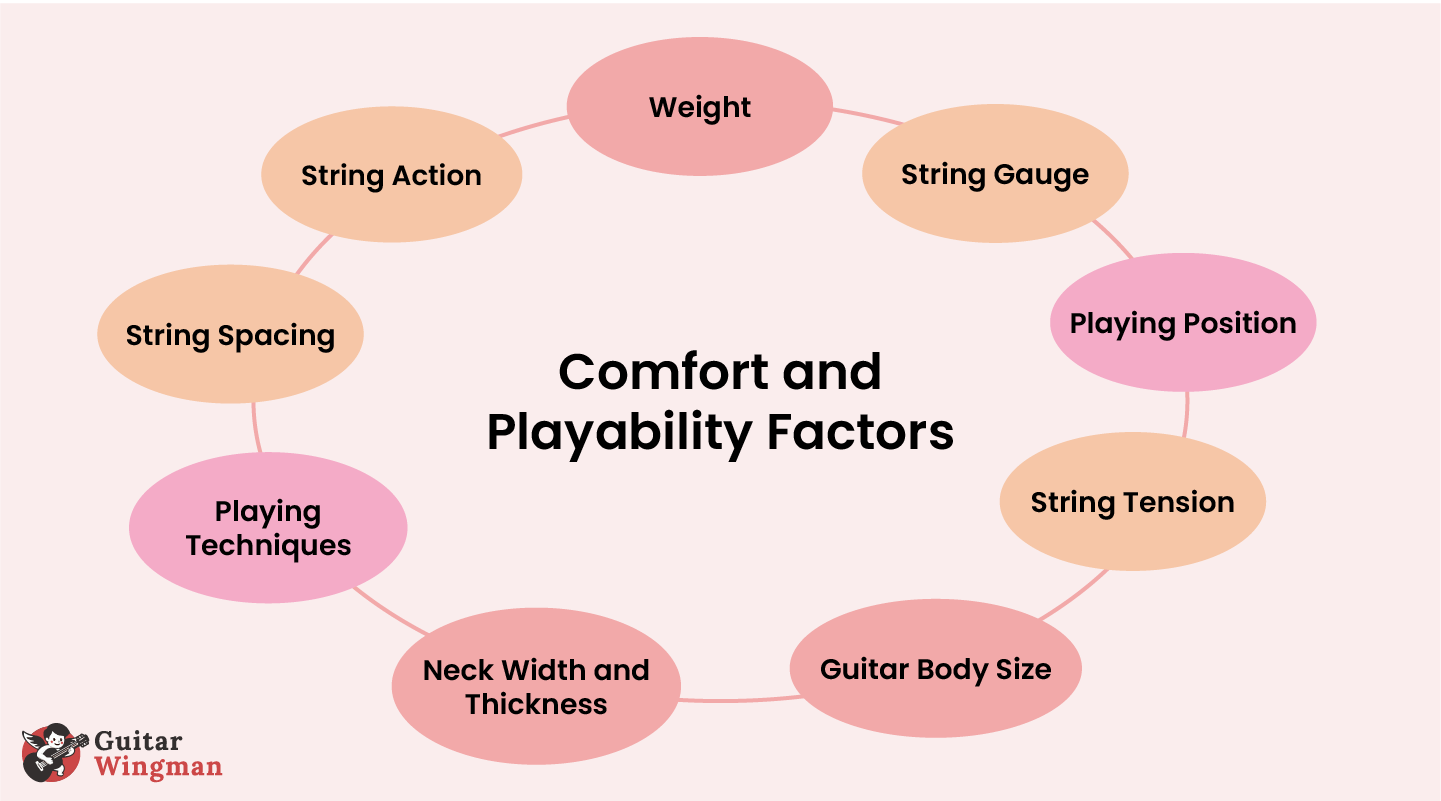
String Properties: The differences between electric guitar and acoustic guitar strings include the differences in string gauge, string action, and string tension. For a beginner, these differences are mainly relevant to how hard or easy it is to fret the strings against the fretboard.
String action is the distance between the strings and the fretboard, measured at the 12th fret. Electric guitars typically have lower action than acoustic guitars, with the low E string set between 1.5 mm to 2.3 mm (0.059″ to 0.090″) and the high E string around 1.0 mm to 1.5 mm (0.039″ to 0.059″). Common string action on an acoustic guitar is at 2.5 mm to 3.5 mm (0.098″ to 0.138″) on the low E string and 1.5 mm to 2.5 mm (0.059″ to 0.098″) on the high E string. Lower string action makes it easier to press the strings down, which is a significant advantage for beginners who are still developing finger strength and dexterity.
String gauge is the thickness of a guitar string measured in inches. String gauges for guitar strings are shown as a range, like .010″ – .047″ or .014″ – .059″. The range refers to the thickness of the thinnest string (high E) to the thickest string (low E) in a set. Electric guitar strings are typically 20% thinner than acoustic guitar strings, requiring less force to press down. String gauges for both acoustic and electric guitars are categorized into extra light, light, medium, and heavy gauges. For beginners, the extra light and light gauge categories are the easiest to fret because they require less hand strength and pressure to fret notes correctly. For acoustic guitars the extra light gauge string sets range from .010″ to .047″ and the light gauge string sets range from .011″ to .053″. For electric guitars the extra light gauge string sets range from .008″ to .038″ and the light gauge string sets range from .010″ to .046″. Therefore, light gauge electric guitar strings (.010″ – .046″) are comparable to extra light acoustic guitar strings (.010″ – .047″) and extra light electric guitar strings (.008″ to .038″) are thinner than extra light acoustic guitar (.010″ – .047″) strings. This difference, combined with the generally lower tension of electric guitar strings, means that electric guitars are easier and more comfortable to fret than acoustics, even with comparable string gauges.
String tension is the force applied to the guitar string when the string is tuned to a specific pitch. String tension directly impacts how much pressure is required to press the strings down to the fretboard. Acoustic guitars typically have higher total string tension due to the thicker strings and larger body size needed to produce volume acoustically. An acoustic guitar with a standard 10-gauge set has an average total tension of around 134.8 lbf (61.1 kgf). Electric guitars, on the other hand, typically have lower string tension. A 9-gauge set on an electric guitar averages around 82.4 lbf (37.4 kgf) of tension. As a general rule, the thicker the string gauge, the higher the string tension. The higher string tension on acoustic guitars makes fretting notes more difficult for beginners. Electric guitars, with their lower tension, require less force to fret, making them generally more comfortable for extended playing, especially for beginners still developing calluses on their fingertips and stamina.
Neck Width and Thickness: Electric guitar necks are slimmer and narrower than acoustic guitar necks. Electric guitar neck widths range from 1 5/8″ (41 mm) to 1 7/8″ (48 mm) at the nut, while acoustic guitar necks are wider, ranging from 1 11/16″ (42.8 mm) to 2″ (51 mm). Electric guitar necks also tend to be thinner, typically ranging from 0.75″ (19 mm) to 1″ (25 mm) in thickness, compared to 0.85″ (21.5 mm) to 1″ (25 mm) for acoustic guitars. This means beginners with smaller hands might find electric guitar necks easier to grip and navigate compared to acoustic guitar necks.
String Spacing: String spacing, the distance between the strings at the nut, also differs between acoustic and electric guitars. Acoustic guitars generally have wider string spacing to accommodate fingerstyle playing techniques, while electric guitars tend to have narrower spacing, which is better suited for single-note riffs and solos. For beginners still developing precision in their fretting hand, wider string spacing on an acoustic guitar can provide more room to maneuver, reducing the likelihood of accidentally touching adjacent strings and unintentionally muting them. This additional space can enhance accuracy and comfort during play, making it easier for beginners to develop their technique.
Size: Acoustic guitars have larger bodies than electric guitars to produce sufficient acoustic volume. A full-sized dreadnought acoustic guitar body measures about 4 3/4″ (120.65 mm) deep at its lower bout, while on a solid-body electric guitar like a Fender Stratocaster, the body is only around 1 3/4″ (44.45 mm) thick. The larger size of a dreadnought acoustic guitar body can feel bulky for some beginners, especially younger players and smaller adults. For kids, there are smaller-bodied acoustic guitars for kids, to make playing more comfortable. For adults, there is a full-sized electric guitar for adults, which is generally more comfortable to hold and play than a full-sized acoustic for adults.
Weight: The average steel-string acoustic guitar weighs between 2.5 and 5 lbs (1.1 kg and 2.2 kg). The average solid-body electric guitar weighs between 6 and 12 lbs. (2.72 – 5.44 kg). However, the weight distribution on each of the guitar types is key when it comes to comfort. Acoustic guitars have a larger, hollow body, distributing the weight more evenly, while electric guitars tend to be more compact, with the weight concentrated in the body. This difference in weight distribution makes electric guitars feel heavier, especially when played standing up for extended periods.
Playing Position: Both acoustic and electric guitars can be played sitting or standing, however, their comfort and handling differ depending on the playing position due to their contrasting designs. Acoustic guitars, with their larger size and broader lower bout, offer more stability and comfort when played seated. This stability reduces fatigue and improves comfort during extended playing sessions. Conversely, electric guitars are less stable on the leg when seated due to their smaller, contoured bodies. But the solid-body electric guitars are more comfortable than acoustic guitars when playing standing up. This is because the solid-body electric guitar bodies are thinner and more ergonomically designed for standing.
Playing Techniques: Electric guitars offer a more comfortable playing experience for strumming, forming chords, and playing lead lines compared to acoustic guitars. The thinner necks, lighter strings, and lower action on electric guitars require less effort and hand strength. Acoustic guitars are less comfortable for beginners due to the thicker necks, heavier strings, and higher action making chords and lead techniques more challenging.
3. Sound differences between acoustic guitar and electric guitar
The main differences in sound between acoustic and electric guitars include sound production, tone differences, and the genres and songs for which the tone of each guitar type is best suited for.
Sound Production: The main difference in sound production between acoustic and electric guitars lies in how each guitar type amplifies string vibrations. Acoustic guitars use their hollow body as a natural resonating chamber, while electric guitars rely entirely on electronic amplification. When a string is plucked on an acoustic guitar, the vibrations travel through the bridge to the soundboard, causing the entire body to vibrate and naturally amplify the sound. In contrast, an electric guitar’s solid body contributes to sound amplification only minimally. Electric guitars use pickups which are mounted under the strings to capture the string vibrations. As the steel strings vibrate, they disrupt the pickup’s magnetic field, generating a weak electrical signal. This signal is then amplified electronically through a speaker, making an amplifier essential for producing audible sound on an electric guitar. Without amplification, the sound of an electric guitar is very quiet, especially when compared to acoustic guitar’s naturally resonant projection. The soundhole in an acoustic guitar serves as a point of projection for this amplified acoustic sound, while an electric guitar relies on the output jack to send the signal to an amplifier.
Tone: Acoustic guitars have a naturally warm and resonant tone, particularly full in the lower frequencies. Electric guitars produce a brighter sound, often with less emphasis on lower frequencies. However, the tone of electric guitars is very versatile and the tone characteristics including tone color and timbre can be changed to alter the sound of the guitar. While the acoustic guitar’s sound is largely defined by its construction and natural resonance, the electric guitar’s tone is mainly shaped through amplifiers and effects pedals. This grants electric guitarists access to a vast palette of sounds, from clean tone ideal for funk and jazz to aggressive, overdriven tones crucial for rock and metal. Furthermore, electric guitars typically excel at sustaining notes far longer than acoustic guitars, which makes expressive techniques like string bending and vibrato easier to play, compared to acoustic guitars.
Genres and Songs: Acoustic guitars shine in genres like folk and singer-songwriter. Simon & Garfunkel’s “The Sound of Silence” showcases the subtlety and warmth of an acoustic guitar. Ed Sheeran’s “Thinking Out Loud” is another example of how the acoustic guitar’s natural warmth can enhance the emotional impact of a song. Electric guitars are practically essential for genres like rock, blues, and metal. Jimi Hendrix’s distorted solos and B.B. King’s bluesy bends would be impossible to replicate on an acoustic guitar. Metallica’s heavy riffs, driven by the electric guitar’s aggression and sustain, are another example. You can play acoustic songs on an electric guitar. However, the acoustic guitar songs sound different when played on an electric guitar. The tone of an electric guitar, even when played clean, lacks the acoustic resonance and natural reverb of an acoustic guitar. A fingerpicked acoustic guitar song might sound thin or overly sharp on an electric guitar, missing the warm and deep tone of an acoustic guitar.
4. Price and cost differences between acoustic guitar and electric guitar
The overall cost of an electric guitar for a beginner is typically higher than the overall cost of an acoustic guitar for a beginner. The main reasons for the price difference include the increased demand for electric guitars, additional gear costs and maintenance costs.
Average Price Range: Electric guitars are on average 35 U.S. dollars more expensive than acoustic guitars. According to Statista Research Department, in 2021, the average price per unit for an electric guitar was $625. On the other hand, the average unit price of an acoustic guitar in 2021 was $590. Part of the reason that electric guitars are on average more expensive than acoustic guitars is the rising popularity of live music performances. Electric guitars are preferred for their versatility and ability to produce powerful, dynamic sounds suitable for stage performances within various musical genres like metal, rock, and pop. In 2023, ticket sales for live performances surged to 140 million, a 17% increase from the previous year, highlighting the growing enthusiasm for live music and the corresponding need for electric guitars among musicians.
Additional Gear Cost: The cost of additional gear for electric guitars is at least $110 higher than the cost of additional gear for acoustic guitars. The reason for the price difference is that acoustic guitars produce sound naturally and do not require any additional gear to produce sound. However, electric guitars require an amplifier to be heard at a practical volume. Beginner amplifier combos, offering decent sound for practice, generally start around $100-$200. A guitar cable is necessary to connect the electric guitar to the amplifier. Guitar cables typically cost around $10-$20. As guitarists progress, they might want to explore effects pedals to shape their sound. These can range from $50 for a single effect pedal to hundreds or even thousands of dollars for multiple pedals and complex setups.
Maintenance Cost: Both acoustic and electric guitars require regular maintenance like string changes, which typically cost around $10-$20 per set, depending on the brand and type of strings. However, electric guitars have a higher potential for additional maintenance costs. The electronic components of electric guitars, such as pickups, potentiometers (volume and tone knobs), and output jacks, can require repairs or replacements over time. These repairs can range from $50 to $200 or more, depending on the complexity of the issue and the cost of replacement parts.
5. Construction and anatomy differences between acoustic guitar and electric guitar
The main differences in the construction and anatomy between acoustic and electric guitars include the differences in strings, number of frets, body design, use of tonewoods, electronic components, and neck design.
Strings: Acoustic guitars use different strings than electric guitars. Acoustic guitar strings are typically made of a steel core wrapped in phosphor bronze or 80/20 bronze, while electric guitar strings usually feature a steel core wrapped in nickel-plated steel. The phosphor bronze and 80/20 bronze on acoustic guitar strings enhance resonance and warmth to achieve a more natural sound and better projection. The nickel-plated steel on electric guitar strings optimizes interaction with pickups to produce a clear, bright amplified tone in electric guitars. You cannot use electric guitar strings on an acoustic guitar because the thinner strings, lower tension, and winding materials would fail to produce adequate volume and would result in a weak, overly bright sound. You also cannot use acoustic guitar strings on an electric guitar because the thicker gauge (around 20% thicker than on electric) and non-magnetic windings would not interact correctly with the pickups, leading to a weak output and an undesirable, dull tone.
Frets: Frets are metal strips on a guitar’s fingerboard that create divisions for producing different pitches when the strings are pressed. Electric guitars have more frets than acoustic guitars. There are at least 21 to 24 frets on an electric guitar, compared to the standard 20 frets on most acoustic guitars. The number of frets on a guitar determines the range of notes that can be played on the instrument. Therefore, electric guitars provide a wider range of notes than acoustic guitars.
Body: Acoustic guitars have a hollow body. The hollow body acts as a resonator, amplifying the string vibrations to create sound naturally. Solid body electric guitars have a solid body to minimize feedback. The solid body of the electric guitar minimizes feedback because it doesn’t have hollow chambers that can resonate. This prevents the pickups from picking up the amplified sound, reducing the chances of creating unwanted high-pitched sounds. For electric guitars with hollow and semi hollow bodies the feedback is a common problem when the guitars are played at high volumes. Steel string acoustic guitar bodies feature a large, hollow chamber with a soundhole for sound projection. Size and shape variations, like Dreadnought or Parlor styles, directly impact the guitar’s tone. Solid body electric guitar bodies are thinner and more compact, designed for better comfort while standing and to accommodate electronics.The dreadnought is a popular body shape for steel-string acoustic guitars. For solid body electric guitars, popular body shapes include the Fender Stratocaster and the Gibson Les Paul. A typical dreadnought steel-string acoustic guitar body measures around 20″ (50.8 cm) in length, 15″ (38.1 cm) in width, and 4.5″ (11.43 cm) in depth. In contrast, a Fender Stratocaster’s solid body measures approximately 18.1″ (46 cm) in length, 12.6″ (32 cm) in width, and 1.75″ (4.445 cm) in depth. A Gibson Les Paul typically measures around 18″ (45.7 cm) in length, 13″ (33 cm) in width, and 2″ (5.08 cm) in thickness.
Tonewoods: Tonewood is a type of wood used to construct musical instruments that influences the sound of the instrument. The tone of an acoustic guitar significantly changes based on the type of tonewood that was used to construct the guitar. For example, spruce is a common tonewood for acoustic guitar tops because spruce produces a bright, clear sound. Mahogany is often used for acoustic guitar backs and sides because mahogany adds warmth and resonance to the acoustic guitar’s tone. On the other hand, the effect of tonewood on the sound of an electric guitar is less significant than it is for acoustic guitars. This is because electric guitars mainly depend on pickups and amplifiers to shape their tone.
Electronics: Acoustic guitars do not have electronic components. In contract, electric guitars, use pickups mounted under the strings to convert string vibrations into electrical signals. These signals are then sent to an amplifier to produce sound. Tone knobs on the electric guitar allow for adjustments to the signal’s frequency, altering the tone from bass-heavy to treble-heavy. Volume knobs, as their name suggests, control the loudness of the output. Purely acoustic guitars do not have any tone or volume knobs that would allow the player to adjust the sound of the guitar. However, it is possible to add electronic pickups to an acoustic guitar. Acoustic guitars with electronic components are called electro acoustic guitars or acoustic electric guitars.
Neck Joint: A neck joint on a guitar is the connection point where the neck attaches to the body. Acoustic guitars commonly use a dovetail joint, where the neck is fitted into a corresponding slot in the body. The dovetail joint method maximizes vibration transfer, improving the resonance and sustain of the acoustic guitar. Electric guitars often employ bolt-on or set neck designs. In a bolt-on design, the neck is bolted to the body, offering easy repair and customization. A set neck is glued to the body, which creates a stronger connection between the neck and body that allows better transfer of string vibrations.
What are the overall pros and cons and when comparing acoustic guitar vs electric guitar for beginners?
Both acoustic and electric guitars have benefits and drawbacks for beginner players. Acoustic guitars offer more affordable and accessible entry point and a strong focus on developing good foundational guitar technique. Electric guitars are more comfortable to play and offer a wide variety of sound effects that players can experiment with. The picture below summarizes the main pros and cons of acoustic vs electric guitar for beginners.

For beginners, acoustic guitars offer a balance between affordability, portability, and foundational skill development. A key advantage of acoustic guitars is their lower cost, especially when considering electric guitar’s need for an amplifier and accessories. The portability of acoustic guitars allows playing and practicing anywhere without needing external power. Additionally, learning on an acoustic guitar is beneficial for building finger strength and stamina due to the higher string tension and action. However, the higher string tensions and action are also the main drawbacks because they make fretting notes more challenging, potentially shortening the practice time for beginners. Acoustic guitars also only have 1 signature sound and the sound can not be changed, modulated or amplified like on an electric guitar.
The main benefits of electric guitars include comfortable playing experience and a wider range of sounds. The lighter strings and lower action make it easier to fret notes on an electric guitar, reducing strain on beginner’s fingertips. Furthermore, Electric guitars offer many sound options with amplifiers and effects pedals, allowing players to explore different genres and playing styles. The ability to control volume, even playing silently with headphones, makes electric guitars suitable for practice in any environment. However, electric guitars and their required accessories (amplifier, cables, etc.) are generally more expensive than acoustic setups. Additionally, beginners need to familiarize themselves with using amplifiers and effects, which adds a technical aspect to learning. Electric guitars also rely on amplification to achieve practical playing volumes, therefore external power or electric socket is a necessity for electric guitars.
What are the advantages of acoustic guitar for beginners when compared to electric guitar?
The advantages of acoustic guitar for beginners when compared to electric guitar are listed below:
- Acoustic guitars are portable and convenient for practice because they do not require an amplifier or external power source.
- Acoustic guitars simplify the learning process, allowing beginners to focus on fundamental techniques and clean sound, due to the lack of electronic components and sound effects.
- Acoustic guitars are more affordable than electric guitars, especially when considering the cost of amplifiers and accessories.
- Acoustic guitar helps develop finger strength and stamina due to the higher string tension, thicker string gauge, and higher string action.
What are the advantages of electric guitar for beginners when compared to acoustic guitar?
The advantages of electric guitar for beginners when compared to acoustic guitar are listed below:
- Electric guitars are physically easier to fret and play for beginners who are still developing finger strength and calluses, due to lighter string gauge and lower action.
- Electric guitars have slimmer neck profiles, which reduce hand fatigue and can be more comfortable for beginners.
- Electric guitars offer a wider range of sounds and tones through the use of amplifiers and effects pedals.
- Electric guitars allow beginners to practice quietly using headphones due to their volume control capabilities.
What is an acoustic-electric guitar?
An acoustic-electric guitar is an acoustic guitar with electronic pickups. Electro acoustic guitars can be played both acoustically and electrically. Acoustic electric guitars have a built-in pickup system that captures the string vibrations and converts them into an electrical signal. This signal can then be amplified through an amplifier, like an electric guitar. You can play an electric acoustic guitar without an amp because the acoustic electric guitar still has a hollow body that produces sound acoustically. However, plugging an acoustic-electric guitar into an amplifier allows for greater volume and the use of effects, just like an electric guitar.