


The Martin D28 is a dreadnought (D-14 fret) acoustic guitar with a balanced tone and an all solid wood body made of solid Sitka spruce top and solid East Indian rosewood back and sides. The Martin D28 has a modified low oval neck profile with a High Performance Taper and a satin finish. The Martin D28’s bracing pattern is a forward-shifted, non-scalloped X-brace with braces measuring 5/16″ (7.94 mm) in width. The Martin D28 has a bone nut and saddle, and an ebony bridge. The scale length of the Martin D28 is 25.4″ (645.16 mm). The Martin D28 comes with a hardshell case.
The Martin D28 belongs to Martin’s Standard Series. The Standard Series represents Martin’s core models known for quality and traditional design. The Martin D28 holds a flagship position within the Standard Series, representing Martin’s dreadnought design.
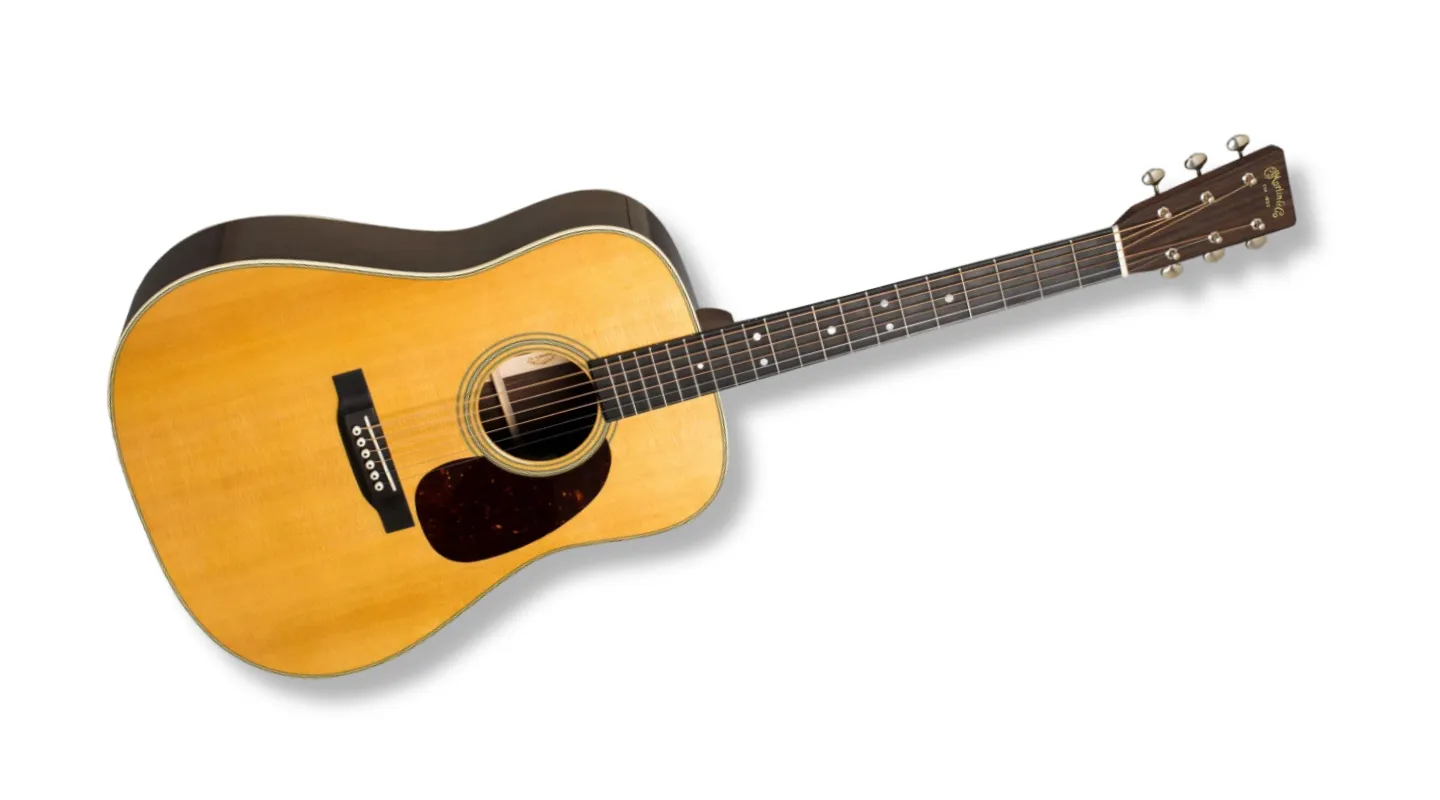
Earlier versions of the Martin D28, pre-1970, featured Brazilian rosewood back and sides. Due to the scarcity of Brazilian rosewood, Martin transitioned to using East Indian rosewood in 1970. Pre-war D28 models also featured herringbone trim and different inlay patterns, which were later changed. The Martin D28 retains the traditional straight bracing. The bracing distinguishes the Martin D28 from other current Martin dreadnoughts that utilize scalloped bracing. The change in bracing on other Martin dreadnoughts occurred around the Woodstock era (late 1960s), when Martin began using scalloped bracing on most of its models. The Martin D28 is made in Nazareth, Pennsylvania, USA. The picture below shows the how the current Martin D28 model.
The Martin D28 is renowned in the music industry, recognized as an iconic acoustic guitar. Musicians like Hank Williams, The Beatles, Johnny Cash, Neil Young, and Bob Dylan have played the Martin D28. The Martin D28 is highly regarded among guitar enthusiasts and professionals, setting a standard for dreadnought acoustic guitars.
The Martin D28 suits a range of players, from enthusiasts to professionals. Its balanced tone and comfortable playability make it versatile for various playing styles. The price of the Martin D28 falls within the range of high-end acoustic guitars at around $2,799. But the price varies depending on the finish, features and retailer.
Compared to similar high end models like the Taylor 814ce and Gibson J-45, the Martin D28 has a more balanced tone than the the brighter Taylor 814ce and a tighter bass response than the boomier Gibson J-45. The Martin D28’s modified low oval neck profile, while comfortable for many, may feel thicker than the Taylor 814ce’s slender neck, which some players prefer for faster playing.
In this review, we explore the Martin D28‘s performance across key areas: sound, playability, versatility, and construction. The table below summarizes the Martin D28’s scores in each category.
Sound and Tone (5/5)
The Martin D28 produces a full and rich acoustic tone that is balanced across the frequency spectrum. The highs, mids, and lows blend harmoniously, with no single frequency range dominating the others.
To evaluate the sound and tone of the Martin D28, we assess its performance across key tonal characteristics, including highs, mids, lows, overtones, projection, sustain, dynamic range, attack, and intonation.
Highs: The D28 offers bright, clear highs with excellent note definition. The combination of the spruce top and rosewood back and sides contributes to this clarity.
Mids: The D28’s midrange is warm and full, providing the core tonal character. The East Indian rosewood back and sides contribute significantly to this warmth, creating balanced tone with rich midrange sound.
Lows: The D28’s low-end is deep and resonant, yet tight and focused, avoiding boominess. The non-scalloped X-bracing contributes to a more focused, traditional low-end response.
Overtones: The D28 produces a complex array of overtones that contribute to its rich, nuanced sound. These overtones add depth and character to the fundamental notes, enhancing the overall tonal complexity.
Projection and Volume: The D28 projects sound effectively, maintaining clarity at various distances. Its dreadnought body shape and solid wood construction contribute to this powerful projection, making it suitable for stage performances. The forward-shifted bracing and the responsive nature of the solid woods enhance volume and projection.
Sustain: The sustain on the D28 is impressive. The notes easily ring out for extended periods and the decay is smooth and gradual. The combination of quality tonewoods, the ebony fretboard, bone nut and saddle, and the guitar’s overall construction contribute to this long sustain.
Dynamic Range: The D28 responds well to varying playing dynamics, from delicate fingerpicking to powerful strumming. Its construction and the quality of its tonewoods allow the guitar to deliver clear and responsive sound at all volume levels. However, the Martin D28’s dynamic range doesn’t offer as much variety and nuance in its sound compared to guitars with exceptionally bright trebles like Taylor 814ce or particularly deep, resonant basses found in guitars like Gibson J-45.
Attack: The D28 responds immediately to playing input, producing a clear, defined attack. The solid spruce top and responsive bracing contribute to this immediate attack, allowing for nuanced playing techniques.
Intonation: The D28’s intonation is generally accurate across the fretboard. However, some owners report minor intonation discrepancies, particularly in the higher registers, which can sometimes require professional adjustments for optimal tuning accuracy.
In the video below you can listen to the sound of the Martin D28 acoustic guitar.
The Martin D28 earns a 5/5 rating for its sound and tone.
Playability and Comfort (4/5)
To assess the playability and comfort of the Martin D28, we evaluate the body size, weight, neck profile, fretboard radius, neck finish, scale length, nut width, fingerboard width, and string gauge.
Body Size: The Martin D28’s dreadnought body shape can feel bulky for smaller players, especially during extended seated playing sessions. The large lower bout, characteristic of dreadnoughts, can dig into the player’s ribs when seated.
Weight: The Martin D28 weighs between 4.34 lbs (1.97 kg) and 4.7 lbs (2.13 kg), depending on the specific guitar. This weight range is on the lighter side when it comes to dreadnoughts but may still feel heavy for some players during long performances.
Neck Profile: The D28 features a modified low oval neck profile with a High Performance Taper. The modified low oval shape combined with the High Performance Taper provides a comfortable grip and allows for smooth transitions between chords. The neck thins towards the nut, easing fretting in the lower positions. It widens towards the body, providing more surface area for complex chords and fingerstyle techniques in higher positions.
Fretboard Radius: The D28 has a 16″ (406.4 mm) fretboard radius, providing a flatter playing surface. This radius is comfortable for both barre chords and single-note playing, offering a balance between ease of fretting chords and comfortable bending of strings.
Neck Finish: The D28’s satin neck finish provides a smooth, non-sticky feel, enabling the player’s hand to glide effortlessly along the neck, which allows for faster playing and less hand fatigue.
Scale Length: The 25.4″ (645.16 mm) scale length provides a familiar balanced string tension. This is a typical scale length for dreadnought guitars, providing a familiar feel for seasoned players. The 25.4″ (645.16 mm) scale length creates enough string tension for full tone and projection, without requiring excessive force.
Nut Width: The D28’s nut width of 1.75″ (44.45 mm) creates adequate spacing between the strings, promoting accurate fingerpicking and minimizing accidental contact between fingers. This width is on the wider side when it comes to nut width but the 1.75″ (44.45 mm) still strikes a balance between comfort for chord playing and clarity for fingerstyle.
Fingerboard Width: The fingerboard width at the 12th fret measures 2 1/8″ (53.975 mm). This gradual widening of the fretboard towards the body gives players more room to maneuver their fingers for complex chords and fingerstyle patterns, especially in the higher registers.
String Gauge: The D28 is often strung with medium gauge strings, typically around .013-.056. These strings provide a balance between comfortable playability and robust tone. While heavier gauges offer a fuller tone, they can be more difficult to bend.
The Martin D28 earns a 4/5 rating for its playability and comfort.
Versatility (5/5)
To assess the versatility of the Martin D28, we evaluate its suitability for different genres, playing techniques, performance settings, and portability.
Genres: The Martin D28 excels in bluegrass. Its powerful projection and focused bass response easily cut through the mix of banjos and mandolins. The solid Sitka spruce top with forward-shifted, non-scalloped X-bracing adds clarity and punch, essential for fast-paced bluegrass picking. While often associated with bluegrass, the D28 also performs well in folk and country due to its warm, resonant tone.
Techniques: The D28’s comfortably supports a variety of techniques, from strumming and flatpicking to fingerstyle and lead playing. The modified low oval neck profile and comfortable string spacing provide good support for fingerstyle patterns. However, the D28 lacks the openness and chime of smaller-bodied guitars when playing more nuanced fingerstyle styles. The moderately flat fretboard radius supports comfortable barre chords, while the slightly curved profile ensures comfortable bending for lead lines and blues techniques. The scale length and string gauge balance easy bending for expressive leads with full, clear tone projection for playing with other instruments in a band setting.
Performance Adaptability: The D28’s acoustic volume allows it to excel in intimate settings or medium-sized venues without amplification, where its rich acoustic tone can shine. In larger venues or band settings with drums and electric instruments, adding a pickup system is necessary for the D28 to cut through the mix.
Portability: The D28’s included hardshell case provides secure protection during travel. However, its dreadnought body size makes air travel slightly more challenging, potentially requiring additional baggage fees or careful handling during transport.
The Martin D28 earns a 5/5 rating for its versatility.
Construction and Design (5/5)
To assess the construction and design of the Martin D28, we look at the wood properties, bracing pattern, finish, aesthetics, nut, saddle, bridge design, bridge pins, body and neck joints, truss rod adjustability, fretwork, binding, fretboard, neck material and tuning pegs.
Wood properties: The Martin D28 features a solid Sitka spruce top. Sitka spruce is strong and lightweight, making it ideal for guitar tops due to its ability to vibrate freely while remaining structurally sound. The back and sides are crafted from East Indian rosewood. East Indian Rosewood, prized for its density and attractive figuring, contributes to the structural integrity of the guitar.
Bracing Pattern: The D28 uses a forward-shifted, non-scalloped X-bracing. On the forward shifted X brace, the X-brace is positioned closer to the soundhole than in traditional X-bracing, increasing the vibrating surface area of the top. The non-scalloped braces, meaning they are not shaved down, provide more mass and rigidity to the top, enhancing structural stability and contributing to the guitar’s powerful projection. Compared to scalloped bracing, which is lighter and more flexible, non-scalloped bracing contributes to a more focused, fundamental tone.
Finish: The D28 traditionally features a gloss nitrocellulose finish on the body. Nitrocellulose lacquer, a thin, hard finish, allows the wood to resonate more freely than thicker polyurethane finishes. The gloss nitrocellulose finish also ages and wears in an aesthetically pleasing way on the D28.
Aesthetics: The D28 sports a classic aesthetic with an aged toner top, antique white binding, a faux tortoise pickguard, and multi-stripe inlays. The aged toner finish, which gives the spruce top a slightly yellowish hue, gives the D28 the look of a vintage instrument. The faux tortoise pickguard, with its mottled brown and yellow pattern, protects the top from scratches. The multi-stripe rosette around the soundhole provides an understated decoration to the soundhole, adding to the D28’s classic look
Nut: The nut is made of bone. Bone nuts are favored for their density and hardness because the bone offers excellent tonal transfer and sustain. Compared to other alternatives like plastic nuts, bone nuts provide a richer, more resonant tone.
Saddle: The saddle is crafted from compensated bone. Compensated saddles differ from straight saddles by having a slightly curved top, and they effectively correct the slight sharpness that can occur in some strings, especially the B string, as you move up the fretboard.
Bridge Design: The D28 has a modern belly bridge made of ebony. Ebony is a dense and resonant wood favored for its ability to transfer vibrations efficiently from the strings to the soundboard. Compared to rosewood bridges, ebony bridges contribute to a slightly brighter, more focused tone. The bridge provides string spacing of 2 5/32″ (54.76 mm), which is a comfortable spacing for picking individual strings or strumming.
Bridge Pins: The bridge pins are white plastic with faux tortoise dots. While functional, plastic bridge pins are a basic option for a high end guitar. This is because, compared to bone or ebony bridge pins, plastic pins may not transfer vibrations as efficiently. Upgrading to bone, ebony, or brass bridge pins could enhance sustain and tonal richness of the D28 even further.
Body and Neck Joints: The D28 features a dovetail neck joint. The dovetail joint, where a flared tenon on the neck fits into a corresponding slot in the body, creates a strong and resonant connection between the neck and body. The dovetail neck joint is generally superior to bolt-on neck joints because the dovetail joints offer slightly better tone transfer and structural integrity.
Truss Rod Adjustability: The D28 has an adjustable truss rod, accessed through the soundhole. The truss rod allows for adjustments to the neck relief, or curvature, compensating for the tension of the strings and ensuring optimal playability. However, if you are buying a used D28 keep in mind that models manufactured before 1980 might not allow you to adjust the truss rod.
Frets and Fretwork: The D28 has 20 frets. The fretboard has 14 frets clear of the body, which means there are 14 frets between the nut and where the neck meets the body. The fretwork on the D28 is pleked. Plek technology uses a computer-controlled machine to precisely level and dress the frets, optimizing string action and playability. This results in consistently even frets across the fretboard.
Binding: The D28 features antique white binding along the body and neck. Binding, a decorative and protective strip of material, adds a touch of elegance to the guitar while also protecting the edges from damage.
Fretboard: The D28’s fretboard is made of ebony. Ebony is a dense, hard wood known for its smooth feel and resistance to wear. The hardness of ebony minimizes wear from string contact, keeping the frets from grooving prematurely.
Neck material: The D28’s neck is crafted from select hardwood, which means that the neck is made from the hardwood that is available at the time of constructing the guitar. This is very commonly mahogany, in the case of Martin Guitars. Mahogany is a strong and stable wood with good resonance. Mahogany is often chosen for guitar necks due to its comfortable feel and contribution to a warm, balanced tone.
Tuning Pegs/Machine Heads: The D28 features nickel open-gear tuning machines. These tuners are common and provide stable tuning. While some players upgrade to sealed or locking tuners for increased tuning stability, the open-gear tuners on the D28 should be stable enough for most players.
The Martin D28 earns a 5/5 rating for its construction and design.
Pros and Cons of Martin D28
Martin D28 Pros: Balanced tone, warm midrange, clear highs, resonant lows, complex overtones, powerful projection, long sustain, responsive to playing dynamics, clear attack, comfortable neck profile, smooth satin neck finish, comfortable scale length for bending, versatile, all solid wood body, forward-shifted X-bracing, bone nut and saddle, ebony bridge, adjustable truss rod, pleked fretwork.
Martin D28 Cons: Bulky body for smaller players, weight can be heavy for some players, plastic bridge pins, dreadnought size can be cumbersome for travel, high price point.
Recommendation and Specifications
The Martin D28 delivers a balanced tone with warm mids, clear highs, and resonant lows, complemented by a comfortable neck and smooth satin finish. Its Sitka spruce top, East Indian rosewood back and sides, forward-shifted X-bracing, and bone nut and saddle contribute to powerful projection and long sustain. The modified low oval neck with a High Performance Taper and 25.4″ (645.16 mm) scale length enhance playability, especially for string bending. While the D28 excels in bluegrass, its versatility makes it suitable for various genres and playing styles. Though expensive, its high-quality materials and construction justify the price for serious musicians seeking a timeless instrument.

Recommendation for Martin D28
The Martin D28 is an excellent choice for experienced players or aspiring professionals who value a versatile, high-quality instrument with a rich, balanced tone suitable for both stage and studio use. Its iconic status and enduring design make it a worthwhile investment for serious musicians.
The Martin D28 might not be ideal for smaller players due to its bulky dreadnought body. The D28’s high price point is also not ideal for beginners or casual players.
The table below summarizes the specifications of the Martin D28 acoustic guitar.
| Martin D28 Full Specifications | |
| Body Size | Dreadnought (D-14 Fret) |
| Finish Top | Gloss |
| Construction | Dovetail Neck Joint |
| Back and Side Finish | Gloss |
| Bracing Pattern | Forward-Shifted X-Brace |
| Scale Length | 25.4″ (645.16 mm) |
| Brace Shape | Non-Scalloped |
| Fingerboard Width at Nut | 1 3/4″ (44.45 mm) |
| Top Material | Spruce |
| Neck Shape | Modified Low Oval |
| Back Material | East Indian Rosewood |
| Neck Taper | High-Performance Taper |
| Side Material | East Indian Rosewood |
| Electronics | Optional (Fishman Gold Plus Natural I, Fishman Infinity Matrix, Fishman Presys Plus, Fishman Ellipse Matrix Blend, LR Baggs Anthem) |
| Top Color | Aging Toner |
| Bridge Style | Modern Belly – Drop in Saddle |
| Binding | Antique White |
| Bridge String Spacing | 2 5/32″ (54.76 mm) |
| Top Inlay Material | Multi-Stripe |
| Bridge Material | Ebony |
| Bridge Pin Material | White Plastic |
| Pickguard | Tortoise Pattern |
| Bridge Pin Dots | Faux Tortoise |
| Saddle | Compensated Bone |
| Rosette | Multi-Stripe |
| Saddle Radius | 16″ (406.4 mm) |
| Brace Material | Spruce |
| Brace Size | 5/16″ (7.94 mm) |
| Back Inlay Material | Multi-Stripe |
| Heelcap | Antique White |
| Endpiece | Antique White |
| Endpiece Inlay | Multi-Stripe |
| Neck Material | Select Hardwood |
| Fingerboard Material | Ebony |
| Finish Neck | Satin |
| Fingerboard Width at 12th Fret | 2 1/8″ (53.975 mm) |
| Neck Color | Dark Mahogany |
| Number of Frets Total | 20 |
| Fingerboard Inlay Material | Mother-of-Pearl |
| Neck Joins Body At | 14th Fret |
| Side Dots | White |
| Headstock Shape | Solid with Square Taper and Diamond |
| Tuning Machines | Nickel Open Gear |
| Headplate Material | East Indian Rosewood |
| Knob | Butterbean |
| Nut Material | Bone |
| Included Case | Yes (Molded Hardshell) |
| Left Handed Availability | Yes |
| Pleked Fingerboard | Yes |
What are the best acoustic guitars?
The best acoustic guitars include the Martin D-28, Yamaha FG830, and Eastman E1D.
The Martin D-28, with its balanced tone and projection, represents a benchmark in acoustic guitar craftsmanship and is favored by professionals across genres like bluegrass and folk. The Yamaha FG830, with its solid Sitka spruce top and budget-friendly price, offers an excellent entry point for players on a budget seeking a quality instrument. The Eastman E1D, featuring an all-solid wood construction and a powerful, resonant tone, delivers exceptional value for intermediate players looking to upgrade. However, ultimately the best acoustic guitar is a guitar that best suits a specific player’s individual needs.