
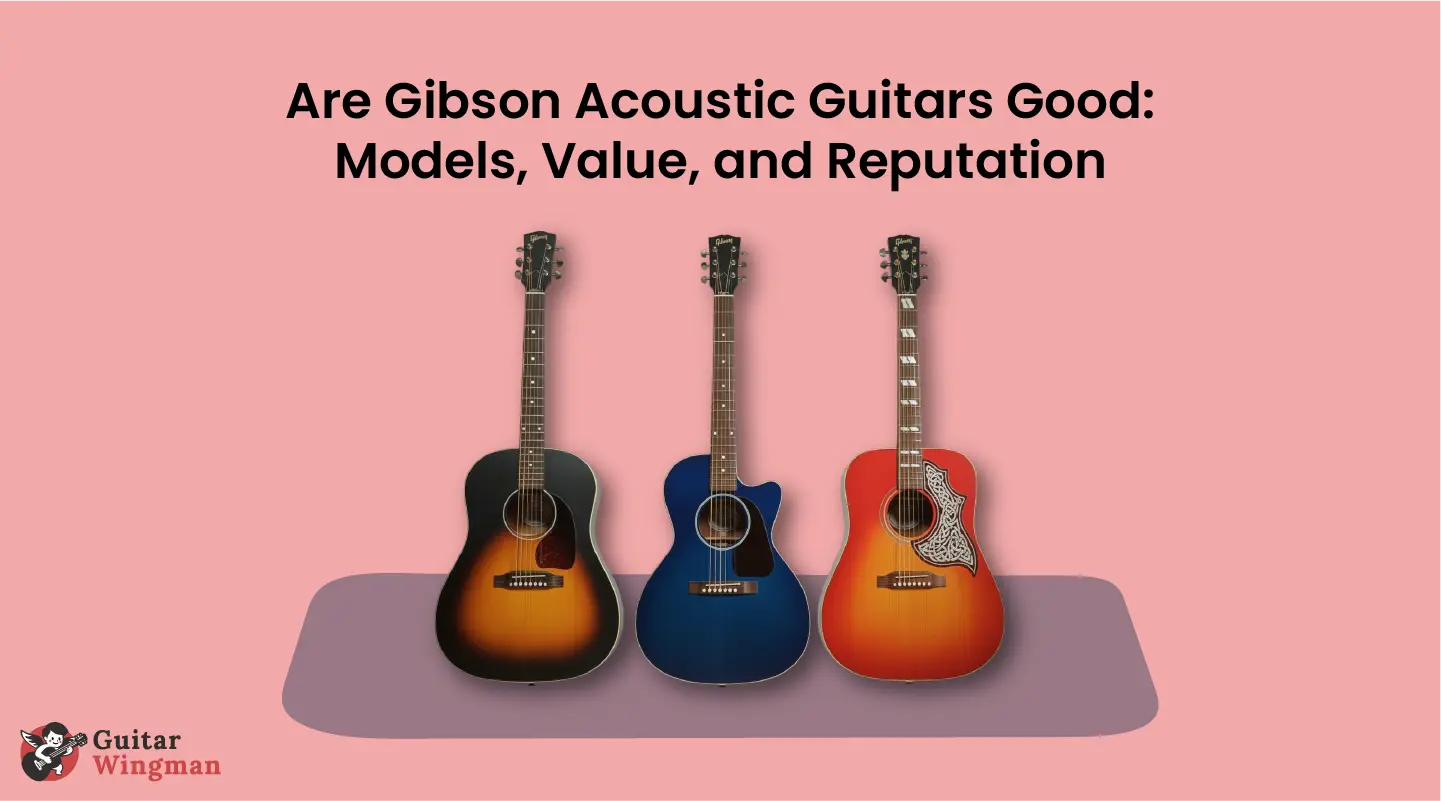

Gibson acoustic guitars are considered high-quality instruments due to their American-made construction, distinctive tonal profile, and long-standing influence on acoustic guitar design. Built in Bozeman, Montana, Gibson acoustics combine traditional handcrafting techniques with modern precision manufacturing. This approach produces a sound characterized by a warm, dry, midrange-forward tone with fast note decay. Often described as “thumpy” or “woody,” this tonal signature is especially valued for vocal accompaniment and rhythmic clarity.
This article offers a comprehensive evaluation of Gibson acoustic guitars, covering the factors that define their quality and help determine whether they are the right choice for a given player. It examines iconic models such as the J-45, known as “The Workhorse,” and the J-200, known as “The King of the Flat-Tops,” to explain Gibson’s value proposition and pricing structure. Finally, we explain the relationship between Gibson’s core acoustic line and its related brands Epiphone and Maestro.
What Defines the Sound and Quality of a Gibson Acoustic Guitar?
Gibson acoustic guitars are defined by distinctive construction techniques, specific tonewoods, and a midrange-focused sound profile. The typical Gibson acoustic sound is warm and dry, with strong fundamental notes, fast note decay, and a balanced tonal output centered in the midrange. This tonal character contrasts with the scooped or bass-heavy response often found in other dreadnought-style guitars and is well-suited for both strumming and fingerpicking. The focused midrange allows Gibson acoustic guitars to sit clearly beneath vocals in a mix.
Core construction features shape this sound. Gibson acoustic guitars include both slope-shoulder dreadnoughts, such as the J-45 and Southern Jumbo, and square-shoulder dreadnoughts like the Hummingbird. Each body style produces a distinct tonal response. Mahogany is widely used for backs and sides, delivering a dry, focused tone with minimal overtones. Sitka spruce is commonly used for soundboards, paired with hand-scalloped X-bracing to enhance resonance and low-end response by allowing the top to vibrate more freely. Gibson acoustic guitars are also finished with thin coats of nitrocellulose lacquer, which enables greater wood resonance compared to thicker polyurethane alternatives.
Gibson acoustic guitars are handcrafted in Bozeman, Montana. Several high-profile artists, including Bob Dylan, Emmylou Harris, and Elvis Presley, have used Gibson acoustic guitars—particularly the SJ-200—for its strong projection and rhythmic presence in full-band arrangements.
What Are the Most Iconic Gibson Acoustic Guitar Models?
The most iconic Gibson acoustic guitar models include the J-45, Hummingbird, J-200 (SJ-200), and Southern Jumbo. Each model is known for distinct tonal characteristics, visual design, and historical significance. The Gibson J-45 is widely known as “The Workhorse” for its versatility and reliability. The Gibson Hummingbird is recognized as a premier vocal accompaniment instrument. The Gibson J-200 is the largest and most powerful Gibson acoustic, often called the “King of the Flat-Tops.” The Southern Jumbo shares much of its design with the J-45 but features upgraded aesthetics and slight tonal variation. Each of these iconic models is described below.
The Gibson J-45: The Gibson J-45 is called “The Workhorse” for its consistent reliability, tonal balance, and versatility across musical styles. J-45 features a slope-shoulder dreadnought body, a Sitka spruce top, and mahogany back and sides. Key specifications include a 24.75″ (629 mm) scale length, a nut width of approximately 1.73″ (44 mm), and traditional hand-scalloped X-bracing. The Gibson J-45 produces a warm, midrange-forward tone with strong projection, suitable for both strumming and fingerpicking. The J-45 is favored by singer-songwriters for its ability to sit clearly under vocals. Variants include the J-45 Standard, which maintains the classic design, and the J-45 Studio, which offers simplified appointments and may use alternative tonewoods such as walnut or rosewood for the back and sides. All J-45 models are built in Gibson’s Bozeman, Montana facility.
The Gibson Hummingbird: The Gibson Hummingbird is a square-shoulder dreadnought designed for vocal accompaniment. Gibson Hummingbird is visually distinguished by an engraved hummingbird pickguard and split parallelogram inlays on the fingerboard. The Gibson Hummingbird typically uses a Sitka spruce top and mahogany back and sides, similar to the J-45. However, its square-shoulder body contributes to a slightly different tonal response. The Gibson Hummingbird produces a balanced, mellow tone with a smooth midrange and rounded highs, making it especially well-suited for strumming behind vocals. Its visual design and tonal profile have made it a favorite among singer-songwriters seeking a blend of style and sound that supports lead vocal performance.
The Gibson J-200 (SJ-200): The Gibson J-200, also known as the SJ-200 or Super Jumbo 200, is Gibson’s largest acoustic guitar model. Gibson J-200 is called the “King of the Flat-Tops” due to its size, volume, and commanding presence. The Gibson J-200 features a Super Jumbo body, a Sitka spruce top, and maple back and sides. J-200 includes distinct visual elements such as a mustache bridge and crown inlays on the fingerboard. The Gibson J-200 delivers a loud, clear, and powerful sound with tight bass, shimmering highs, and excellent projection. This tonal strength made it especially valuable in the pre-amplification era, when cutting through an ensemble required high natural volume. Artists such as Elvis Presley and the Everly Brothers favored the J-200 for its rhythm power and stage presence.
The Southern Jumbo: The Gibson Southern Jumbo is a slope-shoulder dreadnought acoustic guitar that has the same core construction as the J-45, including a Sitka spruce top, mahogany back and sides, a 24.75″ (629 mm) scale length, and hand-scalloped X-bracing. Southern Jumbo’s iconic status stems from being a stylistically enhanced alternative to the J-45, featuring premium aesthetics such as multi-ply binding and mother-of-pearl parallelogram inlays on the fingerboard, offering a more refined appearance compared to the J-45’s simpler dot inlays.
The J-35: The Gibson J-35, introduced in the mid-1930s, is a predecessor to the J-45. It differs in internal bracing and some specifications, resulting in a tone that is generally brighter and more fundamental than the J-45. The J-45 replaced the J-35 in 1942 and became Gibson’s flagship acoustic model.
Are Gibson Acoustic Guitars Worth the Money?
Gibson acoustic guitars are widely considered worth the money due to their proven performance, build quality, and lasting value across decades of use. Gibson’s emphasis on craftsmanship, historical accuracy, and long-term durability sets Gibson’s instruments apart from factory-built alternatives. These features contribute to a level of performance, durability, and long-term value that justifies their premium price.
Gibson acoustic guitars range in price from approximately $1,200 to over $5,000, depending on the model tier. Gibson acoustic guitars follow a consistent price hierarchy based on features and craftsmanship level. G-Series models are the most affordable U.S.-made options, priced around $1,200–$1,400. Studio models, such as the J-45 Studio Walnut or Studio Rosewood, typically range from $2,399 to $2,499. Standard models, including the J-45 Standard, are priced around $2,999. Custom Shop and Historic Series guitars occupy the top tier, often priced above $4,000, with some variants significantly exceeding that range.
Why Are Gibson Acoustic Guitars So Expensive?
Gibson acoustic guitars are expensive due to 4 core factors: U.S. manufacturing, premium tonewoods, complex manual construction, and enduring brand value.
U.S. Manufacturing: Gibson acoustic guitars are built in Bozeman, Montana. Domestic production involves higher labor costs and stricter quality control standards than overseas manufacturing, increasing the final price.
Premium Tonewoods: Gibson uses high-grade, solid tonewoods—such as Sitka spruce, mahogany, and maple—for tops, backs, and sides. These materials are more costly and provide superior acoustic performance compared to laminated alternatives. High-quality hardware and carefully selected components also contribute to the total cost.
Labor-Intensive Construction: Gibson acoustic guitars incorporate traditional construction techniques that require advanced skill and time. These include compound dovetail neck joints, often set with hot hide glue, and multi-layered nitrocellulose lacquer finishes. Nitro finishes require multiple thin coats and extended curing times, increasing production labor.
Brand Heritage and Resale Value: Gibson has maintained continuous acoustic guitar production since the early 20th century. The brand’s legacy, artist associations, and historical impact elevate perceived and real value. Gibson acoustic guitars also retain resale value well, with many models maintaining high prices on the used market due to demand and brand recognition.
What Defines a Vintage Gibson Acoustic Guitar?
A vintage Gibson acoustic guitar is defined by its age, historical context, and tonal character resulting from aged tonewoods and construction techniques specific to earlier production eras. These guitars are highly valued by collectors and musicians for their unique sound, build quality, and connection to Gibson’s early craftsmanship legacy.
Vintage Gibson acoustic guitars are typically categorized into distinct “golden eras,” each associated with specific design features and tonal characteristics:
Pre-War Era (1930s): Gibson acoustic guitars from the 1930s, such as the Advanced Jumbo, are known for lightweight construction, powerful projection, and responsive tone. These guitars often featured Adirondack spruce tops, scalloped X-bracing, and mahogany or rosewood back and sides. The combination of lightly built tops and high-grade tonewoods contributes to their clarity and dynamic range.
Banner Era (1942–1946): Guitars from World War II are identified by the “Only a Gibson is Good Enough” banner on the headstock, introduced due to wartime advertising restrictions. These models often used alternative materials due to shortages and show distinctive tonal warmth and individuality. Variations in neck profiles, tuners, and internal bracing reflect adaptations made during the war effort, making them highly collectible.
1950s–1960s Era: The 1950s and 1960s represent the most consistent production era for key Gibson acoustic models, including the J-45, Hummingbird, and J-200. Gibson acoustic guitars from this period were built with Sitka spruce tops and either mahogany or maple back and sides, establishing the tonal identities still associated with those models today.
The value of a vintage Gibson acoustic guitar depends on rarity, originality (free from major repairs or modifications), cosmetic and structural condition, and the specific era of production. Guitars from highly regarded periods with intact original components and minimal wear command the highest prices in the vintage market.
How To Determine the Age of a Gibson Acoustic Guitar?
To determine the age of a Gibson acoustic guitar, begin by locating and decoding the serial number, then cross-reference structural and cosmetic features to confirm the date of manufacture. Gibson has used multiple, sometimes overlapping, serial number systems throughout its production history, so accurate dating often requires a combination of methods.
The serial number is typically, stamped on the back of the headstock, or printed on a paper label visible through the soundhole. On many vintage Gibson acoustic guitars, an internal Factory Order Number (FON) may also be present. These are usually stamped or penciled on the neck block and are especially important for pre-1960s models, where FONs may be more reliable than external serial numbers. The Gibson’s serial number systems varies by era.
The different eras of Gibson’s serial numbers are listed and described below.
- Pre-1961: Gibson used Factory Order Numbers (FONs), which often do not match the serial numbers stamped on the headstock. These FONs may include letter prefixes and must be decoded using specialized reference charts.
- 1961–1977: Serial numbers from this period were applied inconsistently. Some were reused across different years, making them unreliable in isolation. Cross-referencing with model-specific features is essential for accurate dating.
- Post-1977: Gibson adopted an 8-digit serial number format. In this system, the first and fifth digits typically indicate the year, while the remaining digits reflect the day of the year and production sequence. For example, a serial number starting with 805 might indicate a guitar built on the 5th day of a year ending in 8 (e.g., 1988 or 1998), with further context needed to confirm the exact decade.
When serial number data is inconclusive or falls within an ambiguous range, additional visual and structural cues can help identify the production period. The structural and visual cues are listed and described below.
- Headstock logos — Style and font vary by era (e.g., script, block, or “Only a Gibson is Good Enough” banner designs).
- Tuners — Brand and type (e.g., Kluson, Grover) reflect decade-specific trends.
- Bridge shapes — Variations such as straight, belly-down, or mustache designs are linked to certain model years.
- Binding and inlay styles — Decorative elements evolved over time and can indicate production periods.
- “Made in U.S.A.” stamp — Began appearing on most Gibson acoustics starting in 1970.
Because of Gibson’s overlapping formats and historical inconsistencies, this multi-factor approach is essential for confirming the authenticity and production year of any Gibson acoustic guitar, especially vintage models with altered parts or undocumented repairs.
Which Gibson Acoustic Guitar Is the Best Choice for You?
There is no single objectively best Gibson acoustic guitar. The best choice depends on your playing style, tonal goals, and budget. Gibson offers a range of acoustic models, each designed to excel in specific musical applications. Selecting the right model requires matching the guitar’s tonal profile and physical design to your performance needs.
For Singer-Songwriters, The Gibson J-45 is the most versatile option. Known as “The Workhorse,” the J-45 features a slope-shoulder dreadnought body, a 24.75″ (629 mm) short scale length, and mahogany back and sides. This combination produces a warm, mid-forward tone that complements vocals with clarity and balance.
For Heavy Strummers and Rhythm Players, the Gibson J-200 and Gibson Hummingbird offer strong projection and stage presence. The J-200, or “King of the Flat-Tops,” uses a Super Jumbo body and maple back and sides to deliver loud, bright, and defined sound ideal for ensemble rhythm work. The Hummingbird, a square-shoulder dreadnought, typically features mahogany back and sides and provides a warm, balanced tone with excellent strumming responsiveness and a visually distinctive design.
For Blues and Fingerstyle Players, smaller-body models such as the Gibson L-00 or Gibson LG-2 offer focused tone and precise articulation. These guitars emphasize note clarity and dynamic response, making them ideal for intricate fingerstyle patterns and traditional blues. Their compact body size enhances control and promotes direct, expressive playing.
What Are the Most Affordable Gibson Acoustic Models?
The most affordable Gibson acoustic guitars are found in the Studio and Tribute series. These models maintain core build quality and tonal character while reducing visual complexity and material cost. All models are handcrafted in Gibson’s Bozeman, Montana facility using the same production techniques as higher-tier instruments.
Examples of these accessible models include the Gibson J-45 Studio, Gibson L-00 Studio, and Gibson G-45. Each provides the core tonal identity and build integrity of a Gibson acoustic without the cosmetic upgrades found in higher-end lines. These guitars are designed as entry points into the Gibson lineup while preserving American-made quality.
For those seeking a Gibson-style experience at a lower price point, Gibson’s subsidiary brand Epiphone offers licensed models inspired by Gibson designs, built overseas to more accessible specifications. While not made in Bozeman, Epiphone guitars provide a similar shape, feel, and tonal philosophy at a significantly reduced cost.
What Is the Relationship Between Gibson, Epiphone, and Maestro?
Gibson’s tiered brand structure includes Gibson, Epiphone, and Maestro, each targeting a distinct price point and player tier. Maestro covers the entry-level market, Epiphone targets budget-conscious intermediate players, and Gibson serves professional musicians and collectors seeking high-end craftsmanship.
Gibson produces professional-grade acoustic guitars at its Bozeman, Montana facility, using traditional construction methods, premium tonewoods, and nitrocellulose finishes. Epiphone, a subsidiary of Gibson, manufactures officially licensed versions of Gibson designs, offering more affordable alternatives built overseas in countries such as China, Indonesia, and Korea. Maestro, a separate entry-level brand, serves the beginner market with mass-produced instruments sold through retail outlets.
How Do Epiphone “Inspired by Gibson” Acoustics Compare to Gibson Models?
Epiphone’s “Inspired by Gibson” line offers licensed reproductions of key Gibson acoustic designs—such as the J-45 and Hummingbird—at a significantly lower price. These guitars are designed to mirror the body shapes, visual appointments, and general feel of Gibson models, while using cost-efficient materials and overseas manufacturing to keep pricing accessible.
Gibson guitars are built in Bozeman, Montana, while Epiphone acoustics are produced in Asia. A Gibson J-45 Standard typically costs around $2,999, whereas an Epiphone Inspired by Gibson J-45 sells for approximately $749–$799. Premium Epiphone models, such as the Inspired by Gibson Custom 1942 Banner J-45, are priced around $1,299. While Epiphone guitars do not offer the same tonal richness or craftsmanship as Gibson acoustics, they provide an accessible entry point into Gibson’s iconic designs for non-professional players.
What Are “Maestro by Gibson” Guitars?
Maestro by Gibson is a separate brand name used for beginner-level acoustic guitars marketed through large retailers. These guitars are not made by Gibson or Epiphone, nor do they share construction standards or tonewood quality with either brand. Maestro guitars are built for cost efficiency and ease of play, typically using low-cost materials, including laminated woods, and basic construction methods that prioritize function over tone.
Maestro guitars are not designed to replicate Gibson’s tone or craftsmanship. They lack solid tonewoods, traditional bracing, and premium finishes, and are often packaged in starter bundles with accessories. While suitable for first-time players, they are not considered part of the core Gibson family in terms of musical performance or build quality.
How Do Gibson Acoustic Guitars Compare to Martin Guitars?
Gibson acoustic guitars deliver a midrange-focused, punchy tone with shorter sustain, while Martin guitars emphasize deep bass, rich overtones, and greater projection. This makes Gibson better suited to vocal accompaniment and Martin favored for full-bodied ensemble playing.
Sound: Gibson acoustic guitars are characterized by a midrange-focused tone, fast note decay, and a dry, woody voice. This results in a punchy, controlled sound with strong fundamental presence and limited overtones, making Gibson guitars ideal for vocal accompaniment and rhythmic clarity. Martin acoustic guitars produce a scooped-mid tone with extended sustain, rich overtones, and strong bass response. The result is a more resonant and harmonically complex voice, preferred in genres that demand projection and tonal fullness.
Construction: Gibson frequently uses mahogany for backs and sides, particularly in models like the J-45 and Hummingbird. Its signature body styles include the slope-shoulder dreadnought and Super Jumbo. Martin commonly uses rosewood for backs and sides, emphasizing low-end response and overtone richness. Martin is credited with standardizing the square-shoulder dreadnought shape, now the most widely used acoustic body style.
Feel: Gibson acoustic guitars typically feature a 24.75″ (629 mm) scale length, producing lower string tension for a softer, more pliable feel that facilitates easier fretting and bending. Martin guitars generally use a 25.4″ (645 mm) scale length, resulting in higher string tension, greater projection, and a stiffer tactile response. However, the scale length depends on a specific model.
Musical Application: Gibson acoustic guitars are strongly associated with folk, blues, and rock genres. Their focused tone and responsive feel suit accompaniment, vocal support, and expressive playing. Martin guitars are widely used in bluegrass, flatpicking, and traditional folk, where their deep bass and strong projection are essential for rhythm-driven playing in ensemble settings.
The choice between Gibson and Martin depends on tonal goals and playing style, not objective superiority. Both brands offer professional-grade instruments rooted in long-standing design traditions.